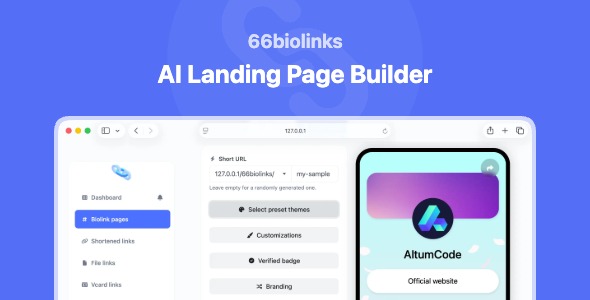
66biolinks Social Networking is a self-hosted PHP script that combines a bio link page builder, a URL shortener, a QR code generator and an AI-assisted landing page builder into one platform. It is sold on CodeCanyon by AltumCode under both a Regular License for personal, agency or internal team use and an Extended License for running a paid service with subscription plans. The product has accumulated 4,765 sales and a 4.99 out of 5 rating across 342 reviews, which places it among the more established items in its category.
The script requires PHP 8.x and MySQL 8.x, ships with full source files in JavaScript, HTML, CSS, PHP and SQL, and runs on Chrome, Firefox, Safari, Edge and Opera. A live demo is published by the vendor, so the interface can be inspected before purchase.
What the platform actually does
At its core, the script gives every registered user a dashboard from which they can build and manage several different kinds of public-facing assets. The most visible of these is the biolink page: a single hosted page that collects multiple destinations, embeds and contact options behind one shareable address. Users can create an unlimited number of these pages from one account, and each page is independently customizable, so a musician, a restaurant and a consultant can each maintain a distinct presence without separate installations.
Those pages accept rich media embeds from YouTube, Soundcloud, Spotify, Twitch, Vimeo and TikTok, which means the page can function as a lightweight media hub rather than a plain list of links. Beyond the biolink itself, the script handles several other link types that are usually sold as separate products: dynamic file links with tracking, dynamic vCard links for contact sharing, event links, and static HTML hosting links that turn a plain HTML site into something reachable through a short URL or a QR code.
URL shortening and QR codes
The URL shortener is not a bolt-on. It includes link management, per-link statistics and analytics, and it shares the same custom domain system as the rest of the platform. QR codes are generated in unlimited volume and can be edited after creation, which matters because a printed code cannot be changed once it is on a menu or a poster — updating the destination behind the code is the only practical fix.
Sixteen QR code templates cover the common real-world cases: plain text, URLs, phone numbers, SMS, email, WhatsApp, FaceTime, location, WiFi credentials, events, cryptocurrency addresses, vCards, and payment formats including PayPal, UPI, EPC and PIX. Design controls include custom colours, gradients, logos and frames, so codes can be branded rather than left in default black and white.
Analytics, domains and integrations
Every biolink, short link and QR code reports visitor data and performance metrics through the same statistics layer. Tracking pixels for Facebook, Google Analytics, Google Tag Manager, LinkedIn, X (formerly Twitter), Quora and Pinterest can be attached, which allows a marketing team to attribute traffic from a bio link to a campaign in the analytics tool they already use.
Unlimited custom domains can be connected for biolinks, short links and QR codes, and unlimited projects let users group related assets together. Notification handlers are unusually broad: email, webhook, Slack, Discord, Telegram, Microsoft Teams, SMS, phone call, WhatsApp, Twitter, Google Chat, internal notifications and push notifications through a plugin. For an operator running the platform as a service, that range makes it possible to alert users about new activity on the channels they already watch.
Administration, security and the web tools module
Administrators get a translation system that covers the entire interface, including AI-assisted translation and full right-to-left support for languages such as Arabic and Hebrew. Social login is available through Google, Facebook, Twitter, Microsoft and Discord, and two-factor authentication can be enabled for both administrators and end users. A dark theme is included without configuration.
On the SEO side, the script generates clean URLs, dynamic titles, per-language control, an automatically maintained sitemap and Schema.org structured data on public pages, plus meta, OpenGraph and Twitter card tags for social sharing. A REST API covers parts of the platform, data can be exported as CSV, JSON or PDF, and users can apply their own logo, favicon and title on paid plans through white-labeling settings. A bundled collection of 126 web tools adds utility pages such as converters and generators directly inside the installation.
Where it fits, and where it does not
The clearest fit is an agency or solo operator who wants to launch a link-in-bio and short link service without building one from scratch. Because the Extended License permits selling plans to other users, the script is designed from the ground up for a multi-tenant business: user registration, plan limits, white-labeling and notification channels are all present. A marketing team that needs branded short domains for campaigns, with analytics and QR codes in one place, is a second strong fit — the Regular License covers that internal use case.
A third scenario is a creator or small business that simply wants a self-hosted alternative to a hosted link page, keeping visitor data on infrastructure it controls rather than on a third-party service.
The script is the wrong choice for anyone who does not want to run a server. There is no managed hosting option: the buyer supplies PHP 8.x hosting, a MySQL 8.x database, SSL certificates and ongoing maintenance. Anyone expecting a drag-and-drop website builder for full multi-page sites will also be disappointed — the landing page builder and static HTML hosting are aimed at single pages and campaign destinations, not at replacing a general-purpose CMS. Finally, a business that needs a mature mobile app for its users will not find one here; the platform is web-based.
Strengths and limitations
Strengths
- Four products in one codebase — biolinks, URL shortening, QR codes and a web tools library — which reduces the number of separate subscriptions or scripts an operator has to maintain.
- Genuinely multi-tenant architecture with plans, white-labeling and per-user limits, rather than a single-user tool with a SaaS label attached.
- Unusually wide notification support, including webhooks and chat platforms, which suits teams that monitor activity outside email.
- Strong SEO foundations out of the box: sitemap generation, structured data, OpenGraph tags and per-language handling.
- Full source files are included, so the code can be modified rather than only configured.
- A 4.99 rating from 342 reviews and 4,765 sales indicate a large installed base and a vendor with a track record of maintaining the item.
Limitations
- Self-hosting is mandatory. The purchase price does not include hosting, domain registration, SSL or the time required to keep PHP and MySQL patched.
- The vendor does not publish performance benchmarks or documented limits on how many users or links a single installation can handle, so capacity planning is guesswork until it is tested.
- Running this as a paid service requires the Extended License, which costs more than the $59 Regular License and should be factored into any business case.
- Push notifications depend on a separate plugin rather than being built in.
- The REST API is described as covering specific parts of the platform, not the whole system, so integrations with external tools may hit gaps.
- Because the script is updated frequently by the vendor, custom modifications to the source can create upgrade friction for buyers who edit core files.
How it compares with the alternatives
Buyers researching this category usually weigh three options: a hosted link-in-bio service, a standalone URL shortener script, and a general-purpose CMS with link management plugins. Hosted services win on convenience — nothing to install, nothing to patch — but they charge monthly, cap features by tier and keep the visitor data. A standalone shortener script typically does one job well and leaves biolinks and QR codes to other tools, which means multiple codebases, multiple admin panels and multiple sets of credentials to manage.
A CMS with plugins can approximate parts of this, but it is not built for multi-tenant link management, and the plan, quota and white-labeling logic would have to be assembled from separate extensions. 66biolinks competes by consolidating all of it into one installation with one admin panel. The trade-off is that consolidation also means one point of failure and one update cycle to manage, and the feature depth in any single area is unlikely to match a specialist tool — particularly for advanced link rotation or enterprise-grade short link infrastructure.
Against other CodeCanyon scripts in the Social Networking category, the differentiators are the breadth of the QR code templates, the notification handler list and the AI landing page builder. The sales volume and review score suggest the vendor has kept pace with buyer expectations over time, which is not guaranteed for scripts at this price point.
Frequently Asked Questions
Do I need the Extended License to use 66biolinks?
It depends on whether money changes hands. The Regular License covers personal use, agency work and internal team deployments where the platform is not sold to end users. Anyone charging users for plans or access needs the Extended License. Buyers should confirm the current license terms on the CodeCanyon item page before purchasing, since the price difference is significant.
What hosting does 66biolinks require?
It requires PHP 8.x and MySQL 8.x, so a standard LAMP or LEMP server or a compatible shared host will work. The vendor does not state minimum RAM or CPU requirements, so a modest VPS is a reasonable starting point for a small user base. SSL, backups and routine PHP updates remain the operator’s responsibility.
Can users connect their own domains?
Yes. The platform supports unlimited custom domains for biolink pages, short links and QR codes, and administrators control how many domains each plan allows. In practice this means a paying user can point their own branded domain at the service, which is one of the main reasons operators choose a self-hosted platform over a hosted link service with fixed domains.
Does 66biolinks work in languages other than English?
Yes. The entire interface can be translated from the admin panel, AI-assisted translations are available, and right-to-left languages are fully supported. Combined with per-language SEO controls and separate sitemaps, this makes the script viable for operators targeting non-English markets where hosted competitors offer limited localization.
Verdict
66biolinks is a strong buy for agencies, developers and entrepreneurs who want to launch or operate a link management platform on their own infrastructure, and who are comfortable maintaining a PHP application. The combination of biolinks, short links, QR codes, analytics and multi-tenant plan logic in a single codebase is difficult to replicate cheaply with separate tools, and the sales and rating history suggest the vendor supports the product actively.
It is not the right purchase for anyone without server access, for a business that needs a full website builder rather than landing pages, or for an operator who wants enterprise-grade short link infrastructure with published performance guarantees. Those buyers are better served by a hosted service or a specialist tool. For everyone else, the decision comes down to whether the Extended License cost and ongoing hosting overhead are acceptable against the recurring fees a hosted alternative would charge.