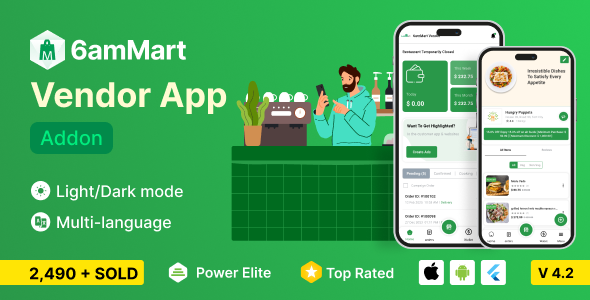
6amMart – Vendor App is the mobile companion for the 6amMart multivendor delivery system, built with 6amMart Flutter code so store owners can run their shop from a phone instead of a desktop browser. It covers the daily operational work of a vendor: order handling, item and menu editing, wallet and withdrawal requests, promotions, delivery staff and live chat. It is aimed at marketplace operators already running the 6amMart platform who want to hand their sellers a native app rather than a mobile web panel.
The product is sold on CodeCanyon by sixamtech for $39.00. It has 2,496 sales and a 4.96 out of 5 rating from 76 reviews, which places it among the better-established items in its niche. The vendor lists compatibility with Flutter 3.x and ships the source as Dart and YAML files alongside platform folders containing Kotlin and Swift code.
What the vendor app actually does day to day
The app is not a stripped-down viewer. It replicates most of what the browser-based vendor panel offers, which matters because store owners often work from a phone while away from a computer.
Order handling and fulfilment choices
Vendors see incoming orders with their details and delivery status, and can print invoices directly from the app. Around that core sits a set of switches that shape how customers can buy: home delivery, takeaway collection, scheduled orders for a chosen time slot, and a cutlery request option for food sellers. Each can be turned on or off per store, so a kitchen that cannot handle its own deliveries can disable that path without touching the admin panel.
Store configuration and availability
Store identity is editable from the app — name, contact details, address and logo. Vendors set a minimum order value, an approximate processing and delivery time that customers see at checkout, and daily opening and closing hours. There is also a temporary closure switch for maintenance or rebranding, which stops customers ordering without deleting the store. That last one is a small feature that solves a real problem: pausing a shop used to mean asking an administrator.
Catalogue and item management
Items can be added, edited and deleted from the phone. Fields include name, price and discount, plus category and subcategory chosen from lists the admin defines. Sellers can attach search tags, set availability windows for individual items, and review customer feedback per item from the food list. In the food module specifically, the app supports a vegetarian or non-vegetarian flag, multiple variations, and addons such as extra cheese or an extra patty. Those three — variations, addons and veg marking — are the features that separate a food-ready catalogue tool from a generic product editor.
Money, marketing and communication
The wallet section shows withdrawable balance, pending and completed withdrawals, cash collected from customers, total earnings and full history, with a withdrawal request going to the admin for approval. Bank details are stored in the app so payouts have somewhere to land. On the marketing side, vendors can join admin-run campaigns and create their own coupons. A conversation screen provides real-time chat with customers and delivery riders, and vendors can add or edit deliverymen records. Profile editing covers name, image and phone number, while app settings handle language, light or dark mode, notification toggles and password changes.
Where this app fits, and where it does not
This is a component, not a standalone product. It only makes sense for someone who already owns or intends to buy the 6amMart multivendor system. Buying the vendor app alone gives a buyer nothing to connect to, because the orders, catalogue and wallet all live in the parent platform’s backend.
The clearest fit is a food or grocery marketplace with a dispersed seller base. Restaurant owners work long shifts and are rarely at a desk; a phone app that lets them accept orders, mark items out of stock and check what they are owed removes a genuine friction point. The same applies to grocery and pharmacy sellers who need to react to stock changes during the day. Agencies building a delivery marketplace for a client also benefit, because handing sellers a branded app is an easier sell than asking them to bookmark a web panel.
It is the wrong choice for a single-store operation. If one business sells its own products, a dedicated e-commerce app or a storefront platform is cheaper and simpler than licensing an entire multivendor ecosystem. It is also a poor fit for sellers who only ever work from a desktop and have no interest in mobile — the app duplicates the web panel rather than replacing it, so the licence fee buys convenience, not capability. Finally, anyone wanting a turnkey app they can reskin and publish without touching code should look carefully: this is a source-code product that assumes a Flutter development environment.
Strengths and limitations
Strengths
- Feature parity with the browser vendor panel is unusually high. Order management, catalogue editing, wallet, promotions, delivery staff and chat are all present, so sellers are not forced back to a desktop for routine tasks.
- The food-specific tooling is properly thought through — variations, addons, veg and non-veg flags, per-item availability windows and item-level review visibility.
- Store-level controls such as minimum order amount, delivery time estimates, daily business hours, temporary closure and the home delivery, takeaway and schedule toggles give vendors real autonomy over how they trade.
- Source files are included in Dart, YAML, Kotlin and Swift, which means the app can be rebranded and extended rather than treated as a black box.
- The rating sits at 4.96 from 76 reviews across 2,496 sales, a track record that suggests the codebase is stable in production use.
- At $39.00 the licence is a small line item against the cost of building equivalent seller tooling from scratch.
Limitations
- It is useless without the 6amMart parent platform. There is no standalone mode, and the vendor does not present it as anything other than an add-on.
- Payouts are not self-service. Withdrawal requests route to the admin for approval, so a marketplace still needs someone handling finance manually.
- New items can only be filed under categories and subcategories the admin has already created. Vendors cannot invent their own taxonomy from the app.
- The vendor does not state minimum server requirements, Flutter SDK version beyond “3.x”, or a documented release cadence, so buyers should check the item comments and changelog before committing.
- Testing the demo requires registering a fresh vendor account through the admin panel, because shared demo credentials are unreliable — an extra setup step before any evaluation can begin.
- Publishing to the App Store and Google Play, including developer accounts and store review, is the buyer’s responsibility and is not covered by the purchase.
How it compares with the alternatives
Sellers in this category generally have three options: a mobile-responsive web panel, a progressive web app, or a native app built from source. The web panel is cheapest and needs no app store approval, but it depends on a browser session and gives no push notifications or offline tolerance. A progressive web app sits in between and is often good enough for basic order acceptance.
What a native Flutter app adds is reliability on poor connections, access to device notifications, and the psychological weight of an installed icon on a seller’s home screen — which in practice drives faster order response. Against custom development, the comparison is straightforward: a bespoke vendor app would take weeks of engineering and cost many multiples of $39.00, but it would be tailored exactly to the marketplace’s workflow. This product trades that tailoring for speed and price.
Against other CodeCanyon vendor apps in the same bracket, the differentiators are the depth of the food module and the breadth of store-level settings. Many competing listings cover orders and products but stop short of variations, addons, per-item availability and campaign participation. The 4.96 rating and 2,496 sales are the strongest evidence that this breadth holds up outside a demo environment.
Frequently Asked Questions
Do I need to buy 6amMart before using the Vendor App?
Yes. The Vendor App is an add-on to the 6amMart multivendor delivery system and cannot function on its own. Orders, items, customers and wallet balances all live in the parent platform’s backend, so the app has nothing to display without it. Buyers should budget for both licences, not just this one.
Can vendors add new products from the app?
Yes, and they can edit or delete existing ones. Fields include product name, price and discount, plus category, subcategory and search tags. Food sellers get extra options for variations, addons and a vegetarian or non-vegetarian flag. Categories themselves must be created by the admin first, so vendors choose from a predefined list rather than building their own.
Is the source code included, and what language is it written in?
Yes, source files are included. The vendor lists Dart and YAML files along with Kotlin and Swift platform folders, and states compatibility with Flutter 3.x. That means a developer can rebrand the app, adjust the interface and compile it for both iOS and Android. Buyers need a working Flutter environment to build and publish it.
How do vendors get paid through the app?
Vendors add their bank details in the app and submit a withdrawal request, which the marketplace admin reviews and approves. The wallet screen shows the withdrawable amount, pending and completed withdrawals, cash collected from customers and total earnings. There is no automatic payout, so the admin remains involved in every transfer.
Verdict
Anyone already running 6amMart should treat this as close to a mandatory purchase. It gives sellers a working tool for the tasks they do most often, and the food module is detailed enough that restaurants will not feel short-changed. The $39.00 price is trivial next to the engineering cost of building comparable seller tooling, and a 4.96 rating across 2,496 sales is a reasonable signal that it holds up in live marketplaces.
Buyers who do not own the parent platform should stop here — this product is inert on its own. The same applies to single-store businesses that do not need a multivendor structure, and to anyone expecting a no-code app they can publish without a developer. For everyone else in the 6amMart ecosystem, the decision is straightforward.