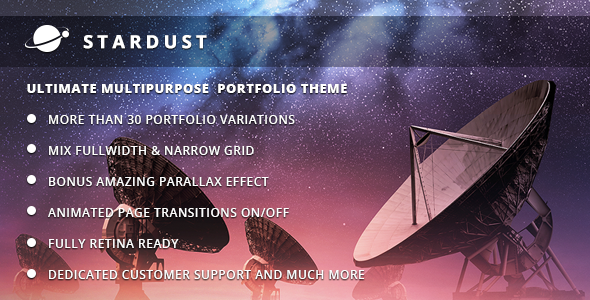
Stardust Creative is a multi-purpose portfolio theme for WordPress, sold on ThemeForest by the developer QODE for $39. It bundles a modular page builder system, per-page header control, AJAX page transitions, parallax sections and the Slider Revolution plugin, and it targets designers, photographers, studios and small agencies that want a highly visual site without commissioning custom development. The theme has passed 974 sales and carries a strong rating, which puts it among the more established creative themes in its price bracket.
What the theme actually gives a site owner
The defining idea behind Stardust Creative is layout freedom at the page level rather than the site level. Most themes ask the owner to pick one container width and live with it. Here the header, footer and content area can each be set to full-width or boxed independently, so a single site can mix a full-bleed hero image with a narrow, readable text column underneath. That sounds like a small detail until a project calls for exactly that combination.
Headers get similar treatment. Any page can carry its own header height and its own background image or slider, and the fixed-header behaviour can be switched on or off per page. For a portfolio where the homepage needs a dramatic full-screen image and the contact page needs a plain bar, this removes the usual workaround of stacking plugins or writing custom CSS.
Page transitions are handled through AJAX, the technique that loads a new page’s content without a full browser refresh. Stardust Creative ships four animated transition styles and lets the owner assign a transition type to individual pages, or switch AJAX off entirely for a conventional browsing experience. The per-page control is the useful part: a site can animate the portfolio gallery and keep the blog and legal pages plain.
A separate parallax page feature is included as a bonus. Parallax means background images move at a different speed to the foreground as the visitor scrolls. The vendor positions this for presentations, microsites and alternative homepages, and it is built through the same admin interface rather than a separate tool.
Content elements, sliders and the admin layer
The theme ships with a library of shortcodes, the small tags that insert pre-built components into a page. These cover counters, horizontal and vertical bar graphs, charts, animated service boxes and other elements that suit an agency presenting numbers or process steps. Shortcodes can be combined freely, which is how the demo layouts are assembled.
Slider Revolution is bundled at no extra cost; the vendor values the plugin licence at $26. It produces responsive or full-width sliders and, importantly, keeps slide text in the page markup so search engines can read it. The admin panel also allows unlimited sliders, slides, portfolio images and videos to be added while editing the relevant post, which keeps content entry in one place instead of a separate module screen.
Typography and colour are open-ended, with more than 500 Google Fonts and no fixed limits on element colours or sizes. Multiple custom sidebars can be created and assigned globally or per post. Two dropdown menu styles are available, and the theme is retina-ready, meaning icons stay sharp on high-density screens.
Technical and editorial groundwork
Stardust Creative is fully responsive, built on HTML5, CSS3 and jQuery, and validated markup is claimed by the vendor. It is WPML-ready for multilingual builds and prepared for translation through standard po and mo files. Per-page meta keywords and description fields are included, though the vendor notes these are hidden when the option is disabled in the theme settings. A dummy child theme is supplied so customisations survive future updates, and the contact page can combine a Google map, a form and free content in any arrangement.
The update log is worth reading before purchase. Version 3.2, released in April 2023, added WordPress 6.2 compatibility, improved PHP 8 support and refreshed the bundled slider. Earlier entries show a jump from 3.0.3 in March 2019 to 3.1 in November 2020 and then to 3.2 in 2023 — a maintenance rhythm of roughly one release every year or two, which is slower than the most actively developed themes on the marketplace.
Where Stardust Creative fits, and where it does not
The theme suits freelance designers and small studios building a portfolio that has to look distinctive without a custom build. Photographers and illustrators who want full-bleed imagery next to restrained text pages are a natural fit, as are agencies that need a case-study section, animated statistics and a services page in one package. It also works for a personal site that doubles as a microsite for a launch or exhibition, where the parallax pages can carry a campaign without a second installation.
Multilingual practices and studios serving clients in more than one language can use the WPML compatibility to run a single site rather than parallel installs.
It is the wrong choice for a content-heavy publisher. A news site, a large blog network or a documentation portal needs fast page loads, complex taxonomy and editorial workflow features; animated transitions and parallax layers add weight without helping. The same applies to stores: there is no e-commerce integration in the supplied feature set, so a shop would need WooCommerce styling built on top. Buyers who need a block-based, full-site-editing workflow should also look elsewhere, because this theme’s page construction depends on its own shortcode system rather than the native WordPress editor.
Strengths and limitations in plain terms
Strengths
- Genuine per-page control over header style, layout width and transition type, which covers design briefs that single-layout themes cannot.
- Slider Revolution included, saving the separate licence cost and keeping slider text readable by search engines.
- Broad element library — counters, graphs, charts, animated services — that suits agency and studio storytelling.
- Translation and WPML readiness, plus a child theme starting point, both of which reduce rework later.
- Established sales history and a high rating, with support reachable by ticket, comment or email.
Limitations
- Update cadence is slow. The most recent release was April 2023, so buyers should confirm current WordPress compatibility themselves rather than assume it.
- Page building relies on the theme’s own shortcodes. Switching themes later means rebuilding pages, and content is tied to the Stardust Core plugin.
- Demo images are licensed for presentation only. Every photograph on a live site must be sourced and paid for separately — a real cost the $39 price does not cover.
- AJAX transitions and parallax add scripts to every relevant page, which works against Core Web Vitals scores on slower hosting.
- No e-commerce support is stated in the feature set.
How it compares with the wider portfolio theme category
Multi-purpose creative themes generally fall into two camps. One group leans on a drag-and-drop builder such as Elementor or WPBakery and offers hundreds of pre-built templates; the other, which includes Stardust Creative, provides a curated set of modules and expects the owner to assemble pages from shortcodes. The builder-led camp is easier for non-technical owners and easier to hand over to a client. The shortcode-led camp tends to produce cleaner, more consistent output and gives finer control over details like header height per page.
Against single-purpose portfolio themes, Stardust Creative offers more range: the same installation can host a gallery-led homepage, a services page with animated charts and a parallax campaign page. Against heavyweight multipurpose themes that bundle dozens of demo sites and plugin integrations, it is leaner and less likely to bloat a small site — but it also carries fewer ready-made layouts and a smaller ecosystem of add-ons.
On price, $39 with a slider licence included sits at the lower end of the commercial range, and the main trade-off is maintenance recency rather than features. A buyer comparing on capability alone will find the layout and header controls competitive; a buyer comparing on long-term support and update frequency should weigh the 2023 release date carefully.
Frequently Asked Questions
Is Stardust Creative compatible with the latest WordPress version?
The vendor’s most recent update, version 3.2 from April 2023, states compatibility with WordPress 6.2 and improved PHP 8 support. Releases after that date are not listed in the supplied data. Buyers running newer WordPress versions should confirm current compatibility with QODE support before purchase, since the theme has not been updated recently.
Do I need to know how to code to use this theme?
No coding is required for normal use. Pages are assembled from shortcodes through the admin panel, and headers, colours, fonts and sidebars are configured in theme options. Some comfort with WordPress’s post editor helps, and anyone wanting deeper changes can use the included child theme to add custom CSS safely.
Can Stardust Creative be used for a multilingual website?
Yes. The theme is stated to be fully compatible with the WPML plugin, which is the standard tool for running a WordPress site in several languages. It is also prepared for translation using po and mo files, so interface strings can be localised. Both approaches can be combined, though WPML requires its own separate licence.
Are the demo images included with the theme purchase?
No. The vendor explicitly states that copyright in the demo images is not held by them and that the images are used for presentation only. They cannot be published on a live site without a licence from a stock image provider. Budget for photography or illustration separately from the $39 theme price.
Verdict
Stardust Creative is a sound buy for designers, photographers and small agencies who want fine control over headers, layout width and page transitions, and who value a curated module set over a drag-and-drop builder. The bundled slider and the per-page flexibility justify the $39 price for that audience. It is a poor fit for publishers, stores and anyone who needs a theme updated on a tight schedule, given the April 2023 release date and the shortcode lock-in that makes migration costly. Buyers should treat the theme as a solid, mature product rather than an actively evolving one, and verify compatibility with their WordPress version before committing.