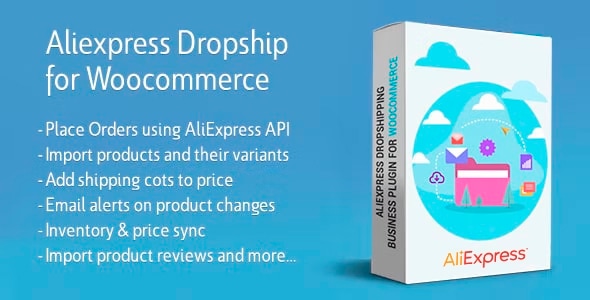
The AliExpress Dropshipping plugin for WooCommerce eCommerce is a WordPress extension that connects a WooCommerce store to AliExpress so products, variations, reviews, shipping data and order fulfilment can be handled from the WordPress dashboard. It is built for store owners who want to run a dropshipping operation without manually copying listings or placing every customer order by hand, and it also supports affiliate monetisation through AliExpress, Admitad or EPN links. The plugin is sold on CodeCanyon by ma-group for $30, with 8,616 sales and a 4.5 out of 5 rating from 262 reviews.
That sales figure matters in this category. Dropshipping tools live or die on whether they keep working when AliExpress changes something on its side, and a product with thousands of buyers tends to get patched faster than an abandoned script. The vendor last updated the plugin in May 2025, and it declares compatibility with WordPress 5.0 through 6.8 as well as WooCommerce 5.x through 9.x.
What the plugin actually does
The core workflow is import, price, publish, fulfil. Products are pulled from AliExpress into WooCommerce with their images, descriptions and variations intact, and there is no stated cap on how many can be imported. Variations are handled as real WooCommerce variations, so a listing with multiple sizes, colours or materials arrives as a single configurable product rather than a pile of duplicates. For sellers who prefer the opposite approach, a splitting tool breaks variations out into separate products, which suits stores that want each variant to rank as its own page.
Bulk import extends to entire seller stores: the plugin can pull every product from a specific AliExpress vendor in one pass. That is useful when a supplier relationship has already been established and the goal is to mirror their catalogue quickly.
Fulfilment is where the AliExpress API does the heavy lifting. Once an AliExpress token is configured, orders can be placed with the supplier in bulk, and tracking information is written back to the WooCommerce order automatically. Order status can then be changed automatically once an order ID and tracking number have synced. Anyone who has processed dropshipping orders one at a time knows this is the single biggest time sink the plugin removes.
Pricing is handled through rules rather than per-product editing. Sellers can define markup rules, apply them in bulk, and optionally fold the shipping cost into the product price. The plugin also lets shipping methods be managed directly: specific AliExpress shipping options can be hidden, labels renamed, and pricing rules applied on top of the original shipping cost. Shipping information can be displayed on the product page, in the cart and at checkout, either as a popup or a standard dropdown. Because the shipping data is stored in the backend, it can also be used to estimate profit per product after shipping is deducted.
Several smaller features round out the day-to-day work. A phrase filter strips or replaces unwanted text from imported descriptions, which is the usual way to remove supplier branding and stray references. Product change alerts send an email when a supplier alters a price, changes stock, adds a variation or discontinues an item. A built-in image editor allows edits before images are pushed live. Reviews can be imported from AliExpress with control over how many, from which countries, and whether they arrive published or as drafts. Product videos can be imported and placed via shortcode, in a dedicated tab, or inside the description. A setup wizard walks newcomers through configuration, and translation options cover sixteen AliExpress languages including English, German, French, Spanish, Russian, Japanese and Arabic. The plugin is also WPML-compatible and works with Elementor and Elementor Pro.
Where this fits, and where it does not
This is a strong fit for a solo operator or small team running a general-interest store built on WooCommerce. The bulk import, automated pricing rules and API-based order placement combine into a workflow that one person can manage at a few hundred orders a month without hiring help. It is equally suited to an agency building a dropshipping store for a client, because the setup wizard and admin-side controls mean the handover does not require the client to touch code.
It also fits sellers who want to hedge. Because the plugin supports affiliate keys alongside dropshipping, a store can run a mix of fulfilled products and affiliate-linked content, which is a reasonable way to test demand before committing to inventory and supplier relationships.
It is the wrong choice for anyone who needs multi-supplier sourcing from sources other than AliExpress. The plugin is built around one platform, and while the supplier override feature lets a product’s source be swapped, that is still an AliExpress supplier. Stores sourcing from Alibaba in bulk, from local wholesalers, or from a mix of CJdropshipping and private agents will find the automation largely inapplicable. It is also a poor fit for high-volume operations that need warehouse integration, custom fulfilment routing or ERP connectivity — this is a storefront automation tool, not a logistics platform.
Strengths and limitations
Strengths
- Order placement and tracking sync run through the official AliExpress API rather than screen scraping, which is the more durable approach.
- Pricing rules, shipping margin rules and bulk editing remove most manual product maintenance.
- Review import includes country filtering, keyword skipping, image support and a draft option, giving control over what appears publicly.
- Product change alerts catch supplier-side price and stock shifts before they turn into lost sales or underpriced orders.
- Compatibility spans WordPress 5.0 to 6.8 and WooCommerce 5.x to 9.x, so it is not tied to a narrow version window.
- Source files in PHP, JavaScript, HTML and CSS are included, which matters to agencies that need to extend behaviour.
Limitations
- Order automation depends on obtaining an AliExpress API token. The vendor states this explicitly and points to separate instructions, but the setup is a real prerequisite and a point of failure if the token lapses or permissions change.
- The plugin is tied to a single platform. There is no support for sourcing outside AliExpress, so it cannot serve as a general-purpose dropshipping hub.
- Importing supplier reviews raises a transparency question that the plugin does not resolve. The mechanics are well built; whether publishing them is appropriate is a judgement call the store owner has to make, and some jurisdictions and platforms take a dim view of it.
- Shipping estimates are only as good as the data AliExpress returns. Carrier pricing and delivery windows shift, so profit estimates should be treated as planning figures rather than guarantees.
- The declared browser support list still includes IE11, which suggests parts of the admin interface have not been modernised as aggressively as the feature set.
- The vendor does not state performance ceilings for bulk import. Stores importing thousands of products should expect to test this on their own hosting before committing.
How it compares to the wider category
Dropshipping plugins for WooCommerce generally fall into three groups: free importers that handle products but leave fulfilment manual, mid-priced tools like this one that cover import through fulfilment, and subscription services that bundle hosting, sourcing and automation for a monthly fee.
Against the free tier, the difference is fulfilment. A free importer gets products into the catalogue; it does not place supplier orders, sync tracking or alert on stock changes. For a store doing more than a handful of orders a week, that gap is the entire value proposition.
Against subscription services, the trade-off is control versus convenience. A one-time $30 purchase on a self-hosted WooCommerce store means no recurring fee and full ownership of the data, but the seller is responsible for hosting, updates and any breakage. Subscription platforms handle that maintenance but charge indefinitely and keep the store on their infrastructure. For sellers already committed to WooCommerce, the one-time model is usually cheaper within a few months.
Within the mid-tier, the distinguishing factors are API-based automation, breadth of import options and pricing rule depth. This plugin covers all three, and the review and video import features go beyond what many peers offer. The 4.5 rating across 262 reviews suggests the feature set holds up in practice, with the usual caveats that come with any tool dependent on a third-party API.
Frequently Asked Questions
Does the AliExpress Dropshipping plugin for WooCommerce place orders automatically?
Yes, it places supplier orders through the official AliExpress API, and bulk order placement is supported. Automatic order status changes follow once an order ID and tracking number sync successfully. The vendor notes that an AliExpress API token must be obtained first, and that separate setup instructions apply before the feature will work.
Can it import product reviews from AliExpress?
Yes. Reviews can be imported with minimum and maximum count limits, filtered by country, and pulled with images and review attributes. Empty reviews or those containing specified keywords can be skipped, and imports can be routed to draft status so they are reviewed before publishing. New reviews can also be imported automatically as they appear.
Is this plugin only for dropshipping, or can it be used for affiliate marketing?
It supports both. The same plugin can run a dropshipping store or monetise products through affiliate keys from AliExpress, Admitad or EPN. That makes it viable for a store testing demand through affiliate links before committing to supplier relationships and order fulfilment, or for a site running both models side by side.
What WordPress and WooCommerce versions are supported?
The vendor declares compatibility with WordPress 5.0 through 6.8 and WooCommerce 5.x through 9.x. It also lists Elementor, Elementor Pro and WPML as compatible, and states that the plugin is optimised for the Gutenberg editor. Source files in PHP, JavaScript, HTML and CSS are included in the purchase.
Verdict
Buy this if the store runs on WooCommerce, sources from AliExpress, and the manual work of importing products and placing supplier orders has become the bottleneck. The pricing rules, shipping margin controls and API-driven fulfilment justify the $30 on their own, and the review, video and translation features add practical value on top.
Skip it if sourcing happens outside AliExpress, if the operation needs warehouse or ERP integration, or if a subscription platform’s managed hosting is worth more than ownership and a one-time cost. The plugin is a focused tool for one platform and one workflow, and it does that job well rather than pretending to be a general logistics system.