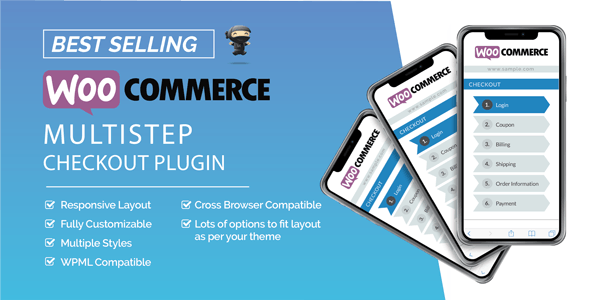
WooCommerce MultiStep Checkout Wizard is a WordPress plugin that breaks the default WooCommerce checkout page into a sequence of separate steps, guided by a progress bar or sidebar. It replaces the long single-page form with a wizard that collects billing, shipping, order review and payment details one screen at a time. Store owners who suspect their checkout page is costing them sales, and who want a more guided purchase flow without rebuilding their store, are the natural audience for this WooCommerce MultiStep Checkout Wizard eCommerce extension.
The plugin comes from developer Kole_Roy and is sold on CodeCanyon for $19. It has accumulated 5,823 sales and holds a 4.46 out of 5 rating across 146 reviews, which places it among the more established checkout customisation scripts in that marketplace. The vendor last updated it in September 2026, and the changelog shows a long, steady release history rather than a single launch-and-abandon cycle.
What the plugin actually changes about the checkout experience
The core function is splitting the standard WooCommerce checkout into discrete stages. Instead of presenting every field at once, the plugin shows one group of fields at a time and validates each step before allowing progression. That validation-on-each-step behaviour matters: errors surface where they occur rather than after the customer has scrolled through a long form and hit the place order button.
Several layout options are available. There are multiple visual designs, including classic and modern wizard styles plus an “Elegant” variation, and the progress indicator can be rendered as a horizontal progress bar or, since version 4.0.0, as a Shopify-style vertical sidebar that sticks in place on desktop. A mobile-optimised progress bar handles smaller screens. Store owners can therefore match the wizard to the existing theme rather than forcing a jarring visual change.
Step composition is configurable rather than fixed. Billing and shipping can be combined into one step, and the order review and payment steps can likewise be merged. That flexibility matters because the ideal number of steps differs by store: a digital goods seller with no shipping address has a very different checkout than a retailer shipping physical products internationally.
The order review step, introduced in version 3.0, shows the customer what they are about to buy before payment. It includes city and state, and the vendor added an option to display product thumbnails in the order table. Version 4.0.0 added a real-time order summary, so the totals update as the customer moves through the wizard rather than only appearing at the end.
Account handling is covered too. A login form can appear inside the wizard, and a registration form is shown only when the store has enabled account creation during checkout — a sensible guard against offering registration where it is not permitted. Coupon entry is available as a wizard step, and the vendor added a fix for coupon behaviour in version 3.1.
For developers, the plugin exposes JavaScript hooks that fire on step changes, plus filters for customising messages such as the login failure error. New fields can be added to individual steps. Source files are included in JavaScript, CSS and PHP, so the code can be inspected and extended. The plugin is also Gutenberg-optimised, though that mostly matters for the block editor rather than the checkout itself.
Where this fits, and where it does not
The strongest fit is an established WooCommerce store with meaningful traffic and a checkout that converts poorly. If a store already receives visitors who add items to the cart but abandon before completing the purchase, restructuring the form into steps is a reasonable hypothesis to test. The plugin is cheap enough that testing it against the default checkout is a low-risk experiment.
It also suits stores with long or complex checkout forms — those collecting company names, VAT numbers, delivery instructions or multiple address types. Splitting that data across steps reduces the visual weight of the page and makes the commitment feel incremental rather than immediate.
Stores selling digital products or subscriptions may find less benefit. When there is no shipping step and the form is already short, adding steps can introduce friction rather than remove it. A three-step wizard for a two-field purchase is worse than a single page. The plugin’s ability to combine steps mitigates this, but a very simple checkout often does not need a wizard at all.
Developers building a heavily customised checkout with their own templates should also proceed carefully. The plugin overrides WooCommerce checkout templates, and the changelog shows repeated fixes for conflicts with payment gateways and third-party plugins — Stripe, WooCommerce Payments, German Market and others. That history is a sign of active maintenance, but it also indicates that checkout customisation sits in a crowded space where conflicts are common.
Strengths and limitations
Strengths
- Per-step validation catches errors early, which is the most defensible reason to use a wizard at all.
- Configurable step structure, including the option to merge billing and shipping or merge review and payment.
- Multiple visual styles plus a sticky sidebar layout, so the wizard can be matched to an existing theme.
- Current compatibility with WooCommerce 9.x, 8.x and 7.x, and with WordPress 6.0 through 6.8.
- High-Performance Order Storage (HPOS) compatibility, which matters for stores on newer WooCommerce data structures.
- Accessibility work targeting WCAG 2.1 AA, a standard many checkout plugins ignore.
- Source files included, with JavaScript hooks and filters for developers who need to extend behaviour.
- A 4.46 rating across 146 reviews is a meaningful sample, and the changelog spans well over a decade of fixes.
Limitations
- The plugin works by overriding WooCommerce checkout templates. Any store with a theme or plugin that also customises those templates should expect to test for conflicts before going live.
- The changelog is dominated by compatibility fixes for payment gateways and third-party plugins. That is normal for this category, but it means ongoing maintenance attention is required after WooCommerce or gateway updates.
- Compatibility is declared for WooCommerce 7.x through 9.x only. Stores running older WooCommerce versions are outside the stated support range.
- The vendor does not publish performance benchmarks or conversion data, so the conversion benefit is a reasonable expectation rather than a documented outcome.
- Browser support lists IE10 and IE11, which suggests some legacy code paths remain in a product whose modern features target current browsers.
- At $19 for a single-site licence on CodeCanyon, the plugin is inexpensive, but buyers should confirm the licence terms and support period on the item page, as the vendor does not state them in the listing data.
How this compares to the wider category of checkout customisation tools
Checkout customisation for WooCommerce generally falls into three groups: field editors that add, remove or reorder checkout fields; full checkout replacement plugins that rebuild the page as a block-based or one-page layout; and wizard plugins like this one that restructure the existing checkout into steps.
Field editors are lighter and less likely to conflict with themes, but they do not change the fundamental shape of the page. Full checkout replacements offer more design control and often better performance, but they are heavier, more opinionated, and can require reconfiguring shipping, tax and payment logic. A wizard plugin sits in the middle: it changes the sequence and presentation of the checkout without replacing the underlying WooCommerce logic.
That middle position is the plugin’s main advantage. Because it works with the standard WooCommerce checkout rather than replacing it, existing payment gateways, shipping methods, tax rules and extensions generally continue to function. The trade-off is that it inherits the constraints of the default checkout templates, which is precisely why template conflicts appear so often in the changelog.
Compared with free alternatives, the paid price buys the multi-step structure, the sidebar layout, the order review step and the developer hooks in one package, along with a support relationship. Whether that is worth $19 depends on how much the store values not assembling the same behaviour from several smaller plugins.
Frequently Asked Questions
Does WooCommerce MultiStep Checkout Wizard work with my existing payment gateways?
It is designed to work with standard WooCommerce payment gateways, and the changelog records specific compatibility work for Stripe, WooCommerce Payments and others. Because the plugin restructures the checkout rather than replacing it, gateways that hook into the normal WooCommerce checkout flow should continue to function. Testing on a staging site before deployment is still the sensible approach.
Can the number of checkout steps be reduced or changed?
Yes. The plugin allows billing and shipping to be combined into one step, and the order review and payment steps can also be merged. That means a store can run anything from a short two-step flow to a longer sequence. Step labels and the order review title are configurable as well, so the wording can be tailored to the store.
Is the plugin compatible with WooCommerce High-Performance Order Storage?
Yes. HPOS compatibility was added in version 4.0.0, and an earlier release also addressed the WooCommerce Order Attribution model. Stores that have migrated to WooCommerce’s newer order storage tables can use the plugin without that being a blocker. The declared compatibility range covers WooCommerce 7.x, 8.x and 9.x.
Does the plugin include the source files for customisation?
Yes. The package includes JavaScript, CSS and PHP source files, and the plugin exposes JavaScript hooks that fire when the customer changes step. There are also filters for adjusting messages such as the login failure text, and support for adding new fields to individual steps. That makes it workable for developers who need to adapt the wizard beyond the built-in settings.
Verdict
WooCommerce MultiStep Checkout Wizard is a sensible purchase for store owners running a standard WooCommerce checkout who want to test whether a guided, step-by-step purchase flow improves completion. The price is low, the plugin is actively maintained, and the configurable step structure means it can be tuned rather than accepted as-is. It is a poor fit for stores with very short checkouts, where extra steps add friction, and for projects with heavily customised checkout templates that will need conflict testing. Developers should treat the template override behaviour as the main technical consideration before buying. On balance, the sales volume, review sample and changelog depth suggest a product that has been used in real stores and supported over time.