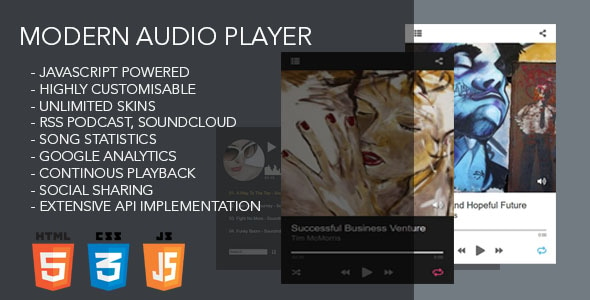
HTML5 Audio Player with Playlist is a self-hosted JavaScript audio player sold on CodeCanyon that plays MP3 files and a wide range of other media sources, including podcasts, SoundCloud tracks, cloud storage folders and live streams. It is built for website owners, freelancers and agencies that need more control over audio playback than a default CMS player provides, without building a player from scratch. The script has sold 4,287 copies and holds a 4.24 out of 5 rating across 251 reviews.
What the Player Actually Does Beyond Basic Playback
At its core, the product handles the expected job: it plays audio in the browser using HTML5, works across Firefox, Safari, Opera, Chrome and Edge, and adapts to desktop, tablet and mobile screens. What separates it from a stock player is the range of sources it can pull audio from and the number of ways a playlist can be presented.
The most practical capability for many buyers is source flexibility. Playlists can be assembled from locally hosted MP3 files, RSS podcast feeds, SoundCloud, Google Drive, OneDrive, Amazon S3 buckets (both public and private, using presigned URLs or CloudFront), XML and JSON playlist files, and YouTube audio or video. A single playlist can mix these types, so a site could combine self-hosted tracks with a podcast feed and a SoundCloud upload in one list. The script also reads ID3 metadata from folders of MP3 files, which means track titles, artists and artwork can be pulled automatically rather than typed in by hand.
Presentation is where the product offers the most choice. Standard skins sit anywhere in a page layout, sticky skins fix a full-width player to the bottom of the viewport, and minimal skins suit stripped-back designs. Waveform skins show visual progress, and a circular skin is included for layouts that need something less conventional. A grid mode turns playlists into thumbnail grids, which is useful for music libraries or album collections. Multiple players can run on the same page, and responsive breakpoints allow specific buttons or elements to be hidden on small screens.
Playback controls go further than most embedded players. Buyers get shuffle, playlist looping, adjustable playback speed, start and end time trimming, crossfade between tracks, and a choice of what happens when a track finishes. The player can remember the active song and current playback position after a page reload, and it can continue playing across page navigation or open in a separate popup window. Keyboard navigation and social sharing buttons are included as well.
Two features stand out for commercial use. First, advert support: audio ads can play before, during or after songs, set globally per playlist or individually per track, with IMA advert support and callbacks that fire when ads run. Second, content protection: song URLs can be obscured using encryption and blobs, individual tracks can be password protected, and the WordPress version supports restricting playback to logged-in users or specific roles. The WordPress build also adds play, like and download statistics with an admin panel, and can replace the default WordPress audio player.
For developers, the script exposes API methods for runtime control and event callbacks during playback. It is written in plain JavaScript, which the vendor notes keeps it fast and reduces conflicts with other scripts on the page.
Where This Player Fits and Where It Does Not
This is a strong fit for podcasters who want a branded player with episode artwork, lyrics display, playback position memory and optional advertising. It suits music sites and labels that need album grids, waveform visuals, song variations (such as long and short edits of the same track) and password-protected previews. Membership sites benefit from the WordPress role restrictions and per-track protection. Agencies building client sites will find the multiple skins and responsive breakpoints useful for matching an existing design rather than compromising around a third-party embed.
It also works well for anyone distributing audio from cloud storage. Reading directly from Google Drive, OneDrive or Amazon S3 means large audio libraries do not have to sit on the web host, which keeps hosting costs and bandwidth limits under control.
There are situations where it is the wrong purchase. Anyone who needs a fully hosted, zero-maintenance solution with no server involvement should look at a SaaS audio platform instead, because this is a self-hosted script that must be installed and configured. Buyers who need SoundCloud playback should also verify API access before purchasing, since the vendor explicitly states that a SoundCloud API key is required and that availability should be confirmed first. Finally, projects that only need to play a single MP3 file will find most of this feature set unnecessary.
Strengths and Limitations
Strengths
- Unusually broad source support, including podcast RSS, SoundCloud, Google Drive, OneDrive, Amazon S3 and Apple HLS live streaming, all mixable within one playlist.
- Genuine layout flexibility: standard, sticky, minimal, waveform, circular and grid skins cover most design briefs.
- Advertising tools with IMA support and callbacks, which is rare in players at this price point.
- Content protection through URL encryption, blobs, password-protected tracks and WordPress role restrictions.
- Developer-friendly, with runtime API methods and playback event callbacks for custom integrations.
- Plain JavaScript implementation reduces the risk of conflicts with other scripts.
- Source files are included in JavaScript, HTML, XML, CSS and PHP, so the code can be modified directly.
Limitations
- The rating sits at 4.24 out of 5 across 251 reviews, which is solid but indicates a meaningful minority of buyers hit problems. Reading recent comments before purchase is worthwhile.
- SoundCloud support depends on obtaining an API key, which the vendor does not guarantee. This is a real dependency outside the buyer’s control.
- High-resolution assets are not included according to the vendor’s own specification, which may matter for retina displays or large-format layouts.
- The WordPress statistics, role restriction and default-player replacement features are limited to the WordPress version. Buyers using the standalone JavaScript plugin do not get them.
- Cloud storage integration adds setup work: S3 presigned URLs, CloudFront configuration and private bucket permissions all require familiarity with those platforms.
- This is a self-hosted script, so installation, updates and any conflicts with existing site scripts become the buyer’s responsibility.
How It Compares to Other Audio Player Options
The wider category splits into three groups: free HTML5 audio elements and lightweight JavaScript players, hosted audio platforms that handle delivery and hosting for a subscription, and full-featured self-hosted scripts like this one.
Free players and basic JavaScript libraries cover simple playback well. They generally do not offer advertising, waveform visuals, cloud storage integration, password protection or playback statistics. For a single track or a short list, they are the sensible choice and cost nothing.
Hosted platforms remove the technical burden entirely and usually provide reliable delivery and analytics. The trade-off is recurring cost, less control over appearance, and audio that lives on someone else’s infrastructure rather than the buyer’s own storage.
This product sits at the feature-heavy end of the self-hosted group. Its differentiators are the breadth of sources, the advertising system and the protection options. Where it competes less well is simplicity: a buyer who wants to paste one line of embed code and be finished will find the setup heavier than necessary. Where it wins is on control and on avoiding subscription fees for audio that is already hosted elsewhere.
Frequently Asked Questions
Does this player work with MP3 files only?
No, MP3 is simply the format the vendor recommends because it plays in all supported browsers and devices. The player also supports WAV, AAC, FLAC and other HTML5 audio formats, along with live streams, podcast feeds and cloud-hosted files. Using MP3 avoids compatibility gaps, but it is not a hard requirement.
Can the player pull audio from Amazon S3 or Google Drive?
Yes, both are supported, along with OneDrive. Amazon S3 works with public buckets, private buckets using presigned URLs, and CloudFront distributions. This lets large audio libraries stay in cloud storage instead of consuming web hosting bandwidth, though setting up private bucket permissions requires some familiarity with the platform.
Does it support advertising inside playlists?
Yes, audio adverts can play before, during or after songs. Ads can be assigned globally to an entire playlist or individually to specific tracks, and IMA adverts are supported. Callbacks fire when adverts play, so ad events can be tracked or used to trigger other behaviour on the page.
Is there a WordPress version with statistics?
Yes. The WordPress version includes an admin panel showing play, like and download counts for each player and playlist, with the numbers displayed next to songs in the list. It also supports restricting playback to logged-in users or specific roles and can replace the default WordPress audio player. The standalone JavaScript plugin does not include these features.
Verdict
This player is worth buying for podcasters, music sites, membership platforms and agencies that need advertising, content protection, cloud storage integration or a specific visual style that a generic embed cannot deliver. The breadth of supported sources and the depth of playback controls justify the $142 price for those use cases. It is not the right choice for anyone who wants a hosted, maintenance-free solution, or for projects that only need to play a single audio file. Buyers planning to use SoundCloud should confirm API key availability before purchasing, and anyone relying on the WordPress-specific statistics and restriction features should make sure they are buying the correct version. Reading the most recent reviews alongside the 4.24 average rating is a sensible final step before committing.