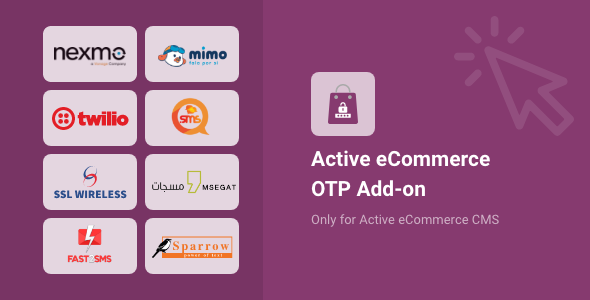
Active eCommerce OTP Add-on is an extension for the Active eCommerce CMS that replaces email-based account verification with one-time passwords sent by SMS or WhatsApp. It lets shoppers register, log in, reset a forgotten password and confirm a checkout using a code delivered to their phone number. Store owners running the Active eCommerce platform who want phone-number accounts and event-driven SMS notifications should consider it; anyone not already using that CMS cannot use it at all.
The add-on is sold on CodeCanyon by ActiveITzone for $25 and has accumulated 2,355 sales with an average rating of 4.48 out of 5 across 40 reviews. That combination of volume and score matters in a category where many add-ons are abandoned after a single release. The version history here stretches from an initial 2020 release to updates in 2026, which suggests the developer has kept pace with the parent CMS rather than shipping once and moving on.
What the OTP Add-on actually changes on a storefront
The core function is authentication by phone number instead of email address. Shoppers enter a mobile number, receive a short numeric code, and use that code to complete registration, sign in, or recover a lost password. For markets where email deliverability is unreliable or where a large share of customers shop primarily from a phone, this removes a common point of drop-off during signup.
Beyond login, the add-on turns the store into an SMS notification channel. Order confirmations, order status changes and payment status changes can all trigger a text message to the customer’s registered number. That is a meaningful operational difference for stores that currently rely on email alone, because SMS tends to be read within minutes rather than sitting unopened in an inbox.
Admins also get a bulk messaging tool for reaching registered customers. This is useful for promotions, restock announcements or service notices, though it is only as good as the gateway behind it and the consent practices of the store.
Checkout verification and guest orders
Two later additions are worth flagging because they address real fraud and abandonment problems. Checkout-level OTP verification can be applied to wallet and cash-on-delivery orders, with prompts encouraging customers to switch the feature on from their profile. Cash-on-delivery is the order type most exposed to fake or prank orders, so gating it behind a verified phone number is a practical control. The most recent version also lets administrators enable OTP for guest checkout, which closes a gap that earlier releases left open.
Gateway coverage and delivery channels
The add-on supports a broad spread of SMS providers, including SSLWireless, Fast2SMS, MIM SMS, MiMSMS, msegat, SPARROW SMS, Nexmo and others, with DLT support for Fast2SMS and sender ID handling for Nexmo. WhatsApp delivery is available through Twilio and Zender. In practice this means a store in South Asia, the Middle East or North Africa can usually connect a local gateway rather than being forced onto a global provider with different pricing and sender ID rules. Gateway changes over time have been handled in maintenance releases, which is the sort of unglamorous work that determines whether an SMS integration still functions a year after purchase.
Where this add-on fits, and where it does not
The clearest fit is an existing Active eCommerce store serving a market where phone-first authentication is the norm. If customers already expect a code by text rather than a confirmation link by email, this add-on aligns the store with that expectation instead of fighting it.
It also suits stores with a cash-on-delivery problem. Adding a verified phone number to the order flow raises the cost of placing bogus orders, and the notification features give customers a reason to keep that number accurate.
A third scenario is a store that has outgrown email for transactional messages. Order and payment status texts reduce inbound “where is my order” contacts, particularly for businesses with high order volumes and thin support staffing.
The wrong choice is any project not built on Active eCommerce CMS. The vendor states plainly that the OTP system is not standalone and works only with that CMS. A store on WooCommerce, Shopify, Magento or a custom Laravel build gets nothing from this purchase. It is also a poor fit for a store with no SMS budget: every OTP and notification is a billable message, and costs scale with order volume and gateway rates.
Strengths and limitations
Strengths
- Phone-based registration, login, password reset and checkout verification in one add-on, rather than four separate integrations.
- Wide gateway coverage, which matters because SMS pricing and sender ID rules are country-specific.
- WhatsApp delivery through Twilio and Zender, useful where SMS is expensive or unreliable.
- Event notifications for orders and payments, turning the store into a proactive communicator.
- Bulk SMS to registered customers for promotions and announcements.
- A long, documented update history with compatibility notes for successive CMS versions.
- Installation runs through the CMS add-on manager, so no server-level configuration is implied by the vendor’s instructions.
Limitations
- It is useless without Active eCommerce CMS. This is a hard dependency, not a preference.
- The vendor lists PHP 7.x and MySQL 5.x as the compatible stack. Both are older branches, and the listing does not state support for PHP 8, so a store on a newer runtime should confirm compatibility before buying.
- SMS and WhatsApp messages cost money per send through a third-party gateway. The add-on price is not the total cost of ownership.
- Deliverability depends entirely on the gateway chosen and, in some countries, on regulatory registration such as DLT in India. The add-on cannot fix a poorly configured sender.
- Bulk SMS capability carries consent and anti-spam obligations that fall on the store owner, not the developer.
- The listing does not specify a message template editor, delivery reports or per-gateway failover, so those capabilities should be confirmed on the demo before purchase.
- Version 2.8 fixed duplicate OTP messages during registration, a reminder that SMS bugs are visible to customers and costly when they occur.
How it compares with the alternatives
There are three broad routes to phone verification on an eCommerce site. The first is a purpose-built add-on like this one, which plugs into a specific CMS and inherits its user model, order flow and admin screens. The second is a general authentication or SMS plugin that works across platforms but knows nothing about the host store’s orders and payments. The third is custom development against a gateway API.
The purpose-built route wins on integration depth. Because this add-on is written for Active eCommerce, it can hook into checkout, wallet orders, cash-on-delivery and order status events. A generic plugin would need custom work to reach the same places. That depth is also the trade-off: the add-on’s value is entirely tied to one CMS, and if a store migrates platforms, the investment does not travel.
Custom development offers the most control and no dependency on a third party’s update schedule, but it carries ongoing maintenance cost and requires a developer who understands both the CMS internals and the gateway’s API. For most stores, that is disproportionate for what is fundamentally a verification and notification layer. The add-on sits in a sensible middle: less flexible than bespoke code, considerably cheaper and faster to deploy.
Frequently Asked Questions
Can the Active eCommerce OTP Add-on be used without Active eCommerce CMS?
No. The vendor states explicitly that the OTP system is not an independent product and works only with Active eCommerce CMS. The CMS must already be installed on the server before the add-on is purchased and installed through the add-on manager. Stores running any other platform need a different solution entirely.
Which SMS gateways does the OTP add-on support?
It supports a range of providers including SSLWireless, Fast2SMS, MIM SMS, MiMSMS, msegat, SPARROW SMS and Nexmo, with DLT support for Fast2SMS and sender ID handling for Nexmo. WhatsApp delivery is available through Twilio and Zender. The vendor has added gateways over time, so the current list on the product page is the authoritative one.
Does the add-on send SMS for orders and payments, or only for login codes?
Both. Beyond registration, login and password reset codes, it can notify customers about new orders, order status changes and payment status changes. Administrators can also send bulk SMS to registered customer numbers. Checkout-level verification can additionally be applied to wallet and cash-on-delivery orders, with prompts inviting customers to enable it from their profile.
What PHP and MySQL versions does it require?
The vendor lists PHP 7.x and MySQL 5.x as the compatible software. No PHP 8 support is stated in the listing. Because the add-on is built on the Laravel framework, stores running a newer PHP branch should verify compatibility against their CMS version and the current add-on release before purchasing, since a mismatch can break both the store and the verification flow.
Verdict
For stores already running Active eCommerce CMS in a market where customers expect phone-based verification, this add-on is a straightforward purchase. It covers registration, login, password reset and checkout in one package, supports local gateways across several regions, and has been maintained consistently since 2020. The 2,355 sales and 4.48 rating reflect a product that a substantial number of buyers have found workable.
Buyers should go in with clear eyes about the dependency: this is not a portable tool, and it is worthless without the parent CMS. The per-message gateway costs and the older PHP 7.x and MySQL 5.x compatibility statement are the two details most likely to cause friction. Stores on other platforms, or those unwilling to fund ongoing SMS spend, should look elsewhere.