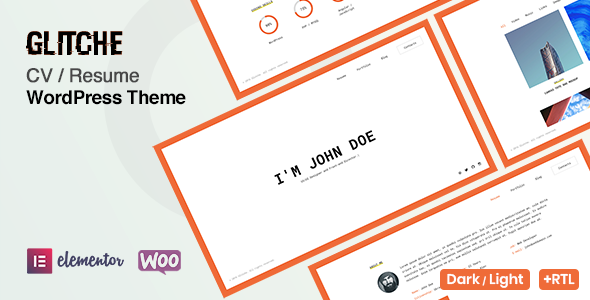
Glitche is a WordPress theme built for personal CV, resume and portfolio websites, sold on ThemeForest by the developer bslthemes for $39. It pairs the Elementor page builder with a set of ready-made demo layouts, dark and light skins, and portfolio and resume modules, so a freelancer, developer, designer or photographer can assemble a personal site without writing code. It suits anyone who wants a single self-hosted site to hold both a career history and a body of work, and it is a poor fit for large corporate sites or content-heavy publications.
What the theme actually gives a personal site owner
The core of Glitche is Elementor. Every page is assembled by dragging widgets onto a canvas, and the theme ships its own custom widgets alongside the standard Elementor set. Those extra widgets are the ones that matter for this niche: resume timelines, skill bars, testimonial and team carousels, pricing tables and portfolio grids. In practice that means a CV page is a matter of stacking pre-styled blocks rather than designing a timeline from scratch.
Portfolio handling is more developed than most personal themes manage. Projects can be displayed as a listing or a grid with several style options, as carousels, and with filter controls so visitors can narrow work by category. The single project page is also built in Elementor rather than locked to a fixed template, which allows each case study to have its own layout. The lightbox supports images, galleries, video from YouTube and Vimeo, iframes, SoundCloud audio and outbound links — useful for a photographer showing full sets or a developer embedding a demo.
Two presentation choices stand out. The first is the dark and light skin toggle, which is a genuine theme-level switch rather than a manual recolour, so a site can offer both without duplicating work. The second is RTL support, covering right-to-left languages such as Arabic and Hebrew with correct text alignment and navigation. Combined with WPML, Polylang and TranslatePress compatibility and included .pot translation files, multilingual personal sites are a realistic target rather than an afterthought.
Under the surface, theme options and custom fields run on ACF Pro — the paid version of the Advanced Custom Fields plugin, which lets developers attach structured data to posts and pages. The vendor states unlimited colour schemes, access to over a thousand Google Fonts, header and footer controls, and Contact Form 7 support. Backgrounds can be set to a solid colour, image, video, gradient or slideshow, which is more flexibility than the category usually offers.
Setup is handled through one-click demo import across four or more demo layouts, with both one-page and multi-page modes available. A one-page mode suits a freelancer who wants everything on a single scrolling page; multi-page suits someone building out separate portfolio, blog and services sections. WooCommerce compatibility means a shop can be added if the site needs to sell something — prints, templates, consulting time.
On maintenance, the theme has been kept current. The changelog shows version 3.4.3 in May 2025, updating bundled plugins and WooCommerce template files, following a December 2024 release. Bundled plugin updates matter because outdated template files are a common source of breakage after WooCommerce releases.
Where Glitche fits, and where it does not
The clearest fit is a solo professional who needs one site to do two jobs: present a career history and show work. A freelance developer can put a skills section, a timeline of roles, a filtered project grid and a contact form on a single site without commissioning design work. A photographer or designer gets the lightbox and portfolio variants that make image-heavy work look deliberate. A writer gets a blog with a grid layout and the same portfolio machinery for published pieces.
A second fit is the agency or freelancer building personal sites for clients. The demo import, child theme support and translation readiness mean a repeatable starting point, and the ACF Pro foundation gives a clean way to hand over editable structured content rather than a page of loose text blocks.
A third fit is anyone serving a right-to-left language audience. RTL support is uncommon enough in this price bracket that it becomes a deciding factor rather than a bonus.
Where it is the wrong choice: organisations that need a multi-author editorial site, complex membership logic, or a large content architecture with taxonomy-heavy navigation. This is a personal theme, and its blog and portfolio modules reflect that scope. A personal site that grows into a fifty-author publication with editorial workflows would be better served by a general-purpose theme or a dedicated CMS setup. Similarly, anyone who wants a hosted, zero-maintenance profile page rather than a self-hosted WordPress install is looking at the wrong product category entirely.
Strengths and limitations
Strengths
- Elementor-based editing with custom widgets purpose-built for resume timelines, skill bars and portfolio grids, which shortens the build considerably compared with assembling the same blocks from generic widgets.
- Portfolio depth unusual at this price: filters, carousels, multiple grid styles and an Elementor-built single project template.
- Lightbox support for image, gallery, video, iframe, audio and link types in one component.
- A real dark/light skin toggle rather than a manual recolour, plus RTL support and multilingual compatibility.
- ACF Pro powers the theme options and custom fields, which gives structured, editable content rather than freeform text.
- One-click demo import across four or more layouts, with one-page and multi-page modes.
- Active maintenance: the changelog shows updates through 2025, including WooCommerce template file refreshes.
- 976 sales on ThemeForest, which indicates a reasonably established user base and a track record the developer has had to support.
Limitations
- The demo images are not included in the download. A buyer must source equivalent photography or the site will not look like the preview out of the box — a real cost in time or licensing.
- Elementor is a hard dependency. Sites already standardised on the block editor or a different builder would be introducing a second editing system.
- ACF Pro is bundled and used for theme options. That is a strength while the theme is maintained, but it ties site configuration to a third-party plugin’s lifecycle.
- The vendor does not state performance benchmarks, Lighthouse scores or page-weight figures, so speed cannot be assessed from the listing alone.
- Scope is deliberately narrow. There is no membership system, no multi-author editorial workflow and no advanced content architecture beyond blog and portfolio.
- WooCommerce support means shop template files to keep in sync, which is ongoing maintenance rather than a one-time setup.
How it compares with the wider category
Personal CV and portfolio themes generally fall into three groups. The first is multipurpose themes that include a resume demo among dozens of unrelated layouts; they are flexible but carry weight and complexity a personal site never uses. The second is minimal portfolio themes with a fixed set of page templates and little editing freedom. Glitche sits between them: narrower than a multipurpose theme, considerably more configurable than a fixed-template portfolio theme.
Against the multipurpose group, the trade-off is scope for focus. A buyer gives up unrelated demo categories but gains widgets designed specifically for resume and portfolio content, which is where multipurpose themes tend to feel generic. Against the minimal group, the trade-off is a dependency on Elementor in exchange for being able to reshape any page, including single project pages.
The differentiators that matter most in comparison are the dark/light toggle, RTL support and the breadth of lightbox media types. Plenty of themes in this bracket offer one of those; offering all three alongside WooCommerce and multilingual support narrows the field considerably. The counterweight is that none of this is verifiable on performance without installing it, and the missing demo images are a cost every buyer absorbs.
Frequently Asked Questions
Do I need to know how to code to use Glitche?
No. Pages are built with Elementor’s drag-and-drop interface, and the theme’s custom widgets cover the resume, skills and portfolio elements that would otherwise need custom work. Theme options and custom fields run through ACF Pro in the WordPress admin. Some comfort with WordPress’s dashboard is expected, but writing PHP, CSS or JavaScript is not required for a standard personal site.
Does Glitche include the images shown in the demo?
No. The vendor states plainly that images used in the preview demo are not included in the downloaded package, and credits them to Unsplash, Graphicburger and Icons8. Buyers need to supply their own photography or licensed alternatives. Budget time for sourcing images, because the demo’s visual impact depends heavily on them.
Can Glitche be used for a right-to-left language site?
Yes. RTL support is built in, covering text alignment, navigation and overall layout consistency for languages such as Arabic and Hebrew. The theme is also compatible with WPML, Polylang and TranslatePress, and ships with .pot translation files, so a genuinely multilingual personal site is achievable without a separate RTL-specific theme.
Is Glitche compatible with WooCommerce?
Yes. WooCommerce is supported, so a shop can be added for selling prints, templates, services or digital downloads. The changelog shows WooCommerce template files being updated to the latest version in release 3.4.3, which matters because stale template files are a frequent cause of layout problems after WooCommerce updates.
Verdict
Glitche is worth buying for freelancers, developers, designers, photographers and writers who want a single self-hosted WordPress site combining a CV or resume with a portfolio. The Elementor widgets, portfolio variants and RTL support do real work that generic themes leave to the buyer, and the 2025 changelog suggests the developer is still maintaining it. It is also a sensible base for agencies building personal sites repeatedly.
It is not the right purchase for multi-author publications, membership sites or anyone needing a hosted profile page rather than a WordPress install. Buyers should also factor in the cost of sourcing their own demo imagery and accept the Elementor dependency. At $39 with 976 sales behind it, the risk is low for the audience it targets.