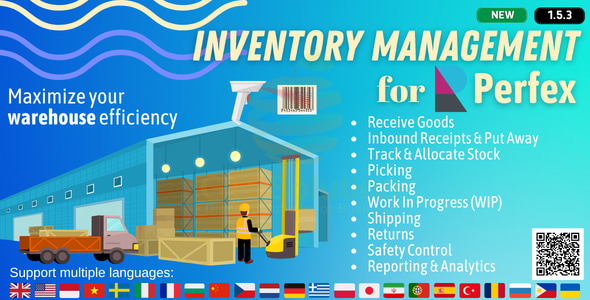
The Inventory Management module for Perfex CRM is a paid add-on that adds warehouse, stock and goods-movement tracking to the Perfex CRM system. It extends Perfex’s existing items list with SKU codes, purchase and sale prices, variants, barcodes and warranty data, then records the flow of those goods from supplier receipt through to customer delivery. It suits businesses already running Perfex that hold physical stock — wholesalers, retailers, light manufacturers — and not service-only firms or teams that have not committed to Perfex as their CRM.
What the module actually adds to a Perfex installation
Perfex CRM ships with a basic items list that works for invoicing but says little about stock. This add-on, developed by GreenTech_Solutions, treats that list as a starting point and layers inventory logic on top. The result is closer to a small ERP than a simple stock counter.
Richer product records
Each item gains a product code, SKU, purchase price, sale price, profit rate, warehouse assignment, tags, barcode, image and long description. Variant attributes — model, size, colour, style — are managed as their own configurable lists, so a single product line can be split into sellable combinations. A warranty field and lot number are also carried on the item, which matters for anything sold with a guarantee or tracked by batch. A profit rate can be applied to calculate selling price either from the purchase cost or from the target margin, with optional rounding.
Documents that mirror real warehouse paperwork
Rather than a single “adjust stock” button, the module models the documents a warehouse actually produces: receiving vouchers for incoming goods, delivery notes, packing lists, internal delivery notes for transfers between locations, and return orders in both directions. Shipping activity can be logged against each dispatch. Loss and adjustment records cover shrinkage, damage and stocktakes. Each document type supports its own prefix and running number, which keeps paperwork consistent with existing office conventions.
Warehouses, safety stock and approvals
Multiple warehouses can be defined, each with custom fields. Minimum and maximum safety stock levels trigger automatic alerts when quantities fall outside range, and expiry-date alerts are available too. An approval process can be switched on for inventory adjustments and internal transfers, so a stock write-off needs sign-off before it takes effect. Permissions are managed separately, which allows a warehouse clerk and a finance user to see different parts of the module.
Barcodes, bulk data and reporting
Barcode labels can be printed from the module and scanned back in, which shortens receiving and picking work. Products, opening stock, minimum stock levels and internal warehouse data can all be imported in bulk rather than keyed in one at a time. Six report types are included: stock summary, inventory analytics, inventory valuation, warranty period, stock movement and stock balance. Filters apply across the reports.
Links to the wider Perfex add-on ecosystem
The vendor lists integrations with eleven other Perfex modules, including Purchase Management, Accounting and Bookkeeping, Omni Channel Sales, Manufacturing Management, Quality Management and Workflow Automation. Two of these are the most consequential: inventory can be created automatically from a purchase order, and a delivery note can be generated from a sales invoice, with invoice edits or cancellations flowing back to the note. That automation is what turns the module from a standalone stock ledger into part of a connected workflow — but it only works if those companion modules are installed.
Where this module fits, and where it does not
The clearest fit is a small or mid-sized trading business that already uses Perfex for sales and wants stock records in the same place as customer and invoice data. A distributor holding several product variants across two or three warehouses, issuing delivery notes and tracking warranty periods, is close to the ideal profile. So is a light manufacturer that buys components and needs receiving vouchers, packing lists and adjustment approvals without paying for a dedicated ERP.
Freelancers and agencies running Perfex for project work should look elsewhere. If the business sells time and services rather than physical units, the warehouse, barcode and valuation machinery is dead weight, and the standard Perfex items list is sufficient. The same applies to any team unwilling to buy the companion Purchase Management module: without it, the automatic stock creation from purchase orders — arguably the module’s strongest workflow feature — is unavailable.
A third mismatch is scale. Businesses processing thousands of order lines a day, or needing multi-currency landed-cost calculations and lot traceability across a full supply chain, will find the reporting and cost model here too shallow. This is inventory control for a small operation, not a distribution platform.
Strengths and limitations
Strengths
- Depth of item data. Variants, warranty, lot numbers, profit-rate pricing and custom fields go well beyond what Perfex offers natively.
- Document-based workflow. Receiving vouchers, delivery notes, packing lists and internal transfers reflect how warehouses genuinely operate, rather than reducing everything to a quantity field.
- Approval and permission controls. Stock adjustments can require sign-off, and access can be scoped by role — useful where more than one person touches inventory.
- Automation with companion modules. Purchase orders and sales invoices can drive stock movements automatically, cutting duplicate entry.
- Proven track record. Nearly 2,000 sales and a 4.89 average from 100 reviews indicate the module has been tested by a substantial user base.
- Broad PHP compatibility. The vendor states support for both PHP 7.x and 8.x, which eases deployment on older hosting.
Limitations
- Dependency on other paid modules. Several headline integrations require separate purchases. The vendor does not state whether the module is fully useful without them, but the automatic stock creation and delivery-note generation clearly are not.
- No high-resolution assets. The listing declares that high-resolution files are not included, which is a minor point but relevant to anyone expecting polished print output for labels.
- Task feature needs manual setup. The changelog notes that adding tasks to delivery and receiving vouchers requires a hook to be configured following attached instructions — not a one-click option.
- Documentation is thin by the vendor’s own account. Setup guidance covers uploading and activating the module; it does not claim to cover advanced configuration in depth.
- Cost stacks up. At $99 the module is a considered purchase, and the realistic total for a full workflow includes the companion add-ons.
How it compares with the alternatives
The main alternative is a standalone inventory application — dedicated stock software or a small ERP — connected to Perfex only loosely, if at all. Those tools usually offer deeper reporting, multi-currency costing and stronger audit trails, but they mean a second system, a second login and duplicated customer data. For a business already living inside Perfex, that friction often outweighs the extra capability.
The second alternative is doing nothing: using Perfex’s native items list plus spreadsheets for stock. That costs nothing and works for very low volumes, but it breaks down as soon as variants, multiple warehouses or approval requirements appear. Spreadsheets also cannot generate delivery notes or trigger safety-stock alerts automatically.
A third option is a broader Perfex add-on bundle. Buyers weighing this module should check which companion modules they already own, because the value proposition shifts sharply depending on whether Purchase Management and Accounting are in place. Compared with generic stock plugins for other platforms, this one’s advantage is native integration with Perfex’s invoices, clients and projects; its disadvantage is that it only works inside Perfex at all.
Frequently Asked Questions
Does the Inventory Management module for Perfex CRM work as a standalone script?
No. It is an add-on that installs inside an existing Perfex CRM installation and cannot run on its own. Buyers need a licensed, working Perfex setup before the module is of any use. The vendor states this explicitly, and the demo runs inside a Perfex environment rather than as a separate application.
Which PHP versions does the module support?
The vendor lists compatibility with both PHP 7.x and PHP 8.x. That range covers most hosting configurations currently in use, including older shared hosts that have not yet moved to PHP 8. The module is built on the CodeIgniter framework, matching Perfex’s own architecture, and ships with PHP, JavaScript, HTML, CSS and SQL source files.
Do I need other Perfex add-ons for the inventory module to be useful?
Not strictly, but several key features depend on them. Automatic stock creation from purchase orders requires the Purchase Management module, and delivery-note generation from invoices relies on sales-side integration. Accounting, Manufacturing and Quality Management links are also listed. The core warehouse, document and reporting functions work without companions, but the automated workflows do not.
Can the module handle multiple warehouses and product variants?
Yes. Warehouse management is included, with custom fields per location and support for importing and exporting internal warehouse data. Products can carry variant attributes — model, size, colour and style — each managed through its own configurable list. Minimum and maximum safety stock levels can be set per item, with automatic alerts when quantities fall outside those bounds.
Verdict
This module earns its place for Perfex users who hold real stock and want warehouse paperwork, variant tracking and stock reporting inside the CRM they already use. The sales count and 4.89 rating suggest it delivers on that promise for most buyers. It is a poor fit for service businesses, for teams that will not add the companion Purchase Management module, and for operations large enough to need genuine ERP-grade costing. The $99 price is fair for the feature set, provided the buyer goes in understanding that the strongest automation depends on further purchases.