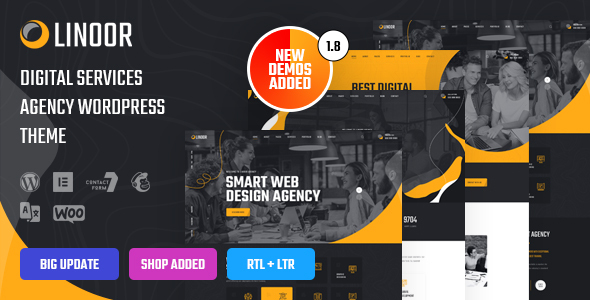
Linoor is a multipurpose WordPress theme built for digital agencies, marketing studios and consulting firms that need a polished website without commissioning custom development. It ships with 18 prebuilt home page variations, more than 40 inner page templates and one-click demo import, so a complete agency site can be assembled in hours rather than weeks. It is aimed at freelancers, small studios and corporate teams selling web design, SEO, advertising or consulting services.
Developed by Layerdrops and sold on ThemeForest for $49, Linoor Business has accumulated 976 sales since its January 2021 release, with the most recent update landing in December 2023. That sales figure puts it in the established tier of agency themes rather than the experimental fringe, and the changelog shows a steady cadence of additions rather than a single launch followed by silence.
What the theme actually gives an agency site
The headline number is 18 home page layouts. That matters less as a menu of choices and more as a shortcut: a design agency, an SEO consultancy and a corporate advisory firm can each start from a layout that already reflects how their sector presents itself, rather than restyling a generic template from scratch. The vendor’s changelog shows these were added over time, with corporate, SEO, consulting, photography and designer-profile variants arriving in later releases.
Alongside the home pages sit over 40 inner templates covering the pages an agency site typically needs: services, team, testimonials, pricing, portfolio listings and single portfolio items, a blog with multiple layout options, an events page, a partners page, a process page and an under-construction page. For a studio that has to produce a credible multi-page site on a fixed budget, having those layouts pre-built removes most of the layout decision-making.
Customisation runs through the WordPress Live Customizer rather than a separate proprietary panel. Colour options are effectively unlimited via a backend colour picker, typography settings were added in version 1.6, and header and footer styles have multiplied across releases — the changelog counts multiple header and footer variants added at different points. A child theme is included, which is the correct approach for anyone planning code-level changes without losing them on update.
Three technical details are worth flagging. First, WooCommerce compatibility arrived in version 1.5, so the theme can run a small product or merchandise store alongside the agency content — useful for studios selling digital downloads or templates. Second, RTL (right-to-left) support was added in version 1.5.1, which matters for agencies serving Arabic or Hebrew-speaking markets. Third, the theme is built on Bootstrap 4 and includes a megamenu, CSS3 animations and Elementor widget markup overrides, meaning it plays reasonably well with the Elementor page builder rather than fighting it.
The vendor also states the code is SEO-oriented, W3C validated and cross-browser tested, and that all files are commented. Those are self-reported claims rather than independently verified ones, but they describe the right priorities for an agency theme.
Where Linoor fits and where it does not
The strongest fit is a small to mid-sized agency that needs a complete marketing site live quickly and does not have a designer on staff. A two-person SEO consultancy, a freelance web designer building a portfolio-plus-services site, or a corporate consulting firm that needs a credible presence with a team page, case studies and a blog will all find the template count does the heavy lifting.
It also suits agencies building client sites on a repeatable basis. The demo import and child theme combination means a studio can spin up a new client project from a known baseline, then customise colours, typography and layout without rebuilding structure each time.
Where it is the wrong choice: agencies whose brand depends on a genuinely bespoke visual identity. Eighteen home pages is a lot, but they are variations within a recognisable commercial theme aesthetic. A studio selling high-end design work to enterprise clients will likely find the layouts too conventional, and the effort of pushing one into something distinctive may exceed the effort of building from a lighter starter theme. The same applies to anyone needing complex custom functionality — booking systems, membership logic, multi-vendor marketplaces — which a theme of this type does not provide and should not be expected to.
One further caveat: the last vendor update was December 2023. That is not alarming for a template, but buyers should check current WordPress compatibility before purchase, since major WordPress releases since then may not have been explicitly tested.
Strengths and limitations
Strengths
- Breadth of prebuilt layouts — 18 home pages and 40+ inner pages cover most agency content needs without custom design work.
- One-click demo import with a child theme included, which shortens setup and protects customisations through updates.
- WooCommerce and RTL support extend the addressable use cases beyond a plain brochure site.
- Customiser-based editing with typography and unlimited colour controls keeps day-to-day changes out of code.
- An established sales record of 976 purchases and a changelog spanning roughly three years of iterative additions.
Limitations
- The last update was December 2023, so buyers should verify compatibility with current WordPress and PHP versions rather than assuming it.
- No rating or review data was supplied with the listing, so there is no independent signal on buyer satisfaction to weigh against the sales count.
- Bootstrap 4 is now a generation behind current front-end practice; sites built on it will not match the markup conventions of newer themes.
- The volume of templates works against coherence — with 18 home pages and dozens of inner layouts, selecting and trimming down to a consistent design system takes deliberate effort.
- Performance figures are not published by the vendor, and a theme with this many demo assets and CSS animations should be tested on the target host before committing.
How it compares to the wider agency theme category
Agency themes on ThemeForest generally compete on three axes: number of prebuilt demos, page builder integration, and how much is editable without touching code. Linoor competes strongly on the first — 18 home pages is at the higher end of what this category offers — and adequately on the other two, with Live Customizer controls, typography options and an Elementor override system rather than deep native Elementor integration.
The main alternative approach is a lightweight starter theme paired with a page builder, which gives more design freedom but requires building every layout. That route suits studios with design capacity and a clear visual direction. Linoor’s value proposition is the opposite: less freedom, far less time to launch. A third option is a dedicated niche theme — SEO-specific, or consulting-specific — which typically offers fewer layouts but tighter alignment with one industry. Linoor trades that focus for range.
Against all three, the deciding factor is usually whether the buyer has design resources in-house. Teams without them get more from a theme like this; teams with them often find the templates a constraint.
Frequently Asked Questions
Does Linoor require Elementor or another page builder?
No. Linoor works with the native WordPress Live Customizer and does not depend on Elementor to function. The theme does include an Elementor widget markup override system, so if Elementor is already part of the workflow it integrates rather than conflicts. Buyers who prefer a different builder should confirm compatibility with the vendor before purchase.
Can Linoor be used to build client websites?
Yes, and that is one of its more practical uses. The included child theme and one-click demo import make it straightforward to spin up a new client project from a consistent baseline, then adjust colours, typography and layout per brand. Standard ThemeForest licensing terms apply, so each client site typically needs its own licence.
Is Linoor compatible with WooCommerce?
Yes. WooCommerce compatibility was added in version 1.5 and the changelog records a fix for an outdated WooCommerce template in version 1.8.2. This allows a small store — digital downloads, merchandise or paid services — alongside the main agency content. It is not a purpose-built ecommerce theme, so complex store requirements may need additional plugins.
What support and documentation come with the theme?
The vendor provides documentation and a support centre, and the listing states quick support is included. Support is handled by the developer, Layerdrops, through the ThemeForest item page rather than a third party. Response times are not published, so buyers with tight deadlines should factor that uncertainty in rather than assume immediate turnaround.
Verdict
Linoor is a sensible purchase for freelancers, small agencies and consulting firms that need a complete, credible multi-page website live quickly and do not have a designer on the team. The 18 home pages, 40-plus inner templates, WooCommerce and RTL support, and included child theme cover the practical requirements of most service-business sites at a $49 price point.
It is a poor fit for studios selling design expertise as their core product, for anyone who needs bespoke functionality, and for projects where a distinctive visual identity outweighs speed of launch. Those buyers will get further from a lighter starter theme and a page builder.
The one thing every prospective buyer should do is confirm current WordPress and PHP compatibility, given the December 2023 update date. If that checks out against the intended hosting environment, Linoor delivers a lot of structure for the money.