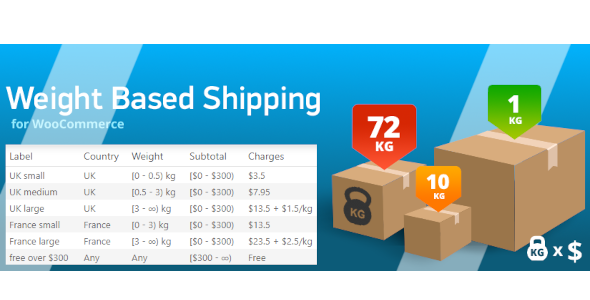
WooCommerce Weight Based Shipping is a shipping method plugin for WooCommerce that calculates delivery charges from the weight of a customer’s cart, with additional rules for country, subtotal and shipping class. It replaces WooCommerce’s single flat rate field with a table of rules, so a store can charge one price for a light domestic parcel and a different price for a heavy international one. It suits store owners and agencies running physical-goods shops where postage cost scales with what is in the box, and it is sold on CodeCanyon for $35 by developer dangoodman.
How the rule engine turns cart weight into a shipping quote
The plugin adds a configurable shipping method to WooCommerce’s shipping zone settings. Instead of one price, each method holds a table of rules. A rule pairs a set of conditions with a price formula, and the plugin walks the table when the cart is calculated, returning the first matching rate. That structure is the core of the product, and most of its other features are variations on how a single rule can be written.
Conditions that decide which rule applies
Each rule can be limited by destination country, by a weight range, and by a cart subtotal range. The ranges are the useful part: a store can define bands such as 0–500g, 500g–2kg and 2kg and above, then give each band its own price. Because country is a condition, the same weight band can carry different prices for domestic and international destinations without duplicating the whole method. The vendor’s demo site shows the rule editor in full, which is worth opening before purchase since the interface is where most of the product’s value sits.
Constant prices, per-unit prices, or both
A rule’s price can be a fixed amount, which behaves exactly like WooCommerce’s built-in flat rate. It can also be progressive: a base charge plus a rate applied to the cart weight. Both can be combined in one rule, so a store might charge a handling fee plus a per-kilogram rate. This is the difference between a flat rate and a genuine table rate, and it is the feature most buyers are actually paying for.
Weight steps for simplified pricing
A weight step, labelled “per each” in the rule settings, rounds the cart weight up to a fixed increment before the price is calculated. A store that prices postage in 500g blocks can set the step to 500g and the plugin will treat a 620g cart as 1kg for pricing purposes. This avoids writing dozens of narrow weight bands and keeps the rule table readable. The vendor’s changelog records an earlier fix for a case where a small order weight combined with a large step produced a zero price, so the interaction between weight and step is worth testing on a staging site with a deliberately light product.
Shipping classes and overrides
WooCommerce lets merchants group products into shipping classes — bulky items, fragile goods, items that ship free. This plugin can override the calculation for any class inside a rule, so a heavy but small item and a light but oversized item do not have to share a pricing formula. Since version 5.2.0, multiple rates entered for the same class in one rule all apply rather than the last one winning, which matters for stores that stack a per-class surcharge on top of a base rate.
Free shipping triggered by conditions
Free shipping can be switched on for a rule when a threshold is met, whether that threshold is measured in subtotal, total weight, or another condition the rule exposes. A common pattern is free delivery above a spend level but only within one country, which the country condition handles. This is a marketing lever as much as a logistics one, and it is the reason many stores install a table rate plugin in the first place.
Where this plugin fits, and where it does not
The strongest fit is a physical-goods store with a modest but real range of product weights selling into two or three countries. A coffee roaster, a bookseller, a supplements brand or a small parts supplier all face the same problem: WooCommerce’s flat rate either overcharges light orders or loses money on heavy ones. A rule table with three or four weight bands per zone solves it in an afternoon.
Agencies building client stores will find the shipping class overrides particularly useful, because they let one shipping method serve a catalogue with genuinely different product types rather than forcing a separate zone per product family. Freelancers migrating a store from a platform that already had table rate shipping will recognise the rule model quickly.
The plugin is a poor fit where postage is calculated by dimensional weight rather than actual weight — the vendor does not claim volumetric or box-packing calculation, and stores shipping large lightweight items usually need a different class of tool. It is also the wrong choice for a store that only ever needs one flat rate per zone, where WooCommerce’s built-in flat rate is free and sufficient, and for stores whose rates come from a live carrier API with negotiated pricing, which is a separate category of plugin entirely.
Strengths and limitations
Strengths
- The rule model is genuinely flexible: country, weight range and subtotal can be combined in a single rule, which covers most real-world postage logic without custom code.
- Constant and progressive pricing coexist, so handling fees and per-kilogram rates can live in the same rule.
- Shipping class overrides let one method serve a mixed catalogue instead of splitting products across zones.
- Weight steps keep rule tables short and readable for stores that price in fixed increments.
- It has a real track record: 1,890 sales and a 4.54 out of 5 average across 48 reviews on CodeCanyon, which is a meaningful sample for a niche shipping plugin.
- Source files are included (JavaScript, HTML, CSS and PHP), so an agency can audit or extend the code rather than treating the plugin as a black box.
Limitations
- The most recent update recorded by the vendor is dated 1 December 2022, with the changelog then showing testing against WooCommerce 7.1 and WordPress 6.1. Buyers running current WordPress and WooCommerce releases should confirm compatibility themselves rather than assume it, and should check the CodeCanyon comments for reports from recent buyers.
- Pricing is weight-driven. Stores that need volumetric (dimensional) weight, multi-box packing or live carrier rates will not find those here.
- The interface is a settings table inside the WooCommerce admin rather than a visual rule builder, so a store with many countries and many weight bands will accumulate a long list that is easy to misconfigure.
- Rules are evaluated in order and the first match wins, which means a broad rule placed above a narrow one will silently shadow it. There is no warning for that scenario.
- At $35 for a single site licence on a marketplace, there is no annual support subscription model — buyers get the item support window CodeCanyon provides, not an ongoing vendor relationship.
How it compares with the wider table rate category
Shipping plugins for WooCommerce fall into three rough groups: flat rate replacements, table rate calculators, and carrier integrations. This product sits firmly in the middle group, and a fairly pure example of it — weight is the primary axis, with country and subtotal as secondary conditions. That makes it more capable than a flat rate method and less capable than tools that price by volume, by number of boxes, or by a live quote from a courier.
Against other table rate plugins, the differentiator is simplicity of scope rather than breadth. Stores that need per-product shipping costs, dimensional weight or multi-vendor splits will find richer (and more expensive) options. Stores that need weight bands per country get a lighter, cheaper tool that does the one job without a settings screen full of unused features. The $35 price point is at the low end for this category, which is consistent with that narrower scope.
The other comparison worth making is against doing nothing. WooCommerce’s flat rate is free, and for a store with uniform product weights it is the correct answer. The plugin earns its price only when weight actually varies enough that a single rate misprices a meaningful share of orders.
Frequently Asked Questions
What does WooCommerce Weight Based Shipping actually do?
It replaces WooCommerce’s single flat rate with a table of shipping rules priced mainly by cart weight. Each rule can also be limited by destination country, cart subtotal and shipping class, and can apply a fixed charge, a per-weight charge, or both. The plugin returns the first rule that matches the cart at checkout.
Is it compatible with the current version of WooCommerce?
The vendor’s last recorded update was December 2022, tested against WooCommerce 7.1 and WordPress 6.1. Compatibility with later releases is not stated in the listing. Buyers on recent WooCommerce versions should test on a staging site and check the item’s comment thread for reports from other users before relying on it in production.
Can it charge different shipping rates for different countries?
Yes. Country is one of the conditions available on each rule, so the same store can define separate weight bands and prices for each destination it ships to. A domestic rule and an international rule can sit side by side in the same shipping method without duplicating the entire configuration.
Does it support free shipping over a certain order value?
Yes. A rule can be configured to return a zero price when a condition such as a subtotal threshold or a total weight threshold is met. Because country is also a condition, free shipping can be restricted to specific destinations, which is useful when a spend threshold only makes commercial sense domestically.
Verdict
Buy this plugin if the store ships physical goods whose weight varies enough that a flat rate either overcharges small orders or loses money on large ones, and if the pricing logic fits into weight bands, countries, subtotals and shipping classes. It is a sensible purchase for freelancers and agencies who want a focused, inexpensive table rate method with source files included and a solid review record behind it.
Do not buy it if postage depends on dimensional weight, live carrier quotes or multi-box packing, or if the store only needs one rate per zone. Anyone running a current WordPress and WooCommerce stack should also verify compatibility first, given how long it has been since the vendor’s last recorded update.