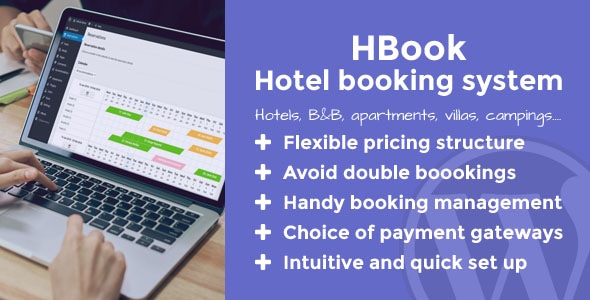
HBook is a WordPress plugin that adds an online reservation system to an existing website. It is built for accommodation providers — hotels, bed and breakfasts, guesthouses, holiday apartments and campsites — who want guests to check availability and book directly rather than through a third-party platform. The plugin centres on HBook Calendars, the availability views that sit on public pages next to rate tables and booking forms.
The product is sold on CodeCanyon for $129 and is developed by Maestrel. It has accumulated 11,584 sales and holds a 4.88 out of 5 rating across 520 reviews, which places it among the more established booking extensions in the marketplace. The vendor last updated the item in August 2026.
What the plugin actually does
The core of HBook is a reservation engine that runs inside WordPress. Rather than sending visitors to an external booking portal, it keeps the whole transaction on the owner’s own domain, which matters for both branding and for keeping customer data in one place.
Availability calendars
HBook Calendars are the public-facing views that show which dates are free and which are taken. They can be embedded into posts and pages, and because the plugin is Gutenberg optimised, they can be placed with the block editor rather than through shortcode guesswork. The calendar reads from the same database that the booking form writes to, so availability updates as reservations come in rather than being maintained by hand.
Rate tables and seasonal pricing
Accommodation pricing is rarely a single flat number, and HBook handles that through rate tables. These let an owner define different prices for different periods — high season, low season, weekend rates, minimum-stay rules — and display them in a structured table alongside the calendar. For a small property with two or three room types this is the difference between quoting prices manually by email and letting the website answer the question instantly.
Booking forms and reservation handling
The booking form collects guest details, dates and accommodation selection, then records the reservation in the WordPress dashboard. That gives the site owner a single administrative screen for incoming bookings instead of a shared inbox. Because the plugin is self-hosted, there is no per-booking commission and no dependency on a third-party service staying online.
Technical and presentation details
HBook ships with the source files for its JavaScript, HTML, CSS and PHP, so a developer can restyle the front-end output to match a theme rather than fighting the default markup. The plugin declares compatibility with WordPress versions from 4.9 through 7.0, which is an unusually wide range and useful for sites that have not been updated recently. It is also listed as compatible with Cornerstone, the page builder used by the X and Pro themes. Browser support extends back to Internet Explorer 9, though that is unlikely to matter to anyone building a site today. High-resolution graphics are included for retina displays.
Where HBook fits, and where it does not
The clearest fit is an independent property with a modest number of rooms or units — a family-run hotel, a bed and breakfast with a handful of guest rooms, a single holiday let, or a campsite with pitches to allocate. These are businesses where the owner manages bookings personally and where paying commission on every reservation is a real cost. A WordPress site already in place plus a $129 one-off licence is a straightforward proposition against an ongoing percentage fee.
It also suits agencies and freelancers building sites for hospitality clients. The included source files mean the front-end can be themed to match a client’s brand, and the wide WordPress version support reduces the risk of a compatibility problem on an older install.
Where HBook is the wrong choice is at scale. A large hotel with hundreds of rooms, multiple rate plans, channel manager integrations, group bookings and complex cancellation policies needs a dedicated property management system, not a WordPress plugin. Inventory that has to stay synchronised across Booking.com, Expedia and the property’s own site in real time is a specific problem that general-purpose booking plugins are not built to solve. Anyone whose main requirement is two-way channel synchronisation should look at platforms designed around that, because HBook does not claim to provide it.
A second poor fit is a business with no WordPress site and no intention of running one. HBook is a plugin, not a standalone application, so it is only useful inside an existing WordPress installation.
Strengths and limitations
Strengths
- No commission model. Bookings are taken on the owner’s own site, so the full room rate stays with the business.
- Calendars, rate tables and booking forms are handled by one plugin rather than three separate tools that need to be stitched together.
- Source files for JavaScript, HTML, CSS and PHP are included, giving developers real control over presentation.
- Declared compatibility spans WordPress 4.9 to 7.0, which is broader than most items in this category.
- Gutenberg optimised, so calendars and forms can be placed with the block editor.
- The sales volume and 4.88 rating across 520 reviews indicate a large installed base and a track record of updates.
Limitations
- The vendor listing does not state any channel manager or OTA (online travel agency) synchronisation. Availability entered in HBook is not automatically reflected on Booking.com or similar platforms, so a property listing on multiple channels risks double bookings unless availability is managed manually.
- Payment handling is not described in the supplied product data. Whether deposits can be collected online, and through which gateways, is not stated by the vendor and should be confirmed before purchase.
- There is no mention of multi-currency or multi-language support. Properties serving international guests may need additional tooling.
- Browser support extends to Internet Explorer 9, which suggests parts of the codebase are old. That is not a functional problem, but it is a signal that the front-end may not follow the most current web standards.
- Pricing is a one-time $129 with no stated ongoing support or update terms in the supplied data. Buyers should check the vendor’s support policy directly.
How HBook compares with the wider category
WordPress booking tools generally fall into three groups. The first is broad appointment and service booking plugins, which handle salons, clinics and consultants. These are flexible about time slots but weak on the things accommodation needs: room types, occupancy limits, minimum stays and seasonal rates. HBook sits outside that group because it is built specifically around nightly stays.
The second group is SaaS booking engines that connect to a WordPress site through an embed or widget. These usually offer stronger channel management and payment infrastructure, but they charge monthly or take a commission, and the booking flow leaves the owner’s domain. HBook trades that infrastructure for ownership and a flat cost.
The third group is full property management systems with a WordPress front end. These are more capable and considerably more expensive, and they are aimed at larger properties with staff who will use the back office daily.
HBook’s position is in the middle: more accommodation-specific than a generic booking plugin, cheaper and more self-contained than a SaaS engine, and simpler than a full PMS. The trade-off is that anything requiring live synchronisation with external channels sits outside its scope.
Frequently Asked Questions
Does HBook work with any WordPress theme?
It should work with most themes, since it is a standard plugin rather than a theme-dependent add-on, and it is declared compatible with the Cornerstone page builder. Because the source CSS is included, any styling conflicts with a theme can be resolved directly. The vendor provides a live demo where the default appearance can be checked before buying.
Can HBook take payments online?
The supplied product data does not state which payment gateways are supported, or whether online payment is handled at all. That information is not declared by the vendor in the listing. Anyone who needs to collect deposits or full payment at the time of booking should confirm gateway support with Maestrel before purchasing.
Does it sync availability with Booking.com or Airbnb?
No channel synchronisation is claimed in the product data. HBook manages availability within the WordPress installation itself, so a property that also lists on external platforms would need to update those calendars separately. For properties taking most bookings direct, that is manageable; for those relying heavily on OTAs, it is a significant limitation.
Is HBook suitable for a large hotel?
Probably not. HBook is aimed at small and independent properties — hotels with a limited room count, B&Bs, holiday apartments and campsites — where the owner manages reservations directly. A large hotel with hundreds of rooms, group bookings, multiple rate plans and channel manager requirements needs a dedicated property management system rather than a WordPress plugin.
Verdict
HBook is a sensible purchase for an independent accommodation business that already runs WordPress and wants to take bookings directly without paying commission on every reservation. The combination of availability calendars, rate tables and booking forms in one plugin, backed by a large sales history and a 4.88 rating, makes it a low-risk choice for that specific use case. It is also a reasonable option for freelancers and agencies building hospitality sites, particularly given the included source files. It is not the right product for a large hotel needing channel manager integration, nor for anyone who has not confirmed that the payment and synchronisation features they require are actually present. Buyers in those situations should verify the specifics with the developer before spending $129.