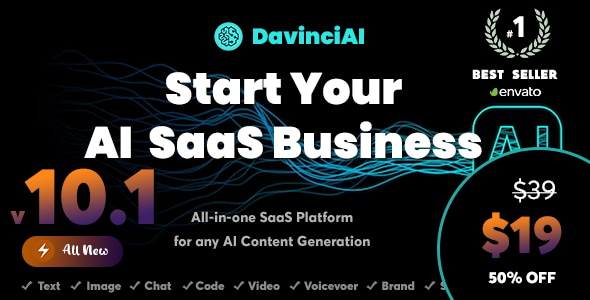
Davinci AI is a self-hosted SaaS platform built with Laravel that lets an operator run their own subscription business around AI generation tools. It bundles text, image, audio, video and chatbot generation into a single dashboard, with billing, credit systems and user management included, so a buyer can launch a branded AI service without assembling separate scripts. It is aimed at developers, agencies and entrepreneurs who want to sell AI access under their own domain rather than reselling someone else’s API. The Davinci AI PHP Scripts package sells on CodeCanyon for $19.00 and has accumulated 4,394 sales at a 4.8 out of 5 rating across 342 reviews, which places it among the more widely adopted items in this category.
What the platform actually lets an operator build
The core of the product is a multi-model generation engine. Rather than locking into one provider, the script connects to a long list of large language models — OpenAI’s GPT family, Anthropic’s Claude line, Google Gemini, xAI’s Grok, Meta’s Llama variants through third parties, DeepSeek, Amazon Nova and Perplexity’s Sonar models among them. For a site owner, that breadth matters because model pricing and capability shift quickly; swapping a default model is a configuration change rather than a rewrite. The vendor also ships a custom model system, so an operator can register endpoints the platform does not include by default.
Beyond chat and text completion, the generation surface covers several distinct output types:
- Images — generation through OpenAI’s image models, Stable Diffusion, Flux and Midjourney-style integrations, plus a photo studio and product photo tool for commercial-style shots.
- Audio — text to speech, voice cloning, speech to text transcription, a sound studio and a voice isolator for cleaning up recordings.
- Video — text to video and image to video through providers such as Google Veo and Kling, along with avatar and video-to-video extensions.
- Chatbots — embeddable assistants that can be trained on documents, PDFs and URLs, with connectors for Telegram, WhatsApp, Slack, Instagram and Messenger.
The business layer is where most of the engineering effort sits. There is a wallet and credit system with configurable calculation rules, subscription handling that can start at registration, gift cards, dynamic pricing, and multiple payment gateways including Stripe, Paddle, MercadoPago and cryptocurrency options. An admin dashboard provides analytics and finance reporting, while a separate user dashboard gives subscribers their own workspace. A REST API and a WordPress integration extension let the generation features be pushed into other properties.
Administrative control extends to branding and localisation: a frontend page creator, theme switching, a menu builder, language manager and RTL support for right-to-left scripts. The vendor states support for more than 53 languages in the generation layer, and the interface itself can be translated.
Where this fits, and where it does not
The strongest fit is an operator who already understands hosting and wants a revenue-generating AI product live quickly. A freelance developer building a client portal, an agency adding an AI tool to its service menu, or a marketer launching a niche tool around one workflow — resume writing, ad copy, product photography — can all use the same base. Because the script is self-hosted, the operator owns the customer relationship, the pricing and the data, which is the main reason people choose this model over an API reseller arrangement.
A second fit is the agency that wants to white-label. Theme options, a page builder and menu controls mean the front end does not have to look like the demo, and the dashboard themes can be swapped for a different internal feel.
Where it is the wrong choice: anyone expecting a zero-maintenance business. This is a Laravel application that needs PHP 8.x and MySQL 5.x, a server capable of handling queue workers for long-running generation jobs, and ongoing attention to API keys, provider quotas and model deprecations. A solo operator with no server experience and no appetite to learn will find that the $19.00 purchase price is the smallest cost in the project. It is also a poor fit for someone who wants a single, tightly scoped tool — a standalone image generator script would be simpler to run and cheaper to host.
Strengths and limitations
Strengths
- Model coverage is unusually wide for a single script, spanning text, image, audio and video providers rather than one vendor’s stack.
- The commercial infrastructure — credits, wallets, subscriptions, gift cards, multiple gateways — is included rather than sold as a separate add-on.
- Extensions cover the delivery channels buyers actually ask for: chatbots on messaging platforms, WordPress embedding, and marketing integrations such as Mailchimp and HubSpot.
- Source files are supplied in full, including PHP, JavaScript, HTML, CSS, Sass and SQL, so the codebase can be modified rather than only configured.
- The update history is long and the item has been maintained consistently, which reduces the risk of buying into an abandoned codebase.
Limitations
- The extension model is uneven. Many of the more attractive capabilities — AI Photoshoot, AI Music Pro, AI Presentations, several chatbot connectors — are paid add-ons, so the effective cost of a fully featured deployment is well above the headline price. The vendor does not publish a single bundled price for everything.
- Feature density creates configuration overhead. With this many models, gateways and extensions, the initial setup and the ongoing decisions about which providers to enable are a real project task, not a checkbox.
- Running costs sit entirely with the buyer. API calls to OpenAI, Anthropic, Google or video providers are billed by those services, and video generation in particular can consume credits quickly. Nothing in the script changes that economics.
- Because the platform depends on third-party model APIs, any provider deprecating a model or changing terms creates maintenance work for the operator, regardless of how active the developer is.
- Documentation depth is not something the listing quantifies, and buyers evaluating a script with this many moving parts should check the demo and support channels before committing to a production launch.
How it compares with the wider category
Scripts in this space generally fall into three groups. The first is single-purpose generators — one text tool or one image tool — which are cheap to run and easy to launch but offer no subscription infrastructure. The second is API reseller wrappers, where the buyer effectively rents someone else’s platform and has limited control over pricing or data. Davinci AI sits in the third group: full self-hosted SaaS kits that include the billing, user management and admin tooling needed to run an actual business.
Against the single-purpose tools, the trade-off is complexity for capability. Against reseller arrangements, the trade-off is responsibility for infrastructure in exchange for ownership. Within its own group, the distinguishing factors are the breadth of model support and the volume of extensions, which is also the source of its main weakness — the paid add-on structure means the total investment is a moving target. Buyers comparing options should price out the specific extensions they need rather than comparing headline figures alone.
Frequently Asked Questions
Do I need coding skills to run Davinci AI?
Basic server skills are enough for installation, but ongoing operation benefits from developer familiarity. The script requires PHP 8.x and MySQL 5.x on a Laravel-capable host, and tasks such as configuring queue workers, managing API keys and applying updates are easier with command-line comfort. Non-technical buyers typically hire help for setup and maintenance.
Which AI models does the platform support?
It supports a broad range, including OpenAI’s GPT and image models, Anthropic’s Claude line, Google Gemini and Veo, xAI’s Grok, DeepSeek, Amazon Nova, Perplexity Sonar and Stable Diffusion. A custom model system allows additional endpoints to be registered. The vendor updates the list frequently, so the exact roster changes between releases.
Are the paid extensions required to use the platform?
No. The core platform generates text, images, audio and video without them. The paid extensions add specific capabilities such as AI Photoshoot, AI Music Pro, AI Presentations and several chatbot channel connectors. Buyers should budget for the extensions their particular use case depends on, since they are priced separately.
Can the platform be white-labelled for client work?
Yes. The frontend page creator, theme options and menu builder allow the public-facing site to be rebranded, and the admin and user dashboards can use alternative themes. Language management and RTL support make localisation practical. Full source files are included, so deeper customisation of the interface is possible for teams with development resources.
Verdict
Davinci AI is a strong buy for developers, agencies and technically confident founders who want to launch a self-hosted AI subscription business and are prepared to manage a server, pay for third-party API usage and budget for the extensions they need. The breadth of model support and the completeness of the billing and admin layer make it a serious foundation rather than a demo. It is a poor buy for anyone without server experience who expects a turnkey business, and for operators who only need one narrow generation tool. The 4,394 sales and 4.8 rating indicate a large, generally satisfied user base, but the true cost of ownership depends heavily on which paid extensions a project requires.