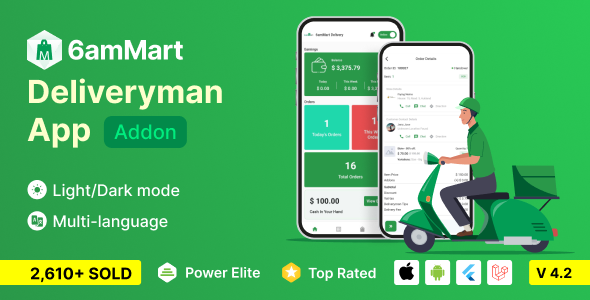
6amMart – Delivery Man App is the courier-facing module of the 6amMart multi-vendor delivery system, a Flutter application that lets drivers go online, accept nearby orders, track their earnings and review past deliveries. It is built by sixamtech and sold on CodeCanyon for $39, and it only makes sense to a buyer who already runs, or intends to run, the parent 6amMart platform. The listing carries 2,612 sales and a 4.77 out of 5 rating across 82 reviews, which places it among the better-established 6amMart Flutter add-ons rather than an unproven experiment.
What the driver app actually does
The app is a companion, not a standalone product. Every function inside it depends on order data flowing from the 6amMart backend, so the useful question is not “what does this app contain” but “what does a delivery worker gain from carrying it.”
The core loop is deliberately narrow. A driver toggles an online or offline status, which tells the dispatch side whether they are available for work. Once online, the app surfaces orders near the driver’s position so they can pick one up rather than waiting for an assignment. That distinction matters operationally: it gives couriers a degree of control over which jobs they take, and it gives the platform a self-balancing mechanism when demand is uneven across a city.
Beyond accepting work, the app handles the record-keeping that delivery staff usually chase manually. Drivers can see a full order history and, for freelance couriers specifically, an earnings balance. That freelance earnings view is the detail worth flagging — it implies the module distinguishes between salaried and commission-based drivers, which affects how a business structures its payouts.
Notifications arrive in real time, so status changes, new order availability and delivery updates reach the driver without a manual refresh. The vendor also notes that admins, stores and customers can see a driver’s movement through the same system, which turns the app into a tracking source for the other three sides of the marketplace.
Technically, the build targets Flutter 3.x and ships with Dart and YAML source plus Kotlin and Swift platform files. In plain terms, that means the buyer receives the full mobile project for both Android and iOS, written in a cross-platform framework, and can compile it in a standard Flutter environment. Anyone planning to rebrand the app will need a working Flutter setup and enough familiarity with the framework to change package names, icons and configuration files.
Where it fits and where it does not
The obvious fit is an operator already running 6amMart as a multi-vendor marketplace — groceries, food, pharmacy, general retail — who needs the courier leg of the workflow covered by a native app rather than a web panel or phone calls. Adding this module completes the chain: customer app places the order, store app fulfils it, admin panel oversees it, driver app delivers it.
A second fit is a delivery-focused business that wants the 6amMart stack as a starting point and treats the courier experience as the priority. Because the driver app is the part customers physically interact with at the doorstep, it carries a disproportionate share of the brand impression, and a polished courier app is often the difference between a marketplace that feels finished and one that feels half-built.
Agencies building on behalf of clients are a third fit. The source files being included means a development team can restyle the app, adjust the order-acceptance radius logic, or wire in additional notification channels without starting from an empty Flutter project.
The wrong choice is equally clear. Anyone without the parent 6amMart system installed gets nothing usable here — this is not a general-purpose courier app that can be pointed at an arbitrary backend, and there is no indication the vendor supports connecting it to a different platform. A single-restaurant or single-store business with its own in-house delivery staff and no marketplace ambitions would be paying for infrastructure it will never use. Buyers who need a ready-made, fully customised app delivered as a finished branded product should also look elsewhere; this is source code and a working module, not a managed service.
Strengths and limitations
Strengths
- Complete source delivery. Dart, YAML, Kotlin and Swift files are included, so the app can be modified and recompiled rather than only configured.
- Established track record. More than 2,600 sales and a 4.77 rating across 82 reviews give a reasonable signal that the module works as described for most buyers.
- Consistent Flutter 3.x baseline. Building on a current Flutter release keeps the codebase in line with a widely used, actively maintained framework.
- Two-sided visibility. Driver location is exposed to admin, stores and customers, which removes the need for a separate tracking integration.
- Freelance earnings handling. Commission-based drivers can see their balance in-app, a detail many courier modules skip.
- Low entry price. At $39 the module is inexpensive relative to the cost of building equivalent courier functionality from scratch.
Limitations
- Hard dependency on 6amMart. The app is useless without the parent system. There is no documented path to run it against a different backend.
- Thin public documentation. The vendor listing does not state supported Flutter versions beyond 3.x, minimum SDK requirements, or the exact backend API contract, so integration questions have to go through support.
- Demo data resets. The vendor notes that the demo database resets every three hours, which makes evaluating multi-day order flows awkward. Buyers testing the live demo should expect to recreate their delivery man credentials from the admin panel.
- Customisation requires real Flutter skills. Source access is only an advantage if the buyer or their developer can work in Dart. Non-technical owners will need to budget for a contractor.
- No stated offline handling or route optimisation. The listing describes order acceptance and tracking but says nothing about navigation, multi-stop batching or behaviour on a weak connection — features common in dedicated courier apps.
How it compares to the wider category
Courier apps sold on marketplaces generally fall into three groups. The first is standalone delivery apps that connect to a generic backend or a custom API; these offer flexibility but require integration work and often carry a higher price. The second is all-in-one delivery platforms where the courier app is one component of a larger suite sold under a single licence; these reduce integration risk but lock the buyer into one vendor’s ecosystem.
6amMart – Delivery Man App sits firmly in the second group, and within that group it competes on completeness rather than on flexibility. Compared with standalone courier apps, it offers less freedom — the backend is fixed — but far less setup friction, because the order, store and customer sides already speak the same data model. Compared with other modular marketplace suites, the distinguishing factors are the Flutter codebase and the fact that source files ship with the purchase, which is not universal at this price point.
The trade-off is the classic one for ecosystem modules: the buyer accepts a narrower set of integration options in exchange for a shorter path to a working, four-sided delivery operation. For someone already inside the 6amMart ecosystem the calculation is straightforward. For anyone outside it, the module should be evaluated as part of the full platform cost, not on its own.
Frequently Asked Questions
Can the 6amMart Delivery Man App be used without the main 6amMart system?
No. The app is a module of the 6amMart multi-vendor delivery platform and depends on that backend for orders, accounts and tracking data. The vendor does not describe any way to connect it to a different system. Buyers must already own or plan to purchase the parent 6amMart product before this module has any value.
What programming skills are needed to customise this Flutter app?
Working knowledge of Flutter and Dart is required, since the package contains Dart, YAML, Kotlin and Swift source files that must be edited and recompiled. Rebranding — icons, app name, colours, package identifiers — is within reach for a competent Flutter developer. Non-technical buyers should plan to hire one, as the vendor offers no drag-and-drop customisation layer.
Does the delivery man app track driver location in real time?
Yes. The vendor states that admins, stores and customers can view a delivery man’s movement through the app, and that notifications are delivered in real time. That makes the app the location source for the rest of the platform. The listing does not specify the polling interval or the mapping provider used, so exact accuracy and update frequency are not documented.
How do freelance delivery men get paid through the app?
The app shows an earnings balance for delivery men classified as freelance, alongside their order history. The listing does not describe the payout mechanism itself, so it is unclear whether funds are disbursed automatically, requested by the driver, or settled manually by the admin. Buyers should confirm the withdrawal workflow with the vendor before relying on it.
Verdict
Buy this if the 6amMart marketplace is already running or firmly planned, and the goal is to close the last gap in the delivery chain with a courier app that shares the platform’s data model. The sales volume, the 4.77 rating and the inclusion of full Flutter source make it a low-risk addition at $39 for anyone with developer access. Skip it if there is no 6amMart installation, if the delivery operation is single-store and in-house, or if the plan is to hand the app to a non-technical owner with no budget for a Flutter contractor. It is also the wrong purchase for teams that need route optimisation or offline-first navigation out of the box, since the vendor does not claim either. Treat this as a component purchase inside a larger system, not as a standalone product decision.
