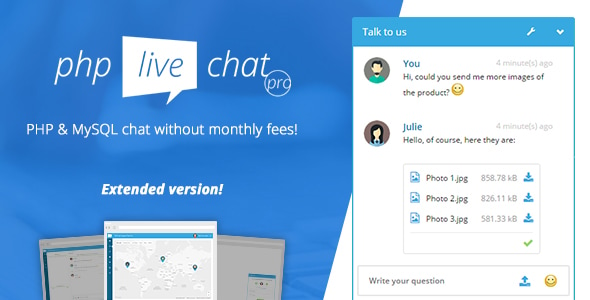
PHP Live Chat Pro is a self-hosted live chat script for websites, built on PHP and MySQL and sold on CodeCanyon for a one-time $59 licence. It places a chat widget on a site so visitors can talk to staff in real time, and it stores conversations, operator accounts and settings in the buyer’s own database rather than on a third-party server. It suits site owners who want live support without a recurring subscription and who are comfortable installing a PHP script on their own hosting.
The product is developed by mirrormx, an author with a long-running presence on CodeCanyon, and it has accumulated 2,414 sales and a 4.15 out of 5 rating across 116 reviews. Those numbers matter because they put the script in the small group of live chat packages that have survived several years of PHP releases without being abandoned — the most recent update, in April 2023, specifically addressed PHP 8 compatibility. For anyone comparing PHP Live Chat Pro Help & Support Tools against hosted chat services, the core trade-off is straightforward: no monthly fee, but the buyer owns the server, the updates and the maintenance.
What the script actually does once it is running
The central piece is the guest widget, a small block of JavaScript and CSS that is pasted into a site’s template. It can sit in the bottom-left or bottom-right corner of the viewport, or be placed inline inside page content, which is unusual for chat widgets and useful on contact pages where a floating bubble would overlap other elements. The widget is responsive, so it adapts to phone screens, and it can be configured to hide itself on specific pages through a display blacklist — handy for checkout flows or landing pages where a chat prompt distracts from the primary action.
Behind the widget sits an operator panel. Multiple staff members can be logged in at once, each with their own account, and conversations can be routed through departments so that sales enquiries and technical questions land with different people. Operators can see which page a guest is currently viewing, which turns a vague “can I help?” into a specific opening line. They can also start a conversation themselves rather than waiting for the visitor to type first, and they can switch their own status between online and offline so the widget reflects real availability.
Geolocation adds a visitor’s approximate location and language to the session, and the script can switch the widget language automatically based on that. Translation support is built in, with German, Italian and Russian added in 2018 alongside whatever the buyer supplies. Beyond plain text, the chat box accepts images and video, and file sharing lets either side send documents. A contact form fallback catches messages when no operator is online, and transcripts can be emailed after a conversation ends. Sound notifications — ten preset tones — plus desktop notifications keep operators aware of new messages when the panel is in a background tab. The administration area includes a filterable conversation history, so past chats can be searched by name, email or other criteria rather than scrolled through manually.
Where it fits, and where it does not
The strongest fit is a business running a content site, a service site or a small store on shared or VPS hosting with PHP and MySQL already available. WordPress, Joomla, Drupal and OpenCart installations all qualify, as does a hand-coded PHP site, because the widget is inserted as a snippet rather than through a plugin architecture. Agencies that deploy the same stack for several clients can install it repeatedly and hand over operator accounts without adding a per-seat cost, which is where the one-time licence model pays off most.
It is a poor choice for a team that wants a managed service. There is no vendor-hosted infrastructure, no automatic scaling and no support desk behind the purchase beyond the author’s own channels. Anyone unwilling to apply a script update manually, debug a server-side upload permission issue or migrate a database should look at a hosted chat product instead, where those problems belong to someone else. Similarly, a business that needs deep CRM integration, AI-assisted replies or omnichannel routing across email and social messaging will find this script’s scope narrower than those platforms.
Strengths and limitations
Strengths
- One-time purchase with no recurring subscription, which keeps the total cost predictable over a multi-year deployment.
- Data residency stays with the buyer: conversations live in the site’s own MySQL database rather than a vendor’s cloud.
- Broad host compatibility, including any PHP and MySQL back end, and stated support for browsers as old as Internet Explorer 9.
- Genuinely useful operator tooling — current-page visibility, departments, operator-initiated chats, geolocation and a filterable history — that covers the everyday needs of a support desk.
- Widget placement flexibility, including inline mode and a page-level blacklist, which is more control than many hosted widgets offer.
- A visible maintenance record, with the April 2023 release fixing PHP 8 issues rather than leaving the script stranded on older runtimes.
Limitations
- The stated server requirement is MySQL 5.x. Modern hosting increasingly defaults to MySQL 8 or MariaDB 10.x, and the vendor does not state tested compatibility with those versions, so buyers should confirm with their host before purchasing.
- The rating sits at 4.15 out of 5, which is respectable but not outstanding; the gap from a perfect score reflects a product with rough edges rather than a polished commercial platform.
- Installation and upgrades are manual. There is no one-click updater, and the vendor points buyers to a separate FAQ page for update instructions, which implies the process is not trivial.
- Support is limited to the author’s CodeCanyon channels. There is no guaranteed response window, and the vendor does not publish a support policy.
- There is no native mobile app for operators. A mobile application and QR code section was referenced in a 2017 changelog, but the vendor does not describe a first-party operator app in the current listing.
- Feature development has slowed. The changelog shows dense activity through 2017 and 2018, then a single compatibility release in 2023, so buyers should not expect a rapid roadmap.
How it compares with the wider category
Live chat tools divide into two camps: hosted SaaS platforms and self-hosted scripts. Hosted services charge monthly per operator or per conversation, and in exchange they handle uptime, updates, mobile apps and integrations. Self-hosted scripts such as this one invert that arrangement — the buyer pays once, keeps the data and absorbs the operational work.
Within the self-hosted group, PHP Live Chat Pro competes on breadth of small features rather than depth in any single area. Its closest rivals are open-source chat packages that are free but require more configuration and often assume a developer is available, and lightweight embeddable widgets that are simpler but lack departments, history filtering and operator accounts. The script’s advantage is that it ships as a complete, working system with an administration panel, avatars, emoticons and a translation layer already in place, so a non-developer can get to a functioning chat in an afternoon. Its disadvantage is that it is a general-purpose tool: teams with specialised requirements around automation or analytics will outgrow it.
Frequently Asked Questions
Does PHP Live Chat Pro work with WordPress?
Yes, it works with WordPress and any other platform running on a PHP and MySQL back end, including Joomla, Drupal and OpenCart. The widget is added by pasting a code snippet into the site’s templates, so it does not depend on a plugin. There is no official WordPress plugin, and the vendor does not state otherwise.
Is there a monthly fee for PHP Live Chat Pro?
No. It is sold as a one-time licence on CodeCanyon for $59, and the vendor explicitly states unlimited usage with no monthly fees. The only ongoing costs are web hosting and a domain, which the buyer would pay for anyway. There is no per-operator or per-conversation charge.
What are the server requirements for PHP Live Chat Pro?
The vendor lists PHP 5, 7 or 8 with PDO support, plus MySQL 5. PDO is the standard PHP extension for talking to databases, and most hosts enable it by default. The listing does not confirm testing against MySQL 8 or MariaDB 10.x, so it is worth checking with a host before buying.
Can multiple operators use PHP Live Chat Pro at the same time?
Yes. The script supports multiple operators and multiple guests chatting concurrently, with separate operator accounts and department routing so conversations reach the right person. Each operator can set an online or offline status, and performance settings let an administrator cap the number of simultaneous chatting users to protect server resources.
Verdict
PHP Live Chat Pro is worth buying for site owners and small agencies who want live support on a PHP and MySQL stack without committing to a subscription, and who are willing to install and maintain a script themselves. The combination of departments, operator-initiated chats, page-level visitor visibility and a filterable conversation history covers the practical needs of a modest support desk, and the 2023 PHP 8 update shows the author has not walked away from the product. It is the wrong purchase for anyone who wants managed hosting, guaranteed support response times or integrations with CRM and marketing platforms, and the MySQL 5.x requirement deserves a check against modern hosting defaults before money changes hands. Buyers who accept the operational responsibility get a capable, self-contained chat system at a flat price.