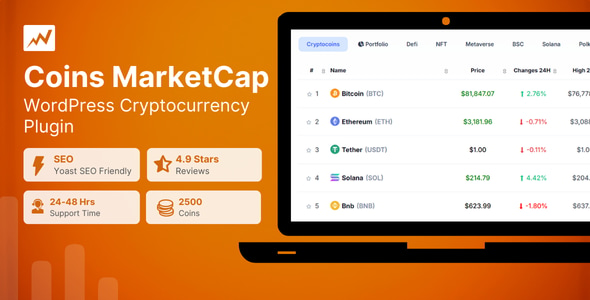
Coins MarketCap is a WordPress plugin that pulls live cryptocurrency market data from third-party APIs and renders it on a site through widgets, shortcodes and automatically generated coin pages. It covers more than 2,500 coins and tokens, and it is aimed at publishers, agencies and site owners building a crypto news section, a price directory or a market tracking page without maintaining a database of coin data by hand. The plugin is sold on CodeCanyon for $39 and has been purchased 2,157 times, with an average rating of 4.85 from 97 reviews.
It is developed by CoolPlugins, a vendor with a broader catalogue of cryptocurrency add-ons for WordPress, and it sits in the widget and shortcode layer of that catalogue rather than in the trading or portfolio tracking space. Nothing here executes trades, connects to a wallet or stores user holdings.
What the plugin actually does with live market data
The core of the product is a data table. Once an API key is in place, the plugin requests prices, market capitalisation, 24-hour volume, circulating supply and percentage changes across several time windows — 24 hours, 7 days, 30 days and one year — and outputs them in a sortable, styled table. Two data sources are supported: CoinGecko and CoinMarketCap, and the settings allow either one alone or a combination of the two. That choice matters more than it first appears, because the two providers differ in rate limits, coverage and the terms attached to their free tiers, and swapping providers later is a settings change rather than a rebuild.
Beyond the flat table, the plugin produces several derived views that are genuinely useful for editorial layouts:
- Top gainers and losers — the largest movers over a chosen period, which gives a crypto news page a self-updating element that does not require someone to write a post every morning.
- Token category lists — Ethereum tokens, Binance tokens, DeFi, NFT and stablecoin groupings, useful for building topic hubs that match how readers search.
- Exchange data — trading pairs and 24-hour volumes, presented as an exchange list rather than a coin list.
- A conversion calculator — coin-to-coin and coin-to-fiat conversion, which is the kind of small utility that keeps visitors on a page longer than a static table does.
- A Twitter feed block — recent posts from crypto accounts, embedded alongside the price data.
The single coin pages are the part that separates this from a plain widget plugin. Rather than requiring an editor to create a page per coin, the plugin generates them, and each one can carry a dynamic SEO title, meta description and Open Graph tags. Yoast SEO is explicitly supported, and coin slugs can be customised, so URLs can be shaped for search rather than left as raw ticker strings. Two layouts are available for these pages — a compact “Regular Clean” view and a tabbed “Advanced” view — and a single-coin chart can be switched to a TradingView chart for a more interactive presentation.
Control over what appears is reasonably granular. Coins can be toggled on or off individually, assigned to custom categories, given custom descriptions, and limited per page so a table of 2,500 rows does not become a table of 2,500 rows. Display currency is selectable, so values can be shown in USD, EUR or another fiat option rather than dollars only. Affiliate links can be attached to coin entries, which is a straightforward monetisation path for a directory site. Custom CSS is available for matching a theme’s typography and colours without editing plugin files.
On the technical side, the plugin declares compatibility from WordPress 5.0 through 6.9, works with Elementor and Elementor Pro, is Gutenberg-optimised, and ships with unminified JavaScript, HTML, CSS and PHP source files. Browser support covers Chrome, Firefox, Safari, Edge, Opera and Internet Explorer 11 — the last of which is unusual to see declared in a current listing and suggests the front-end output is deliberately conservative. The vendor last updated the item in August 2026.
Where it fits, and where it does not
The clearest fit is a content site that already publishes crypto news, analysis or education and wants the price data to sit inside the same template as the articles. A news publisher can drop a gainers-and-losers block into a sidebar, generate a coin page for every asset it writes about, and let the numbers refresh on their own. The auto-generated pages plus custom slugs plus Yoast integration make this a plausible organic search play rather than just a decorative widget.
A second fit is an agency or freelancer delivering a crypto-adjacent site — an exchange’s marketing pages, a token project’s information hub, a comparison or directory site — where building a price table from an API by hand would take days and then need maintenance. Shortcodes mean the same components can be placed across many page templates without touching PHP.
It is the wrong choice for anything that needs to hold or act on user data. There is no portfolio tracker, no watchlist tied to a logged-in account, no alerting, no order flow, and no wallet connectivity. A site whose core feature is “users track their own holdings” needs a different class of product entirely. It is also a poor fit for anyone unwilling to register for an API key and monitor a third-party quota: the vendor’s own disclaimer notes that data comes from external APIs and that price accuracy is not guaranteed, and that is an honest statement of the trade-off rather than a defect.
Strengths and limitations
Strengths
- Breadth of data without manual entry: 2,500+ assets, exchange volumes, multi-period percentage changes and supply figures from a single settings screen.
- Auto-generated coin pages with editable slugs and dynamic meta tags turn a data feed into indexable content, which is the commercially interesting part.
- Choice of CoinGecko, CoinMarketCap or both, giving an escape route if one provider changes its terms or rate limits.
- Shortcode-driven output plus Elementor and Gutenberg support means the components can be placed in almost any theme without template surgery.
- Source files are included, so a developer can extend or restyle rather than work around the plugin.
- Strong reception on the marketplace — 97 reviews averaging 4.85 is a meaningful sample, not a handful of early ratings.
Limitations
- Data quality and uptime depend entirely on third-party APIs. The vendor states plainly that price accuracy is not guaranteed, and free API tiers commonly impose request limits that a busy site can hit.
- Generated coin pages can create a large number of near-identical URLs. Without editorial content added to each one, they risk being treated as thin pages, and the plugin does not solve that problem for the site owner.
- The listing does not state a caching interval, so it is unclear how aggressively API calls are batched or how the plugin behaves under sudden traffic spikes.
- The Twitter feed block depends on a platform whose embedding terms and availability have changed repeatedly; treating it as a durable feature would be optimistic.
- Display is table-centric. Sites wanting a highly custom visual treatment will be writing CSS rather than configuring options.
- No portfolio, alerting or account-level functionality, so it cannot substitute for a dedicated tracking product.
How it compares with the wider category
WordPress crypto display tools generally fall into three groups. The simplest are ticker widgets: a price, a percentage change, a logo, placed in a sidebar. They are cheap and light but produce almost no indexable content. At the other end are full market-data platforms, often SaaS with a monthly fee, which offer richer charting, historical depth and sometimes white-label portals, at the cost of a subscription and a heavier integration.
Coins MarketCap sits between those poles as a one-time-purchase plugin that leans toward content generation. Its distinguishing feature is not the table itself — several products render a price table — but the combination of auto-generated, SEO-configurable coin pages with shortcode placement inside an existing WordPress theme. Compared with a ticker widget, it does substantially more for search visibility. Compared with a SaaS market platform, it does less on charting depth and historical data, but it avoids recurring cost and keeps everything inside the site’s own templates. The honest framing is that it is a publishing tool with market data attached, not a market data terminal.
Frequently Asked Questions
Does Coins MarketCap need an API key to work?
Yes. The plugin pulls its data from CoinGecko, CoinMarketCap or both, and those services require credentials for anything beyond minimal use. A free CoinGecko key is usually enough to start, while CoinMarketCap’s tiers are more restrictive. The vendor does not bundle a key, so registering one is part of setup.
Can it create individual pages for each cryptocurrency automatically?
Yes, that is one of its main features. The plugin generates single coin pages with selectable layouts, and each page can carry a dynamic SEO title, meta description and Open Graph tags, with a customisable slug. Yoast SEO is supported, so the generated pages integrate with an existing SEO workflow rather than sitting outside it.
Is Coins MarketCap suitable for a site with no coding experience?
Largely yes. Coins are enabled or disabled with toggles, display currency and coin counts are set in options, and content is placed with shortcodes or Elementor widgets. Custom CSS and the included PHP source files are there for developers, but they are optional rather than required for a working setup.
Does the plugin show historical price data or only current prices?
It shows current prices plus percentage changes across 24-hour, 7-day, 30-day and one-year windows, and charts for individual coins, including an optional TradingView chart. It does not present itself as a historical data archive, and the listing does not describe downloadable or long-range historical datasets.
Verdict
Coins MarketCap is worth buying for publishers, agencies and site owners who want live crypto prices woven into an existing WordPress theme and who see search traffic as the point of the exercise. The auto-generated coin pages, custom slugs and Yoast support are what justify the purchase over a free ticker widget, and the 4.85 rating across 97 reviews suggests the vendor supports the product after sale. It is not the right purchase for anyone needing portfolio tracking, price alerts or account-based features, since none of those exist here. It is also a poor fit for a site that cannot tolerate dependency on third-party APIs, because the entire data layer is external and the vendor says so directly. Buyers should treat it as a content and publishing tool that happens to display market data, and budget the small amount of ongoing attention that API keys and page quality will require.