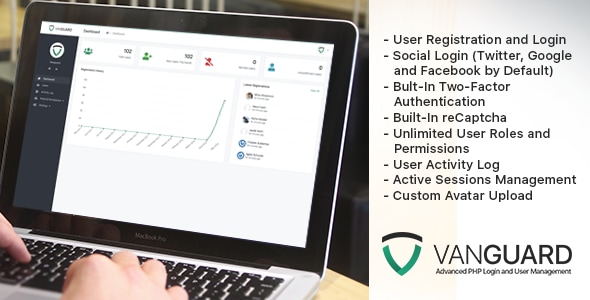
Vanguard is a PHP application built on the Laravel framework that adds registration, login, two-factor authentication, roles, permissions and user administration to an existing website. It ships as a self-hosted script from CodeCanyon, priced at $39, and is written by the developer niftycode. It suits teams that need a complete account system without building one from scratch, and it has been purchased 2,154 times with a 4.81 out of 5 rating across 116 reviews.
The category listing on CodeCanyon places it under PHP Scripts > Miscellaneous, which is a fair description of how it sits in a project: not a CMS, not a framework, but a drop-in authentication and user management layer that can be attached to almost any PHP-backed site. The current release is version 12.0.0, published on 27 August 2026.
What Vanguard actually does beyond a login form
Most authentication scripts stop at a username field and a password hash. Vanguard treats user management as the larger problem, and the feature set reflects that.
Access control that scales past a single admin flag
Roles are unlimited, and permissions are defined separately from roles, then assigned to them. A permission can be checked anywhere in application code through helper methods, which means a site can have editors who publish, moderators who approve comments, and billing staff who only see invoices, all without hard-coding user IDs. Default role names are exposed as constants, so renaming them does not require hunting through the codebase.
Security features that cover the common attack paths
Two-factor authentication uses QR codes rather than a third-party service, so there is no external dependency to configure or pay for. Failed logins trigger throttling that locks an account automatically. Google reCAPTCHA is available on registration, and CSRF tokens protect every form. Passwords are stored with one-way hashing, and sessions are handled by Laravel’s own session layer rather than a custom implementation. The vendor also notes an optional user approval workflow, where an administrator must approve an account before the person can log in.
Administration and visibility
An activity log records what users do. Active sessions can be listed and terminated, which is the practical answer to a user who has lost a phone or left a job. Administrators can also impersonate any account, a feature that turns vague bug reports into reproducible ones. Both capabilities are the kind of thing usually bolted on later, badly.
API access for non-browser clients
A documented JSON API allows mobile apps and third-party services to authenticate against the same user base. For anyone maintaining a website plus an iOS or Android client, this removes the need to run two separate identity systems.
Frontend and developer experience
Version 12 replaced the older frontend stack with Vue 3, Inertia 3 and Tailwind CSS 4, with TypeScript and Vite handling the build. Bootstrap, jQuery and Laravel Mix were removed entirely. The interface is responsive and the dashboard supports pluggable widgets, so custom panels can be added without forking core files. A plugin system supports Vue-based pages and interface slots. Localization is built in, with English, Serbian and German translations supplied and the ability to add others.
Testing and maintenance signals
The vendor states that the codebase carries more than 600 automated tests covering unit, feature, API, browser and visual regression checks. That figure cannot be verified without buying the script, but the release history is consistent with it: the changelog shows regular upgrades tracking Laravel 10, 11, 12 and 13 in turn, along with fixes to the installation wizard, password reset emails and avatar handling. A product that has been maintained across four major framework versions is a different proposition from one abandoned two years ago.
Where Vanguard fits, and where it does not
The strongest fit is a Laravel application that needs authentication and user administration without months of development. A SaaS product in its early stages, an internal tool, or a client portal all benefit from starting with roles, permissions, 2FA and session control already working.
It also fits non-Laravel PHP projects. The vendor states that Vanguard can secure any PHP-powered website, and the standalone installation wizard supports that claim. A legacy PHP site with its own routing can host Vanguard alongside it and delegate login and registration to it. The caveat is that this is not the primary design target, so integration work is likely to be more involved than in a Laravel codebase.
Projects that need a mobile backend benefit from the JSON API. Projects serving an international audience benefit from the localization layer.
There is one clear case where Vanguard is the wrong purchase. A site built on WordPress, Drupal, Joomla or another CMS with its own user system should not layer a second authentication stack on top. The CMS already handles accounts, and running two identity systems creates synchronization problems that outweigh anything Vanguard adds. The same applies to a static site with no PHP runtime, and to a project with no server access at all.
Strengths and limitations
Strengths
- Genuinely complete feature set: registration, social login, 2FA, roles, granular permissions, activity logs, session management and impersonation in one package.
- Documented JSON API makes mobile and third-party authentication viable without a second user database.
- Active maintenance across Laravel 10 through 13, with a changelog that documents real fixes rather than vague improvements.
- Modern frontend stack after version 12, with legacy Bootstrap, jQuery and Laravel Mix dependencies removed.
- Plugin system with Vue-based pages, UI slots and dashboard widgets allows extension without modifying core files.
- Localization support with three languages included and a straightforward path to adding more.
- Strong marketplace reception: 2,154 sales and a 4.81 rating from 116 reviews.
Limitations
- The server requirements are not trivial. PHP 8.3 or higher is mandatory, along with BCMath, OpenSSL, PDO, Mbstring, Tokenizer, Ctype, XML, JSON, GD and Fileinfo extensions. Shared hosting that meets all of these is uncommon, and some budget hosts disable several by default.
- The supported MySQL versions top out at 8.x, and the vendor does not state PostgreSQL or SQLite support. Teams on other database engines should confirm compatibility before buying.
- Social authentication is limited to Facebook, Twitter and Google. There is no built-in support for Apple, GitHub, Microsoft or other providers, so those require custom work.
- Version 12 was a complete frontend rewrite. Anyone upgrading from version 11 or earlier should expect a substantial migration rather than a routine update, and the vendor’s own upgrade guide is a required read.
- Compatible browser support is listed from IE9 upward, which suggests legacy testing, but the Vue 3 and Tailwind CSS 4 frontend in version 12 will not realistically render correctly in Internet Explorer. Treat the modern browser list as the practical one.
- Customization beyond the plugin system means working inside Laravel, Vue and TypeScript. A developer without that background will find deeper changes slow.
How Vanguard compares with the alternatives
Three broad options exist for adding authentication to a PHP project. The first is building it from scratch on top of a framework’s starter kit. That gives complete control and no licensing cost, but it means implementing roles, permissions, 2FA, session management and an admin interface before any product work begins. Realistically that is weeks of effort, and the security details are easy to get subtly wrong.
The second is a hosted identity service. These handle authentication reliably and scale well, but they charge per active user, hold the user data, and require network calls for every login. For a self-hosted product or one with strict data residency needs, that is often disqualifying.
The third is a self-hosted script like Vanguard. It sits between the two: a one-time $39 cost, full control of the data, no per-user fees, and a feature set that already covers what most projects need. The trade-off is that the buyer owns installation, hosting, updates and security patches. That responsibility is real, and it is the main reason someone might reasonably choose a hosted service instead.
Within the self-hosted script category, Vanguard’s differentiators are the breadth of the permission system, the JSON API, and the fact that it tracks Laravel releases closely. Scripts that lag behind framework versions become security liabilities over time.
Frequently Asked Questions
Does Vanguard require a Laravel application to work?
No. Vanguard is built on Laravel, but the vendor states it can secure any PHP-powered website, and the installation wizard supports standalone deployment. Integration is simplest inside a Laravel project, where the framework is already present. On a non-Laravel PHP site, expect additional configuration work to connect existing pages and routing to Vanguard’s authentication layer.
What PHP version does Vanguard need?
PHP 8.3.0 or higher is required as of version 11.0.0. The script also needs the BCMath, OpenSSL, PDO, Mbstring, Tokenizer, Ctype, XML, JSON, GD and Fileinfo extensions enabled. Buyers on older PHP versions, or on shared hosting with restricted extensions, should verify their environment before purchasing, since installation will fail without these.
Can Vanguard authenticate users from a mobile app?
Yes. Vanguard includes a fully documented JSON API designed for exactly this purpose, allowing mobile apps and third-party applications to authenticate against the same user base as the website. That means one set of accounts, one set of roles and permissions, and one activity log rather than separate identity systems to keep synchronized.
Is two-factor authentication included?
Yes. Two-factor authentication is built in and uses QR codes rather than an external provider such as Authy, which was replaced in version 9.0.0. Administrators can also force a password reset on a user’s next login, and the system prevents the same phone number from being registered for 2FA across two different accounts.
Verdict
Vanguard is a well-maintained, feature-complete authentication and user management layer that justifies its $39 price for the right buyer. The combination of granular permissions, two-factor authentication, a JSON API and active Laravel version tracking puts it ahead of most scripts in this category, and the 4.81 rating from 116 reviews reflects that. It is the right purchase for Laravel developers and PHP teams who need a production-ready account system and are prepared to own installation and updates. It is the wrong purchase for anyone on a CMS that already has user management, for projects without PHP 8.3 and the required extensions, or for teams that would rather pay a hosted provider to handle identity entirely.