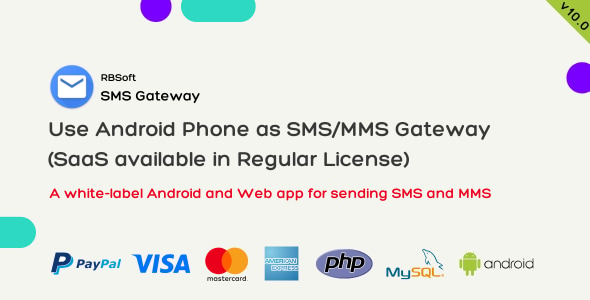
SMS Gateway is a Laravel-based PHP script that turns an ordinary Android handset into the sending device for a bulk SMS and MMS platform. It ships as a web control panel plus a hosted app builder, so an operator can run a messaging service, sell it as a subscription, and route every outbound message through a phone’s own SIM card rather than a commercial SMS aggregator. The product sits in the CodeCanyon Miscellaneous category and is aimed at developers, agencies and small messaging businesses that want to resell SMS capacity without signing wholesale carrier contracts.
The listing carries 4,382 sales and a 4.97 out of 5 rating across 198 reviews, which places it among the better-established scripts in this niche. It was written by rbsoft, who has kept the item updated as recently as August 2026.
What the script actually does once it is installed
The core idea is simple: instead of paying a gateway provider per message, an operator keeps one or more Android phones online, and the web panel pushes send jobs to those devices. The phone’s SIM does the transmitting. Everything else in the product exists to make that arrangement manageable at scale.
Bulk sending from a spreadsheet
Campaigns can be loaded from a CSV or Excel file containing phone numbers plus any extra columns. Those extra columns are not decorative. Their headers act as spintax placeholders, so a column labelled “first_name” can be dropped into the message body and swapped per recipient. That gives genuine personalisation without writing code, and it is the feature most buyers will use first.
MMS, USSD and long messages
Text messages can be sent as MMS, with image attachments, either from the panel or through the API. The vendor is careful to note that MMS depends on the recipient’s handset and on the local network operator supporting it, and that it is not the same thing as RCS or the manufacturer messaging apps preinstalled on many phones. USSD pull requests are supported too, provided the sending device runs Android 8.0 or later. Responses to those pulls appear in the panel, can be read through the API, or can be pushed to a webhook as soon as they arrive, and pulls can be scheduled for a future date and time. Separately, outbound SMS is not capped at the usual 160-character boundary, so long messages go out as a single logical send rather than being manually split.
Architecture and delivery control
Most phone-based gateways keep a persistent connection open between server and handset, which drains battery and loads the server. This one uses Firebase push notifications instead, with an option to run without Firebase if that dependency is unwanted. Heavy workloads are handed to queues so the panel stays responsive. An operator can also insert a delay between messages, which matters when a SIM needs to stay under a carrier’s throughput threshold, and delivery reports can be enabled so the panel shows a message as delivered once the network confirms it.
Running it as a business
The SaaS layer is where the product justifies its price for resellers. Plans can cap credits, contact lists, contacts, devices, sending servers, sender IDs, templates, webhooks, API tokens and auto responses, so a free tier and a paid tier can coexist on one installation. Payments are handled through Crypto.com, PayPal, Paystack, Razorpay and Stripe, and offline methods such as bank transfer, cash or cheque are supported with admin approval. Admins define how many credits each action costs, so an MMS or a USSD pull can be priced differently from a plain SMS. Subscriptions renew automatically at a defined interval until cancelled or expired.
White-labelling and access
The app builder lets an operator change the Android app’s name, logo, package name, server URL, default settings and languages, producing up to three custom APKs per new version per licence. Sign-in on the handset works either by scanning a QR code or by typing credentials manually; the QR route avoids re-entering the server URL. The panel itself is multi-language with several built-in options, and more can be added by following the documentation.
Where this fits, and where it does not
The clearest fit is a small messaging business in a country where local SMS rates are high and SIM-based sending is materially cheaper. An agency running appointment reminders, delivery notifications or one-time codes for its own clients is another good match, particularly if those clients want a branded portal. Developers building an internal alerting system will appreciate the API, which accepts requests from any language and removes the need to integrate a third-party gateway SDK. Anyone reselling messaging as a subscription product gets the billing, credit accounting and plan limits out of the box.
It is the wrong choice for high-volume transactional senders. A single SIM has real throughput limits, and while the delay setting and queue system help manage pacing, no amount of software engineering turns a phone into a carrier-grade connection. Businesses sending hundreds of thousands of messages a month, or needing guaranteed delivery SLAs, should use a conventional aggregator. The product is also a poor fit for anyone unwilling to manage Android devices, because the phones are the infrastructure.
Strengths and limitations
Strengths
- Spreadsheet-driven campaigns with column-based personalisation remove the need for custom code on routine sends.
- Push-notification architecture rather than long polling, which the vendor states reduces server load and preserves handset battery life.
- Genuinely complete SaaS layer: plans, credit consumption rates, five online payment processors, offline payment approval and auto-renewing subscriptions.
- Broad protocol coverage for a script at this price, including MMS, USSD pulls, webhooks, auto responders and delivery reports.
- White-label app builder included, so the handset app carries the operator’s branding rather than the vendor’s.
- Source files for the web panel are included, and the stack is mainstream: Laravel, PHP 8.x, MySQL 5.x or 8.x.
Limitations
- The Android source code is not included. Buyers receive the web panel source and access to the vendor’s build server, which means app customisation is limited to the options that server exposes. Anyone wanting to modify app behaviour beyond branding cannot do so.
- Custom APKs cannot be published to the Google Play Store, per the vendor’s own disclaimer, and future Android developer verification may require action. Distribution has to happen through direct download or a third-party store.
- MMS reliability is outside the script’s control. It depends on the operator and the recipient’s device, and the vendor recommends testing MMS compatibility against the demo before committing.
- USSD pulls require Android 8.0 or above on the sending device, which rules out older hardware.
- Throughput is bounded by the SIM and the carrier, not by the software. Scaling means adding phones, which means real hardware and real maintenance.
- The vendor does not state whether the build server or Firebase dependency carries any ongoing cost, so that needs clarifying before purchase.
How it compares with the alternatives
Against commercial SMS aggregators, the trade is cost against reliability. Aggregators offer carrier-grade routing, high throughput and predictable delivery, and they charge per message forever. This script trades that certainty for near-zero marginal cost per send, at the price of owning the hardware, managing SIMs and accepting whatever throughput a phone can sustain. For low and moderate volumes, the economics usually favour the script; for high volumes, they do not.
Against other phone-based gateway scripts on the same marketplace, the differentiators are the breadth of the SaaS billing layer and the protocol support. Many comparable scripts handle SMS and stop there. This one adds MMS, USSD, webhooks, auto responders, delivery reports and a full subscription engine with credit metering. The push-notification design is also a meaningful architectural difference from the long-polling approach common in this category, since it affects both server cost and handset battery life. The main competitive weakness is the closed Android app, which is a deliberate restriction rather than an oversight.
Frequently Asked Questions
Do I need a dedicated Android phone to run SMS Gateway?
No. The app works in the background, so the device does not need to stay open on screen, which means an existing phone can double as the sending device. That said, any phone used for business sending will be tied up by the SIM and the queue, so most operators eventually dedicate a handset per sending server.
Can I publish the customised Android app on the Google Play Store?
No. The vendor states plainly that custom APKs cannot be uploaded to Play Store because of Google’s developer policies. Distribution has to happen outside the store, typically through a direct download link. The vendor also notes that custom APKs may need verification in future, which the app builder is designed to help with.
Does it work without Firebase?
Yes. Firebase push notifications are the default mechanism for waking the handset, but the vendor confirms the system can optionally run without it. Removing Firebase changes how the server reaches the device, so it is worth testing that configuration against the expected message volume before committing to it in production.
Can I sell SMS as a service to my own customers?
Yes, and the regular licence covers it. Plans can limit credits, contacts, devices, sender IDs, templates, webhooks and API tokens, and payments run through Stripe, PayPal, Razorpay, Paystack and Crypto.com, with offline methods approved manually by an admin. Subscriptions renew automatically until cancelled or expired.
Verdict
Buy this if the goal is to run or resell a messaging service at low to moderate volume, where avoiding per-message aggregator fees matters more than guaranteed throughput. The SaaS billing layer, credit metering and white-label app builder make it a credible foundation for a small commercial product, and the 4.97 rating across 198 reviews suggests buyers are not hitting routine breakage. Do not buy it if the requirement is carrier-grade reliability, very high volume, or the freedom to modify the Android app’s internals, since the app source is withheld and Play Store distribution is off the table. Anyone in that position is better served by a conventional aggregator or by building against a provider’s API directly.