Taqyeem is a WordPress review and rating plugin that adds structured scoring boxes to posts, pages and custom post types. It lets a site owner define their own review criteria, display an overall score as stars, points or a percentage, and optionally let visitors submit their own ratings. It suits publishers, affiliate sites and magazine-style blogs that need a consistent way to score products or content without rebuilding their theme. The plugin is sold on CodeCanyon for $29, developed by TieLabs, and has been purchased more than 2,000 times with a 4.4 out of 5 rating across 164 reviews.
What the plugin actually does once it is installed
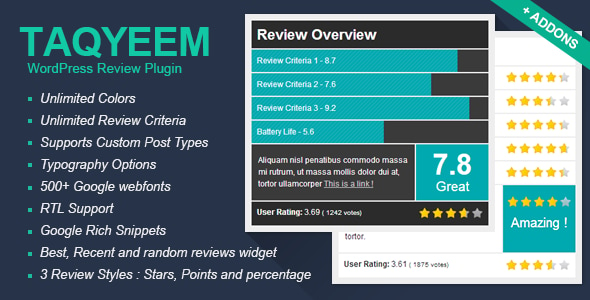
Taqyeem works by attaching a review box to a piece of content. Instead of hard-coding a score into a post, the editor fills in a set of criteria — things like design, performance or value — and the plugin calculates and renders the final result. The core of the product is that criteria list, and it is not fixed. A site can create as many review criteria as it needs and reuse them across content, which matters once a site has published dozens of reviews and needs the scores to stay comparable.
The score can be presented in three formats: star icons, a numeric point total, or a percentage bar. Each review box can carry its own imagery, and the styling is configurable down to fonts and colours. That level of control is the main reason people pick a dedicated plugin over a theme’s built-in rating field — the output can be made to match an existing design rather than the other way round.
Two features deserve separate mention. The first is schema markup. Taqyeem outputs review microdata, which is the structured data search engines read to show star ratings directly in search results. For a review site, that rich snippet is often the whole point, because it changes how a listing appears on a results page. The second is front-end rating. Visitors can be allowed to submit their own scores, which turns a static editorial verdict into a two-part score: the site’s own rating plus a reader average.
Smaller but practical details include right-to-left support for Arabic and Hebrew sites, translation files in the standard .po and .mo format, a library of Google web fonts, and widgets that surface the best, most recent or random reviews in a sidebar. Two add-ons extend the base plugin: one adds styled buttons to review boxes, and the other lets editors save predefined criteria sets and apply them in one step. The vendor lists compatibility from WordPress 4.9 up to 6.1 and names several popular magazine themes — Sahifa, Jarida, Gameleon and GoodInc — as environments where it is already integrated.
Where Taqyeem fits, and where it does not
The clearest fit is an editorial review site: gadget blogs, software directories, hosting comparison pages, film or game publications. Anywhere a writer produces a verdict that needs to look consistent across hundreds of posts, a criteria-driven box saves time and keeps the visual language uniform. Affiliate publishers benefit twice, because the schema markup improves how review pages can appear in search and the star display gives readers a quick summary before they scroll.
It also suits sites built on custom post types. A directory of restaurants, a catalogue of tools, or a portfolio of services can each carry their own review structure, provided the theme outputs the relevant template hooks. Freelancers building client sites will find the styling options useful when a design calls for a specific look that a theme’s default rating field cannot produce.
It is the wrong choice in a few situations. If a site only needs a simple five-star field on blog posts, the built-in functionality of many modern themes or a lightweight free plugin covers it without a paid dependency. And a site running a block-based page builder workflow should check the demo first: the plugin predates the full-site editing era, and its editing experience is built around the classic editor’s meta boxes rather than native blocks. A team that has standardised on block templates may find the review box feels like a separate layer rather than part of the page.
Strengths and limitations in plain terms
Strengths
- Flexible criteria. Unlimited review criteria with reusable sets (via the add-on) keep scoring consistent across a large archive.
- Three display formats. Stars, points and percentages can be mixed to suit different content types on the same site.
- Search-friendly markup. Built-in review schema gives the site a chance at star rich snippets, which is a concrete SEO benefit rather than a vague claim.
- Reader participation. Front-end rating lets an audience contribute scores alongside the editorial verdict.
- Design control. Colours, fonts, images and icon styles are all adjustable, so the box can be matched to an existing theme.
- Localisation ready. RTL support and included translation files make it usable on non-English sites without custom work.
- Proven track record. Over 2,000 sales and a 4.4 rating indicate a stable, widely used product rather than an untested release.
Limitations
- No recent update. The vendor’s last recorded update is February 2023, and the declared compatibility stops at WordPress 6.1. Sites on newer WordPress versions should test thoroughly before relying on it.
- Classic-editor workflow. The review interface is meta-box based, which sits awkwardly beside modern block editing.
- Add-ons cost extra. The buttons and predefined-criteria features are separate purchases, so the $29 entry price is not the full cost for everyone.
- Theme dependency. Output depends on the theme rendering the plugin’s hooks correctly; heavily customised or block-only themes may need template work.
- Rating is a snapshot. The 4.4 average reflects historical buyer experience, and some reviews will predate the current version.
How it compares with the wider category of review plugins
The review-plugin market splits roughly into three groups. The first is free, single-purpose plugins that add a star field and basic schema — enough for a blog that reviews occasionally, but limited on criteria and styling. The second is all-in-one SEO suites that bundle a review block alongside broader optimisation tools; these are convenient if a site already uses them, but the review component is usually less configurable.
Taqyeem sits in the third group: dedicated paid plugins focused on the review box itself. Its advantage over the free tier is breadth — multiple criteria, three output formats, reader ratings, widgets and typography control in one package. Its disadvantage against the SEO suites is integration: a suite’s review block is native to its editor, whereas Taqyeem is a separate layer that a theme must accommodate. The honest summary is that Taqyeem offers more control per dollar than most alternatives, at the cost of being a standalone tool that needs a compatible theme and careful testing on current WordPress versions.
Frequently Asked Questions
Does Taqyeem still work with the latest WordPress version?
The vendor officially lists compatibility up to WordPress 6.1, and the last update was February 2023. It will often function on newer versions because the underlying meta-box approach is stable, but that is not guaranteed. Testing on a staging copy before installing on a live review site is the sensible approach.
Can visitors leave their own ratings with Taqyeem?
Yes. The plugin includes an option to let readers submit ratings on reviewed content, which appear alongside the site’s editorial score. This produces a combined view of the publisher’s verdict and audience sentiment. Site owners should still consider spam and abuse, since open rating fields attract low-effort submissions.
Does Taqyeem add star ratings to Google search results?
It outputs review schema microdata, the structured data format search engines use to display star ratings in results. Whether stars actually appear depends on Google’s own eligibility rules and validation, not on the plugin alone. The markup gives a site the opportunity; it does not guarantee the outcome.
Is Taqyeem compatible with any WordPress theme?
It is designed to work with standard WordPress themes and is explicitly integrated with several TieLabs magazine themes such as Sahifa and Jarida. With other themes, the review box relies on template hooks being present. Custom or block-only themes may require template adjustments, so checking the live demo against a specific theme is worthwhile.
Verdict
Buy Taqyeem if the site publishes reviews regularly and needs consistent, multi-criteria scoring with schema markup, reader ratings and design control that a theme’s default field cannot deliver. The price is low relative to the configuration on offer, and the sales history suggests it does what it claims. Avoid it if the site only needs occasional star ratings, or if it runs entirely on block templates and current WordPress releases where the 2023 update gap becomes a real risk. For a classic-editor review site on a compatible theme, it remains a practical, well-established choice.