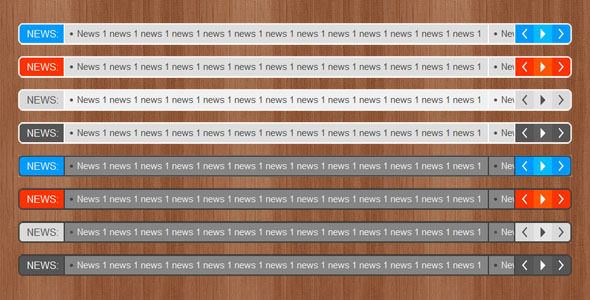
Modern News Ticker is a jQuery plugin that adds a scrolling, fading, typing or sliding headline strip to a web page, pulling its content either from manually entered items or from RSS and JSON feeds. It is sold on CodeCanyon by the developer CreativeTier for $7 and ships with 15 themes, four animation effects, four layout variants and a settings panel of 21 options. It suits developers and site owners who want a lightweight, self-hosted ticker they can style and configure directly in code, and it is a poor fit for anyone who needs ongoing vendor support or a component that still integrates with X (Twitter).
The listing has accumulated 1,913 sales and a 4.46 out of 5 rating across 114 reviews, which is a meaningful signal of stability for a script at this price point. The last recorded update was 20 March 2020, and that date matters more than any single feature in the specification.
What the ticker actually does once it is installed
The core job is simple: take a list of short text items and rotate them through a fixed-height strip, usually near the top of a page. What separates this plugin from a bare-bones marquee is the amount of control it exposes over that rotation.
Four animation effects cover most editorial needs. Scroll moves items horizontally, which is the familiar broadcast-news convention and works best for longer headlines. Fade swaps one item for the next in place, which reads as calmer and suits corporate or financial sites. Type reveals characters sequentially, useful when the ticker is meant to feel like a live wire feed. Slide pushes items in from an edge, a middle ground between scroll and fade. Each effect pairs with the same underlying item list, so switching presentation later is a configuration change rather than a rebuild.
Layout is handled separately from animation. The four layout variants combine the news items themselves with an optional front label (a static “Latest” or “Breaking” tag) and optional control buttons for previous, next and play/pause. The vendor’s changelog notes that the buttons can be configured to show only the arrow pair or only the play/pause control, which matters on narrow viewports where a full control set crowds the headline.
Feed loading is the feature that lifts the plugin out of the decorative category. The ticker can ingest an RSS or JSON feed and refresh it on a timer, so a site can surface its own blog posts, a category archive, or an external wire without anyone editing the page. Because browsers block direct cross-origin requests, the plugin routes RSS and JSON through server-side PHP helper files (load-rss.php and load-json.php) or through the third-party rss2json service. An API key field exists for the latter, which is worth noting because that service has usage limits on its free tier.
Styling is deliberately modest. Fifteen bundled themes provide starting points, corners can be set to round or square, and text direction can be flipped to right-to-left for Arabic, Hebrew and similar locales. Two later settings, random order and centre alignment, give finer control over how items are sequenced and positioned. The plugin is responsive, and the vendor includes a guide covering installation and configuration.
Where this ticker fits, and where it does not
The strongest use case is a news, magazine or sports site that already publishes an RSS feed and wants a persistent headline strip above the masthead. The same applies to a corporate site surfacing press releases, or a financial or trading dashboard where a continuously updating line of figures is part of the expected interface. Because the script is plain JavaScript, HTML and CSS with no framework dependency beyond jQuery, it drops into hand-built templates, static site output and classic PHP-driven themes without an adapter layer.
A second fit is the freelancer or small agency building a one-off site for a client who wants a ticker and will not pay for a subscription component. At $7 with source files included, the plugin can be restyled to match a brand and then left alone. The bundled themes are a starting point rather than a finished design, so expect to write some CSS.
It is the wrong choice in at least three situations. The first is any project requiring a Twitter or X feed: the vendor states plainly that the integration stopped working from 9 February 2023 when the platform restricted access to its formerly free API, and no replacement is documented. The second is a WordPress site where the editorial team wants to manage ticker content from the dashboard — a separate WordPress edition of the product exists for that, and installing this JavaScript version would mean editing template files by hand. The third is a project with a strict maintenance policy: the plugin has not been updated since March 2020, so anyone needing a vendor to respond to a browser change or a security report is buying the wrong thing.
Strengths and limitations in plain terms
Strengths
- Genuinely small footprint. The script is a jQuery plugin with no build step, so it adds little weight and does not force a toolchain onto an existing site.
- Broad configuration surface. Twenty-one settings plus three public methods for controlling autoplay and feed refresh mean the ticker can be driven by other scripts on the page, not just by its own buttons.
- Two feed formats. RSS and JSON are both supported, and the JSON route is useful when the source is a custom endpoint rather than a standard feed.
- Right-to-left support. A single direction setting handles RTL layouts, which many competing ticker scripts still ignore.
- Editable source. JavaScript, HTML and CSS files are included, so behaviour and appearance can be changed at the source rather than fought with overrides.
- Proven install base. Nearly two thousand sales and a rating above 4.4 indicate the plugin works as described for most buyers.
Limitations
- Stale maintenance. The most recent release is version 2.5.0 from March 2020. That predates several rounds of browser privacy changes affecting third-party requests, and the rss2json dependency in particular is the kind of external service that can change terms without notice.
- Broken social integration. The Twitter feed no longer functions, and the listing does not offer a substitute. Any planning that assumed a social feed must be redone.
- Server-side requirement for feeds. The self-hosted loading method relies on PHP files, so a purely static host needs the rss2json route instead, which introduces an outside dependency and a possible API key.
- jQuery dependency. Sites that have moved to modern frameworks or dropped jQuery entirely will need to load it solely for this component.
- Dated browser claims. The compatibility list includes Internet Explorer 7 through 9, which signals how old the codebase is and says nothing useful about current browser support.
- Themes need work. Fifteen themes is a reasonable count, but they are visual starting points, not finished brand systems.
How it compares with the wider ticker category
Ticker components generally fall into three groups: hosted widgets embedded with a script tag, full slider libraries repurposed for headline rotation, and small self-hosted plugins like this one. Hosted widgets are easier to set up and update automatically, but they add a third-party request, often carry a subscription, and give limited control over markup. Slider libraries such as the large general-purpose carousels are more capable and better maintained, but they are heavier and require more configuration to produce a convincing ticker rather than a slideshow.
Modern News Ticker occupies the narrow middle: lighter and more purpose-built than a slider library, more controllable and self-hosted than a widget. Its feed handling is the main differentiator against simple CSS marquees, which cannot refresh content on their own. Against paid commercial ticker plugins, the gap is maintenance rather than features — a buyer comparing on capability alone will find this competitive, while a buyer comparing on update cadence will not. The honest framing is that the feature set holds up and the support lifecycle does not.
Frequently Asked Questions
Does Modern News Ticker still work with Twitter feeds?
No. The vendor states that the Twitter feed stopped working from 9 February 2023, when the platform restricted access to its formerly free API. No replacement integration is documented in the listing. RSS and JSON feeds remain the supported automated sources, and manual news items continue to work as before.
Can Modern News Ticker load an RSS feed without PHP?
Yes, but only through a third-party service. The plugin offers a “self” loading method that uses bundled PHP files on the same server, and an rss2json method that fetches feeds through an external API. On static hosting the second option is the practical route, and it may require an API key.
Is Modern News Ticker compatible with WordPress?
Not directly. This CodeCanyon item is the jQuery plugin version, intended for inclusion in HTML, PHP or other templates by editing files. A separate WordPress plugin edition of the same product exists for sites that want ticker content managed from the admin dashboard. The two are distinct purchases with different installation paths.
How much does Modern News Ticker cost and what is included?
It costs $7 as a one-time CodeCanyon purchase. The download includes the JavaScript, HTML and CSS source files, 15 themes, example files and a configuration guide. There is no stated annual fee, but there is also no stated support or update commitment, and the last release was in March 2020.
Final assessment
Modern News Ticker is a sensible purchase for a developer who needs a configurable, self-hosted headline strip on a site that already loads jQuery, particularly where an existing RSS or JSON feed should populate it automatically. The price is low enough that the decision turns almost entirely on whether the current feature set is sufficient, and for most traditional news and corporate layouts it is. Buyers who need a live social feed, dashboard-managed content on WordPress, or a vendor actively shipping updates should look elsewhere. The plugin earns its rating on capability, but the 2020 update date should be weighed as a real risk rather than a footnote.