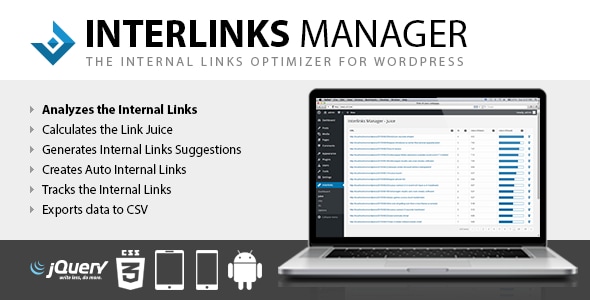
Interlinks Manager is a WordPress plugin that analyses, suggests and automates internal links across a site. It combines a reporting dashboard, a link-equity (“link juice”) calculator, a related-post suggestion tool inside the editor, and a keyword-to-URL automation engine. It suits publishers, affiliate sites and content-heavy stores that treat internal linking as a deliberate SEO task rather than an afterthought — provided buyers understand that the plugin is being retired in favour of the developer’s newer Link Manager product.
That retirement matters, so it belongs near the top rather than buried in a footnote. DAEXT, the developer behind the plugin, has confirmed that Interlinks Manager is no longer under active development, that all new features are being built into Link Manager, and that Interlinks Manager will be removed from Envato Market on 10 September 2026. Existing buyers can request a migration discount and a data migration guide. With 1,887 sales and a 4.97 average from 71 reviews, the plugin earned its audience; the question for anyone researching Interlinks Manager SEO tooling today is whether the remaining feature set justifies a purchase on a product with a published end date.
What the plugin actually does: analysis, suggestions and automation
The feature set splits into four working parts, and each addresses a different stage of internal linking work.
Auditing existing internal links from a dashboard
A dashboard screen reports on the internal link profile of the site. It counts manual internal links and automatically generated ones separately, tracks visits that arrived through internal links, and assigns each post an optimisation status. Regular expressions — pattern-matching rules — can be applied to posts so the plugin can identify links the site owner cares about. In practice this turns a vague instruction like “improve internal linking” into a list of specific posts with too few links, too many, or none at all. The click tracking is the more unusual element: most internal linking tools stop at counting links, while this one attempts to show whether those links produce traffic.
Calculating link juice distribution
A dedicated Juice screen maps how link equity flows across the site’s URLs. For each URL it lists the individual links that contribute to that URL’s overall score. Link juice is a shorthand for the SEO value passed from one page to another through a hyperlink, and it is the reason a link from a strong page is worth more than one from an orphaned post. Seeing the contributing links, not just a final number, is what makes the report actionable — it shows which pages are carrying the site and which are being starved.
Finding related posts while editing
An Interlinks Suggestions panel sits inside the post editor and proposes existing articles that relate to the one being written. The matching algorithm weighs several signals, and its priorities are configurable: posts whose titles share words with the current draft can be pushed up the list, and posts from chosen categories, tags or custom post types can be promoted, included or excluded. The vendor does not publish the exact weighting, but the controls are exposed in the plugin options, so the suggestion quality can be tuned rather than accepted as-is. For anyone who has manually searched a blog for a relevant older post to link to, this is the clearest time saving in the product.
Automating keyword-to-link conversion
The auto internal links module converts specified keywords or phrases into links to a chosen destination. Three scenarios are described by the vendor and they hold up as realistic uses. A glossary or wiki-style knowledge base can turn every occurrence of a defined term into a link to its definition page. A site selling products or collecting sign-ups can link recurring phrases such as “our products” or “the newsletter” to the relevant commercial pages across a large archive. A site with a handful of strong tutorials can point phrases like “configure a server” at those articles, concentrating internal authority on the pages that deserve it. This is the feature that scales; doing the same work by hand across hundreds of posts does not.
Where it fits, and where it does not
The strongest fit is a content site with an archive large enough that manual linking has become impractical — a blog with several hundred posts, a documentation or knowledge base, an affiliate site where commercial pages need traffic from editorial content, or an e-commerce store with a substantial blog attached. Freelancers and agencies managing several such sites benefit from the reporting layer, because optimisation status per post is easier to hand to a client than a spreadsheet of link counts.
The plugin is a poor choice in two situations. The first is a small site: under roughly a hundred posts, a manual pass through the content plus a standard SEO plugin’s basic link tools covers the same ground without another licence. The second is any project with a multi-year horizon. Because development has moved to Link Manager and the listing disappears from Envato Market in September 2026, a new build should start on the successor product rather than on a plugin the developer has openly stopped extending. Interlinks Manager now makes sense mainly for sites already running it, or for buyers who specifically want its current feature set and accept the migration path.
Strengths and limitations
Strengths
- Unusual depth of reporting. Separating manual from automatic links, tracking clicks on internal links and showing per-post optimisation status goes beyond what most internal linking add-ons report.
- Link-level juice detail. The Juice screen attributes a URL’s score to individual contributing links, which supports decisions rather than just observation.
- Configurable suggestion algorithm. Title matching plus category, tag and custom post type rules give real control over which posts are proposed in the editor.
- Automation that scales. Keyword-to-URL rules apply across the whole archive, which is the only practical way to maintain thousands of internal links.
- Proven reception. Nearly 1,900 sales and a 4.97 rating across 71 reviews indicate the feature set has worked for a substantial buyer base.
- Broad WordPress compatibility. The vendor lists support from WordPress 6.2 through 6.9, and source files in PHP, JavaScript, CSS and Layered PNG are included.
Limitations
- Published end of life. The plugin is no longer actively developed, new features go to Link Manager, and the Envato Market listing closes on 10 September 2026. Migration requires contacting the developer for a discount coupon and following a separate guide.
- Automatic linking needs guardrails. Keyword conversion can produce repetitive or unwanted links if rules are broad or overlap, and the vendor’s materials do not describe built-in caps on how often a keyword links per page. Rules need review after they go live.
- Algorithm behaviour is only partly documented. The suggestion engine’s exact weighting is not published, so tuning is a matter of trial and observation.
- Browser support list is dated. The declared compatibility includes Internet Explorer 8 through 11 alongside current browsers, which says little about how the admin interface behaves on modern screens and nothing about mobile admin use.
- Price without a roadmap. At $149 for a product in maintenance mode, the cost has to be weighed against a successor that includes the same features plus more.
How it compares with the wider internal linking category
Internal linking tools generally fall into three groups. The first is the link module bundled inside broad SEO plugins, which typically offers nofollow and noopener controls, breadcrumb links and sometimes a basic related-posts block. Those are convenient but shallow: they do not measure link equity, track internal link clicks or automate keyword conversion at archive scale. The second group is dedicated internal linking plugins, which is where Interlinks Manager sits; these compete on the quality of their suggestions, the depth of their reporting and the safety of their automation. The third group is hosted or standalone SEO platforms that include internal link analysis as one module among site audits, rank tracking and backlink data — broader, usually subscription-based, and less deeply integrated into the WordPress editor.
Against the first group, Interlinks Manager adds genuine analytical capability that a bundled module does not attempt. Against the third, it offers closer editor integration and a one-off licence rather than a subscription, at the cost of scope. Against its own successor, it loses: Link Manager is described as covering everything here plus additional link management features, which makes Interlinks Manager the narrower, frozen option in its own family. The honest comparison is therefore less “is this the best internal linking plugin” and more “is this the right version of this developer’s tool for this site, today”.
Frequently Asked Questions
Is Interlinks Manager still supported?
No. The developer states the plugin is no longer under active development, with all new feature work moving to Link Manager. It remains available on Envato Market until 10 September 2026, after which the listing is removed. Existing customers can email support for a migration discount coupon and follow a published migration guide to move their data across.
What is link juice and why does the plugin calculate it?
Link juice is the SEO value a page passes to another page through a hyperlink. The plugin’s Juice screen estimates how that value flows across site URLs and lists the individual links contributing to each URL’s total. That breakdown helps identify pages carrying the site’s authority and pages receiving too little, so internal links can be redirected where they do more good.
Can it add internal links automatically without editing every post?
Yes. The auto internal links module converts chosen keywords or phrases into links to a specified destination across the site. Typical uses include glossary terms linking to definition pages, commercial phrases linking to product or sign-up pages, and topic phrases linking to a site’s best articles. Rules should be reviewed after activation, since broad keywords can create repetitive links.
Does Interlinks Manager work with custom post types?
Yes, custom post types are part of the suggestion engine’s configuration. The plugin can prioritise, include or exclude posts belonging to specific categories, tags or custom post types when proposing related articles in the editor. The vendor lists compatibility with WordPress 6.2 through 6.9, and source files including PHP and JavaScript are provided.
Verdict
Interlinks Manager earns its rating on capability: the reporting dashboard, the link-level juice breakdown and the configurable suggestion engine form a more serious internal linking toolkit than most WordPress SEO add-ons offer. Buyers should purchase it only with clear eyes about its status. Sites already running the plugin have good reason to stay until migration makes sense, and anyone who specifically needs its current features can still buy before September 2026 and move across with the developer’s discount. New projects, small sites and anyone planning beyond the next year should start with Link Manager instead, or with a manual linking process if the archive is modest. The plugin is a capable product at the end of its life, not a current recommendation for fresh builds.