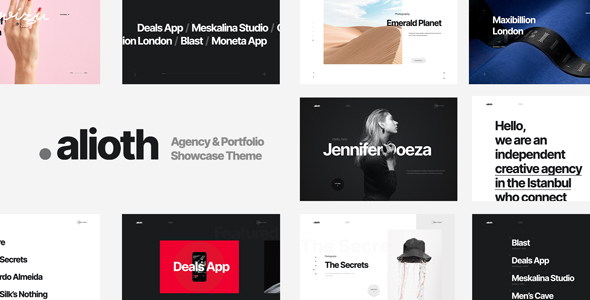
Alioth Creative is a WordPress theme sold on ThemeForest for $89, built by the developer pethemes for agencies, studios and independent creatives who need a portfolio site that feels animated and deliberate rather than templated. It combines Elementor page building with a set of showcase layouts, AJAX page transitions and GSAP-driven motion, and it has been purchased 976 times with a 4.8-star average rating at the time of writing. It suits freelancers, small agencies and photographers who want motion design out of the box and are willing to work within the theme’s own structural rules.
What Alioth Creative Actually Does Well
The theme’s centre of gravity is the showcase system. There are more than ten portfolio layouts, and they are not cosmetic variations of one another: a grid, a carousel, a slideshow, a fullscreen wall and a list view all behave differently and suit different kinds of work. A photographer with a small number of strong images will get more from the fullscreen slideshow; a studio with forty case studies will get more from the filterable grid. The grid supports category filtering and pagination, both added or fixed across the release history, which matters once a portfolio grows past a single screen of thumbnails.
Motion is the second differentiator. Page transitions run over AJAX, meaning a visitor moves between pages without a full browser reload, and a custom page loader covers the gap. GSAP, a widely used JavaScript animation library, is bundled rather than left to the buyer to add. Parallax scroll effects and an interactive mouse cursor round out the effect. These are the details that separate a portfolio that feels considered from one that feels like a stock template, and having them pre-built saves a meaningful amount of front-end work.
On the build side, Elementor handles layout, and the theme ships with its own widgets for showcase elements, testimonials and page navigation. A landing page template is included, which is useful for agencies that want a marketing-style home page separate from the portfolio itself. WooCommerce compatibility means a shop can sit alongside the portfolio, which is relevant for photographers selling prints or designers selling templates. Redux and Advanced Custom Fields are part of the stack, so theme options and per-page settings are handled through established tools rather than a bespoke panel.
Two practical details stand out from the changelog. First, the theme’s custom plugins can be updated from the WordPress dashboard, which removes the manual upload routine that plagues many ThemeForest products. Second, the portfolio permalink slug is customisable, a small thing that matters for anyone who cares about tidy URLs or has migrated from another theme and wants to preserve existing links. The code is described as W3C validated, and the vendor states browser compatibility testing and documentation are included.
Where This Theme Fits and Where It Does Not
The strongest fit is a creative business that treats its portfolio as the product. Photographers, design studios, motion graphics freelancers, architecture practices and small agencies building a first serious website will find the showcase layouts and animation layer do most of the heavy lifting. The WooCommerce integration extends that to anyone selling physical or digital goods directly from the same site, which avoids running a separate storefront.
A second good fit is an agency or freelancer already comfortable in Elementor. Because the theme is built on it rather than a proprietary builder, existing Elementor knowledge transfers directly, and the theme’s widgets slot into a familiar workflow.
It is the wrong choice for content-heavy publishers. A blog or news site with hundreds of posts, complex taxonomy and an editorial workflow gains nothing from fullscreen showcases and page loaders, and the animation layer adds weight for no benefit. It is also a poor fit for anyone who needs a strict, minimal, text-first corporate site, or for a project where the client will manage content without any design oversight: the theme’s options are extensive, and every additional option is another way for a non-designer to break the layout.
Strengths and Limitations
Strengths
- Ten or more genuinely distinct portfolio layouts, covering grid, carousel, slideshow, list and fullscreen presentations.
- AJAX page transitions, a custom loader, GSAP and parallax effects are included rather than assembled by the buyer.
- Elementor-based, so the editing experience is one many site owners already know.
- WooCommerce compatibility allows a shop to run alongside the portfolio.
- Custom plugins update through the WordPress dashboard, avoiding manual file replacement.
- An active update history through to March 2025, with fixes documented rather than silent.
Limitations
- Fullscreen page layouts cannot be combined with other page-building elements. They must be used alone on a page, which constrains how a fullscreen showcase can be integrated into a larger layout.
- Demo images and videos are not included in the purchase. A site built from the demo will look substantially different until the buyer supplies their own media, and licensing that media is a separate cost.
- YouTube embedded videos will not autoplay on mobile, because of YouTube’s own embed policy. The vendor recommends self-hosted or Vimeo video instead, which pushes hosting and bandwidth costs onto the buyer.
- Smooth scroll was still labelled a beta feature as of version 1.2 and the listing marks a smooth scroll plugin as coming soon, so that capability should not be treated as finished.
- Animation-heavy themes carry a performance cost. The vendor does not publish performance benchmarks, so anyone with strict Core Web Vitals targets should test before committing.
- No page-builder alternative is offered. Buyers who prefer Gutenberg or a different builder have no path within this theme.
How It Compares With Other Creative Themes
Creative portfolio themes generally fall into three groups. The first is minimal, typography-led themes that load fast and leave design decisions to the buyer. The second is template-library products that ship dozens of pre-built demo sites and expect the buyer to pick one and swap the content. Alioth Creative sits in a third group: a motion-led theme where the animation and showcase behaviour are the product.
Against the minimal group, Alioth offers far more out of the box and demands less front-end skill, but it also imposes more of its own personality on the finished site and carries more JavaScript. Against the demo-library group, it is narrower in scope but deeper in each layout, and the changelog suggests more ongoing maintenance than many ThemeForest items receive. The Elementor dependency is the clearest dividing line: buyers already in that ecosystem get a smooth experience, while buyers who prefer another builder should look at themes built for their tool of choice.
Frequently Asked Questions
Does Alioth Creative require Elementor Pro?
No. The theme requires the free version of Elementor to function, and the changelog shows compatibility updates for Elementor Pro as well. Some features demonstrated in the demo may rely on Pro widgets, but the theme itself and its own showcase widgets run on the free plugin. Buyers should confirm which specific demo elements they need before purchasing Pro.
Can a fullscreen showcase page include other content?
No, and this is stated explicitly in the vendor’s own notices. Fullscreen page layouts must be used alone on a page and cannot be combined with other page-building elements. That means a fullscreen slideshow or wall functions as a standalone destination rather than a section within a longer page, which affects how a site’s navigation should be planned.
Are the images and videos from the demo included?
No. The vendor states clearly that images and videos shown in the demo pages are not included with the ThemeForest purchase. Buyers must source their own media, and the demo credits list Behance, Unsplash, Pexels, YouTube and Vimeo as sources. Budget for stock licensing or original photography separately from the theme price.
Is WooCommerce supported for selling products?
Yes. The theme is listed as WooCommerce compatible, and multiple releases include WooCommerce update compatibility and shop page responsive adjustments. This lets a photographer sell prints or a designer sell digital files from the same site as the portfolio, rather than running a separate store. The vendor does not state whether every shop template has been individually styled.
Verdict
Alioth Creative is a well-maintained, motion-focused portfolio theme that earns its $89 price for the right buyer. Anyone building a visual portfolio for photography, design, architecture or a small agency, who is already comfortable in Elementor and wants animated transitions without commissioning custom development, will get a strong return. The 976 sales and 4.8-star rating suggest the theme has been tested by a reasonable number of real projects rather than sitting untouched. Buyers should steer clear if the project is content-heavy, if the layout must stay entirely under a non-designer’s control, or if fullscreen showcases need to sit inside larger pages, because the theme’s own rules prevent that. The absence of demo media and the mobile YouTube autoplay restriction are costs to plan for, not reasons to avoid the product.