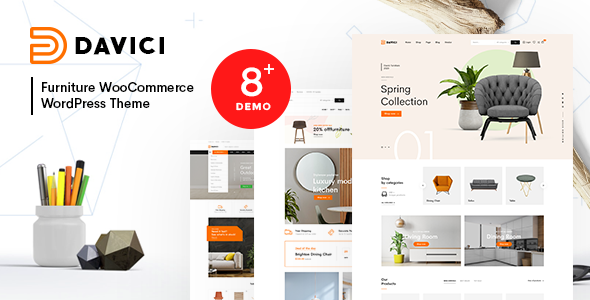
Davici Ecommerce is a WordPress theme built specifically for furniture and home-goods shops running on WooCommerce, the ecommerce plugin that turns WordPress into an online store. It ships with eight homepage layouts, an Elementor-based drag-and-drop builder, multi-vendor support and a bundled AI plugin called Wpbingo AI Commander that edits product data from written commands. It suits store owners who want a polished catalogue without commissioning custom development, particularly those selling bulky, image-heavy goods where category browsing matters more than a single product page.
The theme comes from wpbingo, a developer with a catalogue of WooCommerce themes on ThemeForest, and has been purchased roughly 975 times at $59. That is a moderate sales figure for this marketplace, and the update history is the more telling signal: releases through 2026 show repeated maintenance of WooCommerce template files rather than long silences between versions.
What the theme actually provides beyond a stock WooCommerce install
The central design idea is category-led navigation. Furniture shoppers rarely arrive knowing the exact product they want; they browse sofas, then narrow by material or colour. Davici leans into that behaviour with category-aligned product grids, Ajax filtering on the shop and homepage, and a live search that can be narrowed by category, availability, brand, price range, size, colour and other custom attributes. Ajax here means results update without a full page reload, which keeps a browsing session fluid on mobile connections.
Layout control sits with Elementor, so headers, footers and page sections are assembled visually rather than through code. The theme supplies seven header and five footer variants through dedicated builders, plus a mega menu builder for large catalogues that need three or four levels of nesting. Twenty-four shortcodes — reusable content blocks — extend what Elementor can place on a page. A one-click demo importer populates a working store so the structure can be inspected before any real products are added.
The AI component deserves separate treatment because it is the newest addition and the headline of the listing. Wpbingo AI Commander is bundled at no extra cost and connects to OpenAI, Claude, Gemini, Groq or OpenRouter. Its purpose is bulk editing through natural language: rewriting product titles and descriptions, adjusting prices, assigning categories and attributes, or changing stock status across many items at once. For a store with several hundred SKUs migrated from another platform, that is a practical labour saving. It is not a design tool, and it does nothing for the storefront itself.
Multi-vendor compatibility covers MultiVendorX, WC Vendors and Dokan, which lets the theme host a marketplace where third parties list their own stock. The vendor is explicit about a boundary here: vendor settings are managed inside the plugin, not through the theme, because the plugin keeps its data in separate database tables. Buyers expecting theme-level control over commission rates or vendor dashboards will be disappointed.
The remaining feature set is what a serious WooCommerce theme now needs to include. Variable product swatches for colour, size and image attributes, Ajax add-to-cart and wishlist, YITH Wishlist support, quick view, product zoom, sticky product details, grid and list views, and lazy-loaded images all reduce friction in the buying path. Revolution Slider is bundled with a stated $25 value. WPML compatibility and right-to-left support cover multilingual and Arabic or Hebrew storefronts. There are also blog layouts, a customisable 404 page, and 500-plus Google Fonts with live preview.
Where Davici fits, and where it does not
The strongest fit is an independent furniture retailer or a small chain moving from a marketplace listing or an outdated theme to a self-hosted store. The category-first layout, swatches and attribute filtering map directly onto how people buy sofas, dining sets and lighting. A freelancer or agency building a furniture client site also benefits: the demo importer and Elementor structure shorten the build, and the header and footer builders mean less custom CSS per project.
A second fit is a multi-vendor marketplace in the home and living niche. With Dokan or MultiVendorX installed, the theme can host multiple sellers without template conflicts, and the vendor states there are no errors when those plugins are active.
Stores with large, messy product databases are a third case, and the AI Commander is the reason. Bulk rewriting descriptions or reassigning categories across hundreds of items is the task it was built for.
It is the wrong choice for a store whose products are digital downloads, subscriptions or highly configurable made-to-order items. The design language is built around photographs of physical goods, and the filtering assumes attributes like size and colour. A business selling software licences or services would be paying for furniture-specific layout work it will strip out. It is also a poor fit for anyone who wants to avoid page builders entirely; Elementor is not optional here in any practical sense.
Strengths and limitations, stated plainly
Strengths
- Attribute-rich Ajax filtering and live search are native to the theme, not bolted on, which matters for catalogues where shoppers narrow by material, dimension or colour.
- The AI Commander plugin is included at no extra charge and supports five different AI providers, so buyers are not locked into one vendor’s API.
- Seven headers, five footers and a mega menu builder give agencies reusable structure across multiple client sites.
- Update cadence through 2026 shows active WooCommerce template maintenance, which is the most common failure point for ecommerce themes.
- WPML and RTL support broaden the addressable market for stores selling across language regions.
- Revolution Slider is bundled, removing a separate $25 purchase.
Limitations
- Multi-vendor settings cannot be controlled from the theme. Commission structures, vendor dashboards and payout rules must be configured inside Dokan, MultiVendorX or WC Vendors, so the theme is a shell in that respect.
- AI Commander requires an API key and a paid account with one of the supported providers. The plugin is free; the usage is not, and the vendor does not state token costs or rate limits.
- Elementor is a hard dependency for layout work. Sites already standardised on Gutenberg or a competing builder would be adding a second editing system.
- Eight homepage layouts is a modest count next to multipurpose themes that ship dozens, and the listing itself notes more concepts are planned rather than delivered.
- The bundled plugin is recent — introduced in version 1.4.9 — so its long-term support record is short compared with the theme itself.
How it compares with the wider WooCommerce theme category
Most WooCommerce themes on ThemeForest are multipurpose: one purchase, dozens of demos, any niche. Davici takes the opposite approach and optimises for a single vertical. The trade-off is depth against breadth. A multipurpose theme will have more homepage options and a larger user base for community support, but its furniture demo is usually one layout among many, and the filtering and swatch behaviour is often shallower than what a dedicated theme provides.
Against lightweight, code-first themes, Davici offers far more out of the box but carries more weight — Elementor, Revolution Slider and a shortcode library all add page weight and update surface. Against hosted storefront platforms, it offers full ownership and no transaction fees, at the cost of managing hosting, security and plugin updates.
The AI feature is the clearest differentiator. General-purpose themes increasingly advertise AI, but most mean AI-generated text inside a page builder. Bundling a plugin that edits live WooCommerce product records through an API is a narrower, more operational use of the technology, and it is the reason a store with a large back catalogue might pick this theme over a cheaper alternative.
Frequently Asked Questions
Does Davici require Elementor to work?
Yes, in practice. The theme is built on Elementor, and its homepage layouts, header and footer builders and shortcodes all assume the plugin is active. WooCommerce is also required for any store functionality. A site could technically run the theme without Elementor, but the demo content and layout system would not function as designed.
Is the Wpbingo AI Commander plugin free to use?
The plugin itself is included with the theme at no extra cost, but using it requires an account and API key from one of the supported providers: OpenAI, Claude, Gemini, Groq or OpenRouter. Those services bill per usage. The vendor does not publish cost estimates, so running costs depend on how many products are processed.
Can Davici run a multi-vendor marketplace?
It can host one. The theme is tested for compatibility with Dokan, MultiVendorX and WC Vendors and will not conflict with them. However, vendor commissions, dashboards and payout settings are controlled inside whichever plugin is chosen, not through the theme’s options, because the plugin stores that data separately.
Does the theme support right-to-left languages and translation?
Both are supported. The theme includes right-to-left styling for Arabic, Hebrew and similar scripts, and it is compatible with WPML for building multilingual stores. Translation files are handled through standard WordPress localisation, so interface strings can be translated independently of the content.
Verdict
Davici is a sensible purchase for furniture, homeware and interior retailers who want category-driven browsing, rich attribute filters and swatches without custom development. Agencies building repeat storefronts in that niche will get value from the header, footer and mega menu builders. The bundled AI Commander adds genuine operational value for stores with large product catalogues, provided the buyer accepts ongoing API costs. It is a poor fit for digital-goods sellers, Gutenberg-based workflows, or anyone wanting theme-level control over a multi-vendor marketplace. At $59 with an active update record, the risk is low for the audience it was designed for.