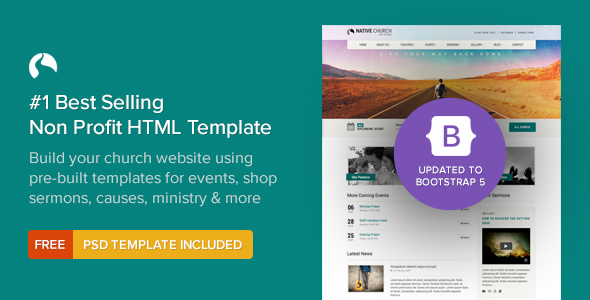
Deeds is a commercial WordPress theme built by webinane for churches, ministries and religious nonprofits that need to publish sermons, promote events and collect donations from one site. It ships with dedicated content types for sermons, events, ministries, news and prayer requests, plus Elementor and WPBakery page builders, WooCommerce donation selling and a recurring giving option. It suits small congregations and ministry teams that want a purpose-built structure rather than assembling a generic theme with plugins.
The theme has been purchased 976 times on ThemeForest and sells for a one-time $69. That is a moderate track record rather than a runaway bestseller, and it tells a buyer something useful: the theme has a real installed base, but it is not the category default. Deeds Churches buyers are mostly choosing it for the sermon, prayer and donation workflows rather than for the design alone.
Sermon, Prayer and Donation Workflows Built Into the Theme
The most consequential thing about Deeds is that the church-specific features are native content types, not add-ons. Sermons are handled as their own post type with a single post template, and each entry can carry audio, video, body text and a featured image. That matters because it means a sermon archive, a sermon detail page and a media player layout exist the moment the theme is activated, without a separate sermons plugin that may or may not match the site’s design.
Events work the same way. Past and future events are stored as custom posts, and the theme bundles shortcodes for an events carousel, a latest-events block, an upcoming event with embedded video, and an upcoming event with a countdown counter. The practical effect is that a church can build a homepage that surfaces the next service or fundraiser with a live countdown, then link through to a full event page, using only the theme’s own elements.
The prayer system is the feature that most clearly separates Deeds from a general-purpose theme. Visitors can submit a prayer request through the front end, and the submission is stored in the WordPress dashboard rather than published immediately. An administrator can then reply by email from inside the dashboard, publish the request to a public prayer page, or delete it. There is also a variant that accepts audio or video prayer submissions. For congregations that run an active intercession list, this replaces what would otherwise be a form plugin plus a moderation workflow bolted together by hand.
On the giving side, Deeds offers more than one path. WooCommerce is integrated with PayPal, so a church can raise funds by selling products, event tickets or merchandise. Alongside that sits a recurring donation system that transfers a preset amount from a donor’s account on a monthly schedule. The vendor does not state which payment gateway handles the recurring transfers specifically, so that is a detail worth confirming before purchase if monthly giving is central to the plan. A built-in contact form is included as well, which removes the need to license a premium form plugin.
Around those core systems, the theme covers the supporting content a church site normally needs: ministry pages with their own post type, a priest and team management system that lists staff with their ministries and areas of expertise, a news post type with list and single-page views, and a video and image gallery that accepts embedded YouTube and similar code. Unlimited sidebars can be placed left, right or removed entirely for full-width layouts, and the full Font Awesome icon set is available anywhere in the theme.
Design flexibility comes from a choice of seven homepage layouts and eight header styles, plus more than thirty inner pages. Editing runs through Elementor (the current version, per the vendor) or WPBakery, so a site can be assembled with drag-and-drop rather than custom code. Right-to-left support is built in and switches with a single click, which is relevant for Arabic, Hebrew, Persian, Urdu and Yiddish congregations. The markup is described as HTML-validated with a proper H1-to-H6 heading hierarchy, and the layout is responsive across screen sizes.
Where Deeds Fits and Where It Does Not
A mid-sized church with an active preaching calendar is the clearest fit. The sermon archive, events countdown and prayer moderation together cover the three things such a site does most weeks, and they are already styled to match. The same applies to a ministry or parachurch organization that publishes teaching content and runs fundraising campaigns, and to a religious nonprofit that wants to sell event tickets or merchandise through WooCommerce while also accepting recurring gifts.
It also fits agencies building church sites on repeat. Having seven homepages and eight headers in one license means an agency can produce visually distinct sites for different congregations without buying a new theme each time, and the Elementor and WPBakery support means the build process matches whatever the team already uses.
Deeds is the wrong choice for a church that already runs its sermons, events and giving through established third-party services and simply wants a fast, minimal brochure site. The theme’s value is concentrated in its own content types; a congregation that will not use them is paying for structure it will ignore. It is also a poor fit for anyone who needs a fully custom design system with no page-builder dependency, since the layouts here are built around Elementor or WPBakery rather than hand-coded templates. Finally, a congregation whose giving depends on a specific gateway or a particular recurring-payment processor should verify compatibility first, because the vendor’s listing does not name the gateway behind the recurring donation feature.
Strengths and Limitations
Strengths
- Sermon, event, ministry, news and prayer content types are native to the theme, so no third-party plugin is needed to get the core church workflows running.
- The prayer request system includes moderation, dashboard replies by email and an option to publish approved requests, which is a complete workflow rather than a bare contact form.
- Two giving routes are supported: WooCommerce with PayPal for product or ticket sales, and a recurring monthly donation system.
- Seven homepage layouts, eight header styles and 30+ inner pages give genuine variety for agencies building multiple church sites.
- Both Elementor and WPBakery are supported, so the theme does not force a single builder on the buyer.
- Built-in RTL support covers Arabic, Hebrew, Persian, Urdu and Yiddish without a separate plugin.
- A working contact form is included, which avoids an extra plugin license.
- 976 sales and a $69 one-time price put it in reach of small congregations.
Limitations
- The vendor does not state which payment gateway powers the recurring donation feature, only that WooCommerce is PayPal-integrated. Monthly giving is exactly the area where gateway compatibility needs checking before purchase.
- There is a documentation inconsistency in the source listing: the feature headings reference eight homepages and eight header styles, while the body text says seven homepages and eight headers, and another line says five homepage layouts. Buyers should confirm the actual count from the live demo.
- The recurring donation system is described as transferring a preset amount monthly, which suggests limited flexibility for donors who want to choose their own amount or frequency.
- Design work depends on Elementor or WPBakery. Sites that avoid page builders, or that need to remove builder markup for performance reasons, will find the theme’s layouts harder to reuse.
- The listing makes broad SEO claims but names no specific schema markup, structured data type or plugin integration, so search performance will depend on whatever SEO setup the site adds separately.
- At 976 sales the theme has a real user base but a smaller one than the category leaders, which can mean fewer community-written tutorials and third-party answers when something breaks.
How Deeds Compares With the Wider Church Theme Category
Church themes generally fall into two groups. The first is the general multipurpose theme with a church demo imported on top; it is flexible, well supported and familiar, but sermons, events and giving all come from separate plugins that must be styled to match. The second group is the purpose-built church theme, and Deeds sits firmly here.
The trade-off is straightforward. Deeds gives up some of the raw flexibility of a multipurpose theme in exchange for content types that already know what a sermon is, an events countdown shortcode that already exists, and a prayer moderation screen that does not need to be assembled. For a congregation whose site revolves around preaching, gatherings and giving, that trade is usually worth making. For a site that is essentially a brochure with a service-times page, a lighter general theme plus a forms plugin will be cheaper in effort and easier to maintain.
Within the purpose-built group, Deeds competes mainly on breadth. Having sermon, event, ministry, news, gallery, prayer and team management in one package, with both major page builders supported, is a wider feature set than many church themes offer. The areas where it is less clearly ahead are documentation clarity and payment gateway transparency, both of which a buyer can resolve by testing the demo and asking the developer directly before paying.
Frequently Asked Questions
Does Deeds require Elementor, or can it work without a page builder?
Deeds ships with support for both Elementor and WPBakery, and the vendor describes Elementor as the primary editing route. The theme’s homepage and inner-page layouts are built around those builders, so using it without one is impractical. A church that already standardised on either builder will fit straight in; a team that avoids page builders should look elsewhere.
Can visitors submit prayer requests and have them moderated before publishing?
Yes. Visitors submit prayers through the front end and the submissions are held in the WordPress dashboard rather than appearing publicly. An administrator can reply to the submitter by email from the dashboard, publish the prayer to the public prayer page, or delete it. Audio and video prayer submissions are also supported.
How does Deeds handle donations and recurring giving?
Deeds supports two giving routes. WooCommerce is integrated with PayPal, so churches can raise funds by selling products, tickets or merchandise. Separately, a recurring donation system transfers a preset amount from the donor’s account each month. The vendor does not specify which gateway handles those recurring transfers, so that should be confirmed before purchase.
Is Deeds suitable for a church website in Arabic, Hebrew or Urdu?
Yes. Right-to-left support is built into the theme and the vendor describes switching the site to RTL as a single click. That covers Arabic, Hebrew, Persian, Urdu and Yiddish, along with other right-to-left scripts. The full Font Awesome icon set is also included, so icon direction and layout can be adjusted to suit an RTL reading order.
Verdict
Deeds is worth buying for a church, ministry or religious nonprofit that publishes sermons regularly, runs an events calendar and collects donations or monthly gifts through its website. The native sermon, event, ministry and prayer content types, combined with two giving routes and support for both major page builders, cover the work these organisations actually do each week. Agencies building church sites repeatedly will get additional value from the range of homepages and headers in a single license. It is not the right purchase for a congregation that only needs a simple brochure site, or for one that has already outsourced sermons, events and giving to dedicated external services. Anyone whose giving depends on a specific recurring-payment gateway should confirm that detail with the developer before paying, since the vendor listing does not state it.