Food Delivery Flutter + PHP Laravel Admin Panel is a source-code package that gives a buyer two working pieces of software: a customer-facing mobile app built with Flutter and a browser-based administration dashboard built with PHP and the Laravel framework. The app handles browsing restaurants, placing orders and tracking them, while the admin panel handles restaurants, menus, orders, staff roles, coupons and notifications. It is aimed at developers, small agencies and entrepreneurs who want a ready-made multi-restaurant ordering platform rather than a build from nothing.
The product is sold on CodeCanyon by SmarterVision for $29, has been purchased 2,412 times and carries a 3.99 out of 5 rating across 143 reviews. That combination — high sales volume, middling score — is worth keeping in mind throughout this review, because it usually signals a product that does a lot for its price but leaves some buyers frustrated in specific, repeatable ways.
What the package actually delivers
The core of the offer is a two-sided marketplace. Customers open the Flutter app, pick from a directory of restaurants, and each restaurant presents its own separate menu. The admin panel is where that structure is managed: restaurants, food items, categories, pricing and availability all live there. The vendor describes the panel as serving both an overall administrator and individual restaurant owners or managers, with a customer able to request an upgrade to the restaurant-owner role and an administrator approving that request.
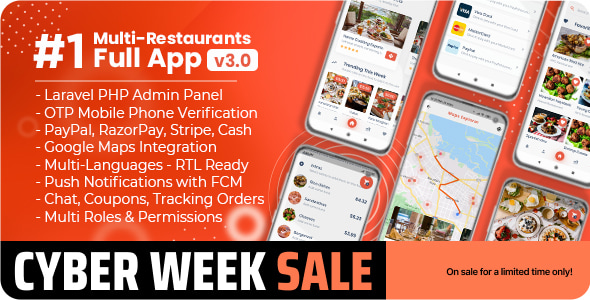
Order flow is handled end to end. A customer places an order, the restaurant sees it, a manager assigns it to a delivery person, and the customer follows progress on a timeline and can cancel while the order is still unstarted. Push notifications built on Firebase Cloud Messaging fire at each of those handoff points, so the customer, the restaurant and the driver each get told when something changes. Email notifications are supported too, through SMTP, Mailgun or Sparkpost, which matters for order confirmations and receipts that people expect to keep.
Payments are handled through the usual suspects — Stripe, Razorpay and PayPal are named — plus cash on delivery for markets where card penetration is weak. Coupons are supported in two forms, a fixed amount off and a percentage off, and each coupon can carry an expiry date. Restaurant owners can run their own promotions on individual food items, which is the kind of thing that separates a real marketplace from a single-vendor storefront.
Two features deserve separate mention because they are frequently missing from cheaper scripts. The first is multi-language support with right-to-left layout handling, which means Arabic, Hebrew, Farsi and Urdu can be rendered correctly rather than mirrored badly. The second is multi-currency support, where a currency can be created and the whole suite follows it. For anyone targeting a region outside North America and Western Europe, those two alone change whether the product is usable at all.
On the presentation side, the Flutter app ships with a light and dark theme that can be switched, and with animations — hero transitions, parallax, sliding and swiping effects — that make the interface feel less like a template. Rebranding is handled through colours, logos and icons. Restaurants can be plotted on Google Maps, and customers see nearby restaurants that deliver to their location, which is the correct behaviour for a delivery product rather than a plain list.
Installation is handled by a wizard. The vendor states that setup of the app and panel takes a few steps, and the package includes the full Flutter source for Android and iOS alongside the Laravel backend.
Where this fits, and where it does not
The obvious fit is a regional or city-level delivery startup that needs a working product in front of real customers quickly. A development shop building a delivery platform for a client is the second fit, because the source is included and can be extended rather than merely configured. A restaurant group running several locations under one brand is a third, since the multi-restaurant structure can represent branches or sister brands. Anyone building for a market that needs right-to-left text or a non-dollar currency should treat this as a serious candidate.
The wrong choice is equally clear. A single restaurant that wants its own branded ordering app does not need a multi-restaurant directory, and the extra structure becomes clutter to work around. An agency that needs a fully custom delivery model — subscription meal boxes, scheduled weekly deliveries, tipping logic, or a courier fleet with route optimisation — will spend more time bending this codebase than writing fresh code. And a buyer who wants a hosted service with no server to manage should look elsewhere, because this is source code that has to be installed, configured and maintained.
There is also a scope problem that buyers must read carefully before purchasing. The package includes the customer app and the admin panel. The separate delivery-person app and the manager or owner app are explicitly not included in this item. The admin panel does support driver accounts and admin-side driver login, but the mobile apps those roles would use are sold separately. Anyone budgeting for a complete three-app delivery business needs to account for that.
Strengths and limitations
Strengths
- Full Flutter source for both Android and iOS, so the app can be modified rather than only reskinned.
- Laravel backend with a documented installation wizard, which shortens the gap between purchase and a running environment.
- Genuine multi-restaurant architecture with per-restaurant menus, coupons and promotions.
- Right-to-left language support and multi-currency handling, both of which are rarer than they should be at this price.
- Push notification coverage across all three order handoffs — customer, restaurant and driver.
- Three payment gateways plus cash on delivery, covering both card-first and cash-first markets.
- Light and dark themes, plus a set of built-in animations that lift the interface above stock template quality.
- An active purchase history of over 2,400 sales, which means third-party discussion and community answers exist.
Limitations
- The delivery-person app and the manager or owner app are not part of this purchase. This is the single most common source of disappointment, and the vendor does state it in the listing.
- The rating sits at 3.99 out of 5 from 143 reviews. That is not a failing score, but it is meaningfully below the 4.5-plus range that buyers usually expect from a mature CodeCanyon item, and it suggests recurring friction in support, setup or edge cases.
- The last vendor update recorded is 17 January 2023. The package targets Flutter 3.x, and Flutter moves quickly, so a buyer starting today should expect to resolve dependency and version drift before the app builds cleanly.
- Social authentication is available on the admin panel only, not in the customer mobile app, which is an inconsistency users will notice.
- Everything runs on infrastructure the buyer supplies. There is no hosted option, so server setup, SSL, cron jobs and email deliverability all become the buyer’s responsibility.
- Customising the visual identity beyond colours, logos and icons requires Flutter and Laravel skills. This is source code, not a no-code builder.
How it compares to the wider category
Delivery scripts on marketplaces generally fall into three tiers. At the bottom are single-restaurant ordering templates with a basic panel and no real marketplace logic. In the middle sit multi-restaurant packages like this one, offering a customer app, an admin panel and the operational features — coupons, notifications, geolocation, roles — that make a marketplace function. At the top are enterprise platforms with dedicated courier apps, dispatch algorithms and support contracts, priced orders of magnitude higher.
This product sits firmly in the middle tier and is priced accordingly at $29. Against bottom-tier alternatives it wins on architecture: multi-restaurant support, RTL languages, multi-currency and role management are not features those packages have. Against top-tier platforms it loses on completeness, because the courier and manager apps are separate purchases and there is no dispatch intelligence. The honest comparison is not “is this the best delivery platform” but “does this give a developer a defensible starting point for the money” — and for a two-app core with full source, it broadly does.
Frequently Asked Questions
Does this package include the delivery boy app and the restaurant owner app?
No. The purchase covers the customer mobile app and the PHP Laravel admin panel only. The vendor states plainly that the delivery-person app and the manager or owner app are not included in this item and are sold separately. Buyers planning a complete three-app operation must budget for those additional purchases.
Which technologies and versions does it require?
It is built on Flutter 3.x for the mobile app and PHP with the Laravel framework for the backend. The included files cover Dart, YAML, Kotlin, Swift, plist and header files for the app, plus PHP, JavaScript, CSS and HTML for the panel. The vendor does not state a specific minimum Laravel version.
Can the app support right-to-left languages like Arabic or Hebrew?
Yes. Both the customer app and the admin panel support multiple languages including right-to-left scripts, so Arabic, Hebrew, Farsi and Urdu can be rendered properly. Multi-currency support is included alongside it, letting a currency be created and applied across the whole suite, which suits operators targeting non-Western markets.
Is the source code included, or is this a hosted service?
Full source code is included for both the Flutter app and the Laravel admin panel. This is not a hosted service. The buyer installs everything on their own servers using the provided installation wizard, which means server configuration, SSL, email setup and ongoing maintenance remain the buyer’s responsibility.
Verdict
This is a sensible purchase for a developer or small agency that needs a multi-restaurant ordering platform with full source, works comfortably in Flutter and Laravel, and is prepared to spend time on setup, version updates and branding. The combination of RTL languages, multi-currency, three payment gateways and real marketplace structure is a lot of capability for $29, and the sales volume means help is likely to exist in community forums. It is a poor fit for anyone expecting a finished, hosted product, for single-restaurant operators who do not need a directory, or for buyers who need the courier and manager apps in the same box. The 3.99 rating and the 2023 update date are the two signals to weigh most heavily before committing.