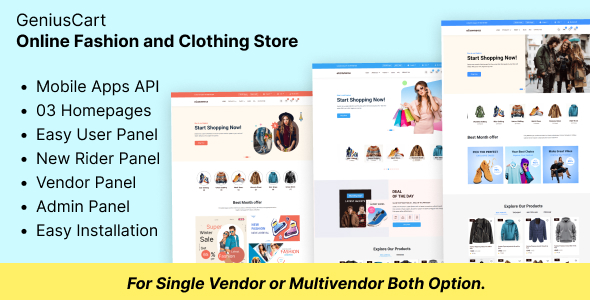
GeniusCart is a PHP shopping cart script built on the Laravel framework that lets a site owner run a single-vendor or multi-vendor fashion and clothing store from one admin panel. It bundles physical products, digital downloads and licence keys into the same catalogue, and adds affiliate, subscription and wholesale selling on top. It suits freelancers and small agencies building a ready-made storefront for a client, rather than teams that need deep custom development.
The GeniusCart Shopping Carts category on CodeCanyon is crowded, and this entry has earned a meaningful track record: 2,025 sales and a 3.84 out of 5 rating across 123 reviews, at a flat $35. That sales volume says more about the price point than the polish, so a closer look at what the script actually delivers is warranted before committing a project to it.
What the script actually does well
The headline capability is a unified catalogue. Most carts force a choice between physical goods, downloadable files and licence keys. GeniusCart lets all three sit in one store, or be split into separate storefronts per category. For a fashion retailer that also sells gift cards or digital lookbooks, that removes the need to bolt on a second system.
The vendor switch is the other notable feature. A store can launch as single-vendor and be flipped to multi-vendor from the admin panel when the business grows. In practice this means the same installation supports a solo boutique and a marketplace of independent sellers, with vendor verification, vendor subscription plans and withdrawal management handled in the back end. Sellers get their own dashboard covering balance, orders, affiliate earnings, deposits and disputes.
Affiliate marketing is built in rather than added via a plugin. Any visitor can register as an affiliate, promote products and earn commission, and the admin panel tracks referral performance in charts. For a new store with a small ad budget, that is a genuine acquisition channel. The script also supports commission-based selling, wholesale pricing and subscription products, so a clothing brand could run a membership box alongside standard retail.
Storefront, admin and the parts that matter day to day
The admin panel is broad to the point of being sprawling. It covers order states from pending through processing to completed and declined, country and tax rules, coupon management, shipping and packaging methods, pickup locations and a staff management system with role permissions. There is a secret admin login option and a maintenance mode toggle, both small features that matter when a store is live and needs to be locked down quickly.
Content management is included rather than delegated to a separate CMS. Blog posts, FAQ pages, contact pages, homepage sliders, deal-of-the-day blocks and footer content are all editable from the dashboard. Email templates, group email sending and integrations with Sendiio and GetResponse are present for basic list marketing. Payment gateway and currency settings sit in the same place, with multiple currencies and languages supported.
On the customer side, the account area covers order tracking, favourites, a messaging system between buyers and sellers, support tickets and a dispute flow for problem orders. Product reviews and ratings are native. The vendor lists high-resolution assets and the full source in JavaScript, HTML, CSS, PHP and SQL, so the code can be modified rather than treated as a black box.
Where GeniusCart fits, and where it does not
This is a sensible fit for a freelancer delivering a fashion, jewellery or general apparel store on a defined budget and timeline. The breadth of pre-built features means a client gets affiliate tools, multi-vendor capability and subscription selling without commissioning custom work. It also suits an agency prototyping a marketplace concept before investing in a bespoke build, since the single-to-multi-vendor switch keeps the door open.
It is a poor choice for an established retailer with an existing ERP, warehouse system or complex inventory integration. Nothing in the vendor data suggests deep third-party logistics hooks, and a Laravel script of this scope will need developer time to connect to external systems. Teams that need guaranteed long-term support contracts, PCI-level compliance documentation or enterprise SLAs should look at hosted platforms instead. The same applies to anyone who wants a hands-off managed solution: this is self-hosted software that requires a server, PHP 7.x and MySQL 5.x or 8.x, plus someone to maintain it.
Strengths and limitations
Strengths
- One installation handles physical products, digital downloads and licence keys, avoiding a second system for mixed catalogues.
- Single-vendor to multi-vendor conversion happens from the admin panel without a rebuild.
- Affiliate, wholesale, commission and subscription selling are native, not plugin add-ons.
- Full source files included, so the store can be extended by a developer.
- Broad admin tooling covers tax, shipping, coupons, staff roles and content pages in one place.
- Low one-off cost at $35 with a substantial installed base of 2,025 buyers.
Limitations
- The 3.84 rating across 123 reviews signals a meaningful minority of buyers hit problems; it is not a uniformly smooth experience.
- The declared browser support list includes IE6 through IE11, which points to an ageing compatibility matrix rather than a modern, actively pruned codebase.
- Feature breadth comes at the cost of interface complexity; the admin panel carries a very large number of screens and settings.
- No managed hosting, no support SLA and no documented integration with external inventory or accounting systems.
- Self-hosted means the buyer owns updates, backups, security patching and server configuration.
How it compares with the wider shopping cart category
Against hosted SaaS storefronts, GeniusCart trades convenience for ownership. A hosted platform handles hosting, updates and security, but charges monthly and limits how far the code can be changed. This script is a one-time purchase with editable source, which appeals to agencies that want to hand a client a self-contained asset.
Against open-source carts like WooCommerce or PrestaShop, the difference is packaging. Those are ecosystems that require assembling plugins for affiliates, multi-vendor and subscriptions. GeniusCart ships those features in the box, which shortens the build but narrows the pool of developers who know the specific codebase. Against other CodeCanyon cart scripts, its differentiator is the combined single/multi-vendor model and the mixed product types, which many cheaper scripts split across separate products.
Frequently Asked Questions
Does GeniusCart require coding knowledge to set up?
No coding is needed for standard configuration, but server setup is. The script must be installed on hosting that runs PHP 7.x and MySQL, and the admin panel handles store settings, products and payments through forms. Buyers without server experience will still need help with installation and ongoing maintenance.
Can GeniusCart run both a single-vendor and a multi-vendor store?
Yes, and it can switch between them. A store starts as single-vendor and the admin panel can convert it to multi-vendor when needed. Sellers then receive their own dashboards, subscription plans, verification checks and withdrawal management, all controlled from the same back end.
What product types can be sold with GeniusCart?
Physical goods, digital downloads and licence keys can all be sold from one catalogue. The vendor also supports wholesale pricing, commission-based products and subscription products. That means a fashion store could sell clothing, digital gift cards and a recurring membership box without running separate installations.
Is GeniusCart suitable for a large established retailer?
Generally no. It is built for small and mid-sized stores and marketplaces that want a ready-made feature set at low cost. Large retailers usually need documented integrations with inventory, logistics and accounting systems, plus formal support agreements, none of which the vendor lists for this product.
Verdict
GeniusCart is worth buying for freelancers and small agencies that need a feature-rich fashion or multi-vendor store delivered quickly on a tight budget, and who are comfortable managing their own hosting. The native affiliate, subscription and mixed product-type support genuinely reduces build time. It is not the right pick for enterprise retailers needing integrations and SLAs, nor for buyers who want a fully managed platform with no server responsibility. The 3.84 rating should be read as a prompt to test the demo thoroughly against the specific workflow before purchase, not as a reason to dismiss it.