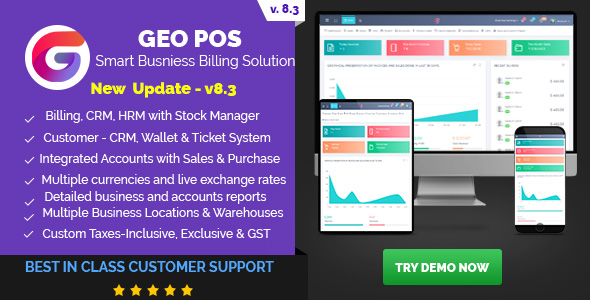
Geo POS is a self-hosted point of sale, billing and stock management application built with the CodeIgniter framework and sold as a PHP script on CodeCanyon. It bundles retail checkout, invoicing, purchasing, inventory, accounting, HR and a customer portal into a single installable system, and it is aimed at small retail chains, wholesalers and service businesses that want to own their sales data rather than rent it monthly. The script has been purchased 2,310 times and holds a 4.69 out of 5 rating across 164 reviews.
The current release is version 10.0 build 300, published by UltimateKode. That release is not a cosmetic refresh: the vendor rewrote the core code, migrated the application to CodeIgniter 4, extended PHP support to 8.2 and rebuilt the authentication layer around a Bcrypt and SHA256 hybrid. For anyone who evaluated Geo POS PHP Scripts in an earlier form, the architecture underneath has changed substantially even though the interface has not.
What Geo POS Actually Does Beyond Ringing Up a Sale
At its centre is a checkout screen designed for speed, with support for barcode-driven product lookup, configurable product units and variable products such as size and colour. Each employee can be assigned a dedicated POS register, and the register log records activity per till, which matters when more than one person shares a terminal across shifts. Unpaid invoices can be issued as QR codes, so a customer can scan and settle later without staff re-keying the order.
Around that checkout, the script layers the back-office functions a shop actually runs on:
- Multi-store operation. Several branches can sit under one brand, with employees assigned to specific stores. Stock, sales and reporting can therefore be read either per location or across the business.
- Inventory control. Stock is tracked by category and by warehouse, with product serial numbers, live stock status, low-stock email alerts and an integrated link to purchasing so replenishment follows demand rather than guesswork.
- Quotations and purchase orders. Quotes can be emailed as proposals and converted into invoices once accepted; purchase receipts can be sent to suppliers with the stock requirement attached, and received goods feed straight into inventory.
- Accounting and reporting. Sales, purchases, payments and manual transactions all post into the accounts module, which produces company statistics, income and expense statements, and tax statements for sales and purchases.
- Tax handling. Inclusive, exclusive and GST tax modes are supported, with tax rates and discount rates configurable per product rather than applied globally.
- Subscriptions. A recurring billing module handles services and memberships, including online payment collection.
- HR and payroll. Employee attendance, holidays, salary, salary history and increments are managed inside the same system, so payroll draws on the same employee records used for register assignment.
- Project and task management. Jobs can be tracked with customer-visible comments, and managers can assign tasks to staff.
- Support tickets. Customers raise tickets from their own login and employees respond, keeping after-sales communication inside the application.
Two integration points deserve separate mention. A REST API driver ships with sample methods, so the POS can exchange data with an existing website, accounting tool or mobile app with limited custom coding. The script also supports CRON jobs, which is how scheduled tasks such as low-stock alerts and recurring subscription charges run without anyone pressing a button.
Payments are handled through preloaded gateways including Stripe, PayPal, Authorize.Net, RazorPay and PayUMoney. SMS and Twilio integration is included, with optional Bit.ly shortening for invoice links sent by text. The interface ships translated into 21 languages, with the language files bundled, and the vendor states that no programming knowledge is needed to install or operate it. A ready-to-use REST API, reCaptcha on forms and export and backup utilities round out the administrative side.
Where Geo POS Fits, and Where It Does Not
The script suits a single-location retailer that has outgrown a spreadsheet and a standalone cash register, and it scales to a handful of branches under one owner. A pharmacy, electronics shop or clothing store with serialised or variable stock will find the inventory and variation handling unusually complete for this price bracket. Wholesalers benefit from the quotation-to-invoice pipeline and supplier purchase orders. Service businesses with recurring revenue can use the subscription module instead of bolting on a separate billing tool. Agencies also buy scripts like this as a starting point for a client build, since the CodeIgniter 4 codebase is a mainstream framework that a PHP developer can extend.
It is the wrong choice for a business that needs a fully managed cloud service with staff on call, automatic infrastructure scaling and PCI-compliant hosting handled for it. Self-hosting means the buyer owns the server, the backups, the SSL certificate and the upgrade path. It is also a poor fit for high-volume hospitality or restaurant environments that depend on table maps, kitchen display screens and split-bill workflows, none of which the vendor lists. Anyone needing native iOS or Android apps for staff should look elsewhere, because the product is a browser-based application.
Strengths and Limitations
Strengths
- Breadth of modules in one licence: POS, inventory, accounts, HR, projects and support tickets would otherwise mean four or five separate subscriptions.
- CodeIgniter 4 with PHP 8.2 support puts the codebase on a currently maintained framework rather than a legacy one.
- Bcrypt and SHA256 hybrid authentication is a meaningful upgrade for anyone storing customer and payroll data.
- Multiple stores, per-employee registers and role-based access (admin, manager, sales manager, sales person, customer) reflect how real shops are staffed.
- REST API and CRON support give a clear route to automation and third-party integration.
- 21 bundled translations widen the addressable market for agencies reselling a localised build.
- A public demo covering every user role lets a buyer test the workflow before paying.
Limitations
- Support is delivered exclusively through the vendor’s help desk by email or message. There is no phone or live chat channel, so a till that fails on a Saturday depends on ticket turnaround.
- The vendor does not publish a formal support period, response-time commitment or refund policy in the listing, so those terms need confirming before purchase.
- Setup, hosting, backups and version upgrades are the buyer’s responsibility. A major release such as the CodeIgniter 4 migration is not something a non-technical owner can apply alone.
- The feature set is wide, which means configuration effort is real: tax modes, warehouses, registers, roles and email templates all need decisions before go-live.
- Thermal printer support is listed but the compatible models are not enumerated in the supplied data.
- Documentation depth beyond the installation video is not stated, and heavy reliance on a help desk suggests the written docs may be thin.
How It Compares With the Wider Category
Buyers researching this space usually weigh three options: a hosted SaaS POS with a monthly fee per terminal, a bespoke build, or a licensed script such as this one. Hosted platforms win on convenience, automatic updates and phone support, but the cost compounds and the data lives on someone else’s server. A bespoke build offers a perfect fit at many times the price and with an ongoing maintenance burden.
Geo POS sits in the licensed-script middle. Its advantage over typical scripts in the category is module coverage: many competitors stop at checkout and inventory, leaving accounting, payroll and subscriptions to separate tools. Its disadvantage is the same as every self-hosted option, namely that the buyer becomes the IT department. Against free open-source POS projects, the trade is reversed: no licence fee, but no vendor to escalate to and no single accountable author. UltimateKode has a track record here, and the author’s stated background in published research is a reasonable signal of engineering discipline, though it is a claim rather than a guarantee.
Frequently Asked Questions
What are the server requirements for Geo POS?
Geo POS needs PHP 7.3 or later with MySQL, and the current version supports PHP up to 8.2 on the CodeIgniter 4 framework. The vendor states no special server configuration is required and that the application runs on modest hardware. MySQL 5.x is listed as compatible in the declared specifications.
Can Geo POS handle more than one shop location?
Yes. Multiple stores can be created under one brand, and employees are assigned to specific stores. Stock is managed across warehouses, and reporting can be read per location or combined. This makes the script workable for a small chain rather than only a single shopfront.
Does Geo POS integrate with payment gateways and other software?
Yes. Stripe, PayPal, Authorize.Net, RazorPay and PayUMoney are preloaded, and a REST API driver with sample methods lets the system exchange data with external applications. CRON job support allows scheduled tasks such as recurring subscription charges and low-stock alerts to run automatically.
Is Geo POS a one-time purchase or a subscription?
It is a one-time licence purchase of $47 through CodeCanyon, not a recurring fee. The buyer receives the HTML, CSS, PHP and SQL source files. Ongoing costs come from hosting, domain and any custom development, plus the vendor’s own terms for future updates, which the listing does not spell out.
Verdict
Geo POS is worth buying for a shop owner, wholesaler or small chain that wants a complete retail back office in one licence and is comfortable arranging hosting and maintenance. The 2,310 sales and 4.69 rating across 164 reviews suggest the script is stable enough to trust with daily trading, and the CodeIgniter 4 rewrite shows the developer is still investing in the product rather than letting it stagnate. Agencies building for clients will find the module coverage and REST API reduce the amount of custom work needed.
It should be avoided by anyone who wants a managed service with guaranteed response times, or whose operation depends on restaurant-style table and kitchen workflows. Buyers should also confirm the update and support terms directly with the vendor, because the listing does not state them, and should budget for a developer to handle the initial setup and any future major upgrade.