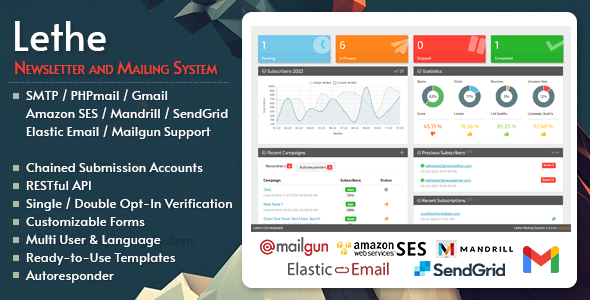
Lethe PHP Newsletter & Mailing System is a self-hosted email marketing script built in PHP and MySQL, sold on CodeCanyon as a Miscellaneous PHP script. It gives an organisation its own subscriber database, sign-up forms, campaign builder, delivery accounts and reporting, all running on infrastructure the buyer controls rather than on a third-party platform. It suits freelancers, agencies and small teams that want to send bulk mail without a recurring per-subscriber fee, and who are comfortable maintaining a PHP application on their own server. The script has been purchased 1,846 times and holds a 3.89 out of 5 rating across 142 reviews, which suggests a working product with a meaningful share of dissatisfied buyers.
What the script actually handles, from sign-up form to delivery report
The core of Lethe is a multi-user application. Each account gets its own theme choice from a set of 16, its own file storage, and its own sending accounts, and an administrator can restrict which modules each user may touch. That structure is what separates it from a single-login script: an agency can hand clients a login and keep them out of each other’s lists.
Subscription management is the most developed area. Groups are unlimited, and the system maintains its own categories for blacklisted, ungrouped, unsubscribed and bounced addresses so those contacts do not silently re-enter a send. Import covers plain text files, a CSV importer with drag-and-drop field mapping, and connectors that pull records directly from WordPress, WooCommerce-adjacent platforms such as OpenCart, PrestaShop, Magento and osCommerce, plus Joomla and phpBB. Export produces TXT or CSV. Anyone migrating away from an older platform will find that connector list does most of the painful work.
Sign-up forms are built with a drag-and-drop editor that supports 14 field types, Google reCAPTCHA v2 and v3, regex validation, custom success and error messages, redirect-after-subscribe behaviour and several layout styles. Forms can be embedded in an existing site, which matters because Lethe is explicitly not a blog or a CMS plugin — the vendor states plainly that the front-end demo only illustrates form integration, not a complete website.
On the sending side, campaigns can be scheduled for a future date, targeted at multiple groups at once, and given their own sender and reply-to addresses and their own submission account. Attachments are unlimited in count. Delivery runs through SMTP, PHP mail, Gmail with OAuth, SendGrid, Mandrill, Mailgun, Amazon SES or Elastic Email, with DKIM signing and a chained-account option that rolls over to a second provider when the first hits its limit. Bounce handling is rule-based: a returned message can trigger deletion, group movement, blacklisting or unsubscription.
Automation is handled through autoresponders rather than a visual journey builder. The available triggers are subscription, unsubscription, a delay of a set number of days, selected weekdays on a repeating cycle, and a specific calendar date tied to the subscriber — a birthday or an invoice due date, for example. Reporting covers opens, clicks, bounces and unsubscribes, with per-subscriber graphical views and a productivity breakdown that attempts to score campaign and list quality. A survey module and a manual email sender for individual contacts round out the feature set, and 23 bundled languages plus a language editor cover localisation.
Where Lethe fits, and where it does not
The clearest fit is an agency or freelance developer running email for several small clients who each want their own branding and their own sending domain. The multi-user permissions, per-user themes and per-user submission accounts are built for that arrangement, and the one-off $55 price compares favourably with monthly platform fees once a list grows past a few thousand contacts.
It also suits organisations with data-residency or compliance constraints that rule out handing a subscriber list to an outside provider. Because the database sits on the buyer’s server, the list never leaves it. A membership site, a school, a club or a small publisher with an existing PHP host and a technical person on hand is a natural buyer.
It is a poor choice for a non-technical site owner who wants to install something and forget it. The requirements list is long and specific: PHP 7.4 or newer, cURL, fopen and fileinfo functions, bcmath or gmp plus sodium, mod_rewrite, and writable directories. Shared hosting frequently blocks some of these, and the vendor’s own notes acknowledge that hosting configuration differences are the most common source of trouble. Installation is not included in support; buyers who want help must pay the author separately. Anyone expecting a WordPress plugin should stop here, because Lethe is a standalone application.
Teams that need sophisticated lifecycle marketing — branching journeys, behavioural triggers, A/B testing on subject lines — will also find the autoresponder model too linear. And anyone unwilling to manage deliverability, domain reputation and IP warming themselves should stay with a hosted platform that does it for them.
Strengths and limitations in plain terms
Strengths
- Genuine multi-tenancy: separate users, themes, files and sending accounts with module-level permissions.
- Broad import coverage, including direct database pulls from WordPress, Magento, PrestaShop, OpenCart, Joomla and phpBB.
- Flexible delivery: eight sending methods, DKIM, and chained accounts that fail over automatically when a provider limit is reached.
- Rule-based bounce handling that can blacklist or unsubscribe a bad address without manual intervention.
- Drag-and-drop builders for both sign-up forms and email templates, with reCAPTCHA v2 and v3 support.
- One-time purchase with no per-subscriber pricing, and full source files included for customisation.
- Actively maintained — the vendor’s most recent update was in February 2025.
Limitations
- A 3.89 average from 142 reviews is a warning sign. Read the low-scoring reviews before buying, not just the summary.
- Installation is explicitly excluded from support, and the vendor charges extra for setup help.
- No refunds on the downloaded file, and the vendor states that requirements are the buyer’s responsibility to check first.
- The autoresponder is trigger-and-delay based, not a branching visual journey builder, so complex lifecycle sequences are awkward.
- Deliverability is entirely the buyer’s problem: IP reputation, SPF, DKIM and DMARC alignment, and warm-up all sit outside the script.
- Support covers error fixes and server-side mismatch checks only. Customisation is out of scope.
- The demo front end is not a website, so there is no ready-made public-facing experience beyond embedded forms.
How it compares with the wider category
Self-hosted newsletter scripts occupy a narrow band between hosted platforms and full marketing automation suites. Against hosted services, Lethe wins on cost structure and data ownership and loses on convenience: there is no vendor managing uptime, IP reputation or compliance tooling. Buyers trade a monthly fee for server administration.
Against other self-hosted scripts in the same marketplace category, Lethe’s differentiators are the multi-user architecture and the breadth of third-party import connectors. Many competing scripts assume a single administrator and a single list, which makes them simpler to install but useless for an agency. Lethe also goes further than most on sending-account chaining, which is a practical answer to the per-provider daily limits that free and low-tier SMTP services impose.
Against full marketing automation platforms, the gap is workflow depth. Lethe handles campaigns, autoresponders and surveys competently but does not attempt multi-branch journeys, lead scoring or CRM integration. Buyers who need those should look at heavier commercial systems, or pair a simple sender with a dedicated automation tool.
Frequently Asked Questions
Is Lethe a WordPress plugin or a standalone script?
It is a standalone PHP application, not a WordPress plugin. It installs on a web server with PHP and MySQL and runs independently of any CMS. The vendor states this explicitly, noting that the front-end demo only shows subscription forms and integration examples rather than a full website. WordPress appears only as one of several supported data sources for importing subscribers.
Can Lethe send through Amazon SES or SendGrid instead of PHP mail?
Yes. Delivery accounts can be configured for SMTP, PHP mail, Gmail with OAuth, SendGrid, Mandrill, Mailgun, Amazon SES or Elastic Email. Accounts can be chained, so when one provider’s limit is reached the system continues from the next selected account. Each user can be assigned their own submission account, and DKIM signing is supported.
What are the server requirements for installing Lethe?
It needs PHP 7.4 or newer with cURL, fopen, fileinfo and file_get or file_put functions, plus the bcmath or gmp extension and sodium, and mod_rewrite. MySQL 5.x or 8.x is supported. Writable files and folders are required. The vendor also lists imap_open and shell_exec as recommended but optional. Buyers should verify these against their host before purchasing, since refunds are not available.
Does Lethe handle bounced emails automatically?
Yes, through configurable bounce rules. When a returned message is detected, the system can be set to delete the address, move it to another group, add it to the blacklist or mark it unsubscribed. Rules are customisable, and a dedicated system group holds problematic addresses. The vendor lists the imap_open function as recommended for bounce processing, so hosts that block it may limit this feature.
Verdict
Lethe is a sensible purchase for developers, agencies and technically staffed organisations that want to own their subscriber data and stop paying per-contact fees, and that can meet the server requirements and take responsibility for deliverability. The multi-user design and import connectors are the strongest reasons to choose it over simpler self-hosted scripts. Buyers who need installation help, a non-technical operator, or advanced branching automation should look elsewhere, and the 3.89 rating means the low-scoring reviews deserve a careful read before checkout. The author, thunderfury, has kept the script updated into 2025, which is a reasonable signal of ongoing maintenance.