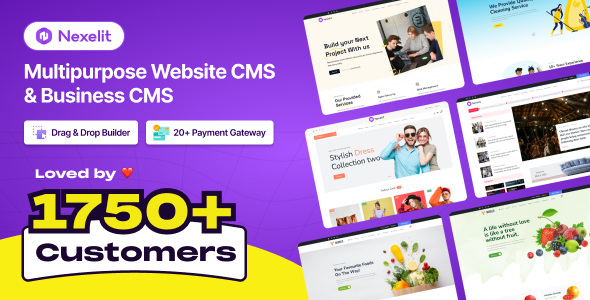
Nexelit is a self-hosted PHP application built on the Laravel framework that combines a content management system with a set of small business tools — product sales, event ticketing, appointments, course enrolment, donations, job listings and support tickets — inside one admin panel. Sold on CodeCanyon by the developer xgenious for $39, it is aimed at freelancers and small agencies who want to launch a multi-purpose business site without stitching together a CMS, an e-commerce plugin and several separate booking scripts. The category it sits in is CodeCanyon’s PHP Scripts > Miscellaneous, which is a fair description of Nexelit Miscellaneous: it is a general-purpose toolkit rather than a specialist product in any single vertical.
What the script actually gives a site owner
The core proposition is breadth. Instead of installing WordPress with a theme plus a commerce plugin plus a booking plugin plus a donation plugin, a buyer gets a single Laravel codebase where all of those functions share one user table, one login and one dashboard. That matters most for the parts of a site that usually need custom work: a user who buys a product, books an appointment and opens a support ticket does so under one account.
Selling products, physical or digital
The commerce module handles both shippable goods and downloadable files. Products support attributes for describing variations, a stock counter that disables the add-to-cart button when an item runs out, and coupon codes. Shipping is configured separately with a selectable default method, and cash on delivery sits alongside a long list of gateways including PayPal, Stripe, Razorpay, Paystack, Mollie, Flutterwave and a manual option. Each gateway can be switched off individually, which is useful when a client only wants one or two payment routes live.
Bookings, tickets and courses
Three modules follow the same pattern: a public-facing listing, a checkout, and an admin screen for managing submissions. Appointments suit clinics, consultancies or law practices where a visitor picks a date and time slot. Events carry organiser and venue details plus an optional Google Maps location, and can sell tickets. Courses can be sold as online or offline products, with a cap on the number of applicants and the ability to mark individual lessons as free previews.
Fundraising, hiring and client work
The donation module lets an administrator publish a cause with a target amount and displays a progress bar against what has been raised, with every transaction visible in the back end. The jobs module posts vacancies by category and accepts applications either through a form or by email. A package-selling module covers service businesses that quote for work or sell fixed price plans, and includes a client feedback page that can both collect and display testimonials.
Support and site building tools
A ticket system lets logged-in users raise and reply to requests, attach zip files, set priority and have status changes tracked, with notifications on updates. On the presentation side there is a drag-and-drop menu builder with mega menu support, a popup builder with four preset styles and configurable delay, and twelve preloaders with the option to upload a custom image. A knowledge base module with searchable articles rounds out the self-service support story.
Where Nexelit fits well, and where it does not
The strongest fit is a small agency or freelancer running several client sites that each need two or three of these functions. A yoga studio that sells class packages, runs retreats with tickets and takes appointment bookings is a realistic single install. A consultant who sells a digital product, publishes a price plan and collects testimonials is another. Because the script is multi-tenant only in the sense that a super admin can create additional admin and editor roles, it also suits a single organisation with a small content team rather than a SaaS operator.
It is the wrong choice for anyone who needs deep specialisation in one area. A store that lives or dies on product filtering, variant pricing matrices, tax rules by region and abandoned-cart recovery will find the commerce module thinner than a dedicated e-commerce platform. Likewise, a business that needs recurring subscriptions, calendar sync with external providers, or complex membership tiers is outside what the vendor describes. Buyers who cannot run PHP 8.3 with MySQL on their own hosting, or who want a fully managed hosted platform, should look elsewhere — this is a script that must be installed and maintained.
Strengths and limitations
Strengths
- One shared user account and dashboard across commerce, bookings, courses, donations and tickets, which removes the integration work that normally eats a project budget.
- Built on Laravel 12 with Bootstrap 4 on the front end, so a PHP developer inherits a familiar, well-documented framework rather than a bespoke codebase.
- Security basics are stated as handled: CSRF and XSS prevention, password hashing and protection against SQL injection.
- Installation and updates run through visual wizards, with written documentation and video walkthroughs, which lowers the barrier for less technical buyers.
- Source files are included in full — JavaScript, JSON, HTML, XML, CSS, PHP, SQL and layered PNG — so the front end can be rebranded rather than merely re-coloured.
- A track record of 1,973 sales and a 4.72 average across 183 reviews, with a recent update in September 2025 to version 4.1.0.
Limitations
- Bootstrap 4 is an ageing front-end framework; sites will look and feel current only after deliberate template work, and the default styling will read as generic.
- Support is delivered through the vendor’s own channels rather than a marketplace SLA, so response times are not something a buyer can verify in advance.
- The documentation and demo credentials are public, but the vendor does not publish a changelog depth or a roadmap, making it hard to judge how quickly individual modules will mature.
- Running PHP 8.3 and MySQL 8 rules out cheap shared hosting on older stacks and puts patch responsibility on the buyer.
- Each module is functional rather than best-in-class; anyone expecting the depth of a dedicated booking or e-commerce system will be disappointed.
How it compares with the wider category
The realistic alternatives fall into three groups. The first is WordPress with a multipurpose theme and a stack of plugins: cheaper to start, far larger an ecosystem, but the integration between commerce, bookings and memberships becomes a maintenance burden and plugin licences add up annually. The second is a hosted all-in-one platform such as Squarespace or Wix, which removes installation entirely but charges monthly forever and limits how far the code can be changed. The third is a custom Laravel build, which offers exactly the right features at several times the cost and timeline.
Nexelit’s argument is a one-off $39 payment for source code that covers most of the same ground as the plugin stack, with the integration already done. It wins on cost of ownership and on the freedom to modify. It loses on ecosystem depth, on design polish out of the box, and on the safety net of a large plugin community. For a developer comfortable with PHP, that trade is usually worth making; for a non-technical owner who wants to install and forget, the hosted route is calmer.
Frequently Asked Questions
What is Nexelit and what does it do?
Nexelit is a Laravel-based content management system with extra modules for selling products, ticketing events, taking appointments, enrolling students, raising donations, posting jobs and handling support tickets. It is a self-hosted PHP script bought once from CodeCanyon, so the buyer installs it on their own server and owns the source code outright.
Do I need coding knowledge to install Nexelit?
Basic server knowledge is enough for installation, because the script ships with a visual installer that asks for database and site details through a form. The vendor also provides written documentation and video tutorials. Customising the design or adding new modules, however, requires a PHP developer familiar with Laravel and Bootstrap.
Which payment gateways does Nexelit support?
Nexelit lists PayPal, Stripe, Razorpay, Paystack, Mollie, Flutterwave, Paytm and manual payment, plus cash on delivery for physical products. Each gateway can be enabled or disabled from the admin panel, and the same set is available across the product, event, course, appointment and donation modules rather than being limited to checkout.
Can Nexelit run more than one type of business on a single install?
Yes. A single installation can sell products, take bookings, run a fundraising campaign and publish job listings at the same time, and one registered user account spans all of them. Administrators can also create additional admin and editor roles with different permissions, though the vendor does not describe full multi-site tenancy.
Verdict
Nexelit is a sensible purchase for a PHP-capable freelancer or small agency that needs to deliver a business site combining two or more of commerce, bookings, courses, donations and support in one codebase, and that values owning the source over renting a platform. The price is low enough that a single project justifies it, and the Laravel foundation means the code is maintainable. Buyers who need a specialist storefront, subscription billing or a design that looks bespoke without development work should not buy it, and neither should anyone unwilling to manage PHP 8.3 hosting and updates themselves. Treat it as a strong starting framework rather than a finished product.