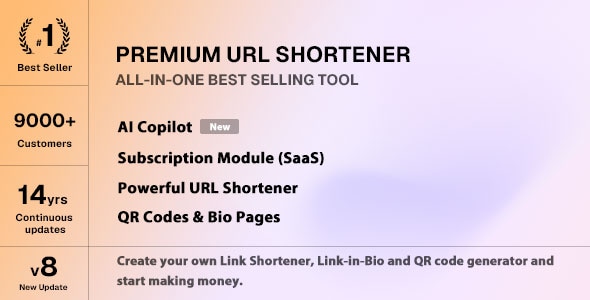
Premium URL Shortener Miscellaneous is a self-hosted PHP script from developer KBRmedia that lets a site owner run a link shortening platform on their own server, complete with analytics, bio pages, QR codes and optional paid plans. It is sold on CodeCanyon for $59 and has been downloaded more than 9,200 times, holding a 4.81 out of 5 rating across 837 reviews. The product suits freelancers, agencies and operators who want a branded alternative to public shorteners rather than a simple redirect tool.
What the script actually does beyond shortening links
At its core the script takes a long web address and returns a compact one, but the value sits in everything wrapped around that basic function. The dashboard records clicks, and each link can carry rules that change where a visitor lands.
Redirect logic is the most practical layer. Geotargeting sends visitors from a chosen country or state to a different destination, and device targeting does the same for mobile, desktop or tablet traffic. Both can be switched off globally from the admin panel or restricted per membership plan, which matters if those rules are meant to be a paid perk.
Campaigns group several links under one shareable address. A visitor opening that address sees every link in the set, and the statistics for the campaign are aggregated rather than scattered across individual entries. This is useful for product launches or affiliate roundups where a single call to action needs to fan out.
The AI Copilot is the newer headline addition. It connects to OpenAI, Gemini or Claude to generate slugs, bio page content and summaries of click data. The vendor meters this with monthly credits, per-feature costs and rate limits, so the operator controls spend rather than absorbing unlimited API calls.
Bio pages work as a link-in-bio builder. A user assembles a profile with social widgets, custom colours and a single shareable address, then watches traffic on it. The QR generator is a separate module: codes can be styled with different shapes and colours, carry a logo, and report scan counts.
Platform, membership and monetisation features
An extended licence converts the installation into a software-as-a-service operation, with Stripe, PayPal and bank transfer handling payments automatically. Even on the standard licence, the premium membership system is present, so free and paid tiers can coexist.
Custom domains are supported for both the administrator and individual users. An operator who does not want customer links living on the main domain can hand out alternative domains instead, which keeps branding separate and limits reputational spillover.
Supporting tools include a team feature for shared account access, an API that authenticates users by unique key, integrations with Slack, Zapier and a bundled WordPress plugin, and social login through Facebook, Twitter and Google. There is a built-in blog, a help centre, a translation manager, and a private mode that locks the whole installation to accounts the administrator creates.
Where this fits, and where it does not
An agency running a branded short domain for client campaigns is a natural fit. Links stay on agency infrastructure, click data stays in-house, and geotargeting or device rules can be applied per campaign without a third-party subscription.
A creator or small publisher building a link-in-bio hub alongside a blog is another match. The bio builder, QR codes and splash pages cover the usual distribution channels, and the bundled blog and help centre remove the need to bolt on separate software.
A developer launching a paid link management service is the third clear case. The SaaS mode, membership tiers, API and custom domain allocation are the pieces such a product needs, and the extended licence is what unlocks the payment automation.
The wrong fit is anyone wanting a managed service. This is a script that must be installed on a PHP and MySQL host, kept patched, and backed up. A marketer who wants short links without touching a server will find a hosted provider cheaper in time, even at a higher monthly cost. The same applies to anyone whose needs stop at redirecting a handful of internal URLs; the feature depth becomes overhead rather than advantage.
Strengths and limitations
Strengths
- Broad feature coverage in one package: shortening, analytics, bio pages, QR codes, campaigns and a CMS, so fewer separate subscriptions are needed.
- Genuine monetisation path through premium memberships and, on the extended licence, full SaaS billing with three payment routes.
- Targeting rules at country, state and device level, with the ability to gate them per plan.
- Custom domains for both admin and end users, which keeps client links off the main brand domain.
- Self-hosted data ownership, which matters for teams with privacy or compliance constraints.
- Long development history and a large review base, suggesting the codebase is maintained rather than abandoned.
- Source files are included in JavaScript, HTML, CSS and PHP, so the front end can be restyled without a rebuild.
Limitations
- The AI Copilot depends on third-party API keys and is metered by credits, per-feature costs and rate limits. Costs scale with usage and are not fixed by the licence fee.
- SaaS billing is tied to the extended licence, so the $59 standard price does not include the payment automation.
- Operational responsibility sits with the buyer: hosting, PHP and MySQL version management, security patching and backups are all outside the purchase.
- Browser support is listed as including IE11, which signals a codebase carrying legacy compatibility rather than a purely modern front end.
- Feature breadth means a real configuration phase. Enabling memberships, domains, captchas and targeting rules is a project, not a switch.
- The vendor does not state performance benchmarks or limits on how many links or clicks a single installation handles, so capacity must be tested against the intended host.
How it compares with the wider category
Alternatives fall into three groups. Hosted shorteners charge recurring fees per user or per click volume and keep the data; they win on setup time and lose on ownership and margin. Bare redirect scripts are cheap or free but stop at the redirect, leaving analytics, membership and QR generation to be built or bought separately. General-purpose CMS platforms can be extended into link management, but that means custom development and ongoing maintenance of bespoke code.
This script competes on consolidation. It bundles the analytics, the monetisation layer, the bio page builder and the QR module into one installation, which reduces the number of moving parts an operator has to integrate. The trade-off is depth in any single area. A dedicated analytics platform will report in more detail, and a specialist QR service will offer more export and design options. Buyers who need one of those functions at expert level should expect to keep a second tool alongside this one.
Against other CodeCanyon scripts in the same niche, the differentiators are the AI integration, the team feature and the maturity implied by nine years of updates and a high review count. Those are the areas worth checking in the live demo before committing, since the demo resets weekly and reflects the current build.
Frequently Asked Questions
Do I need coding skills to run this URL shortener script?
No coding is required for day-to-day operation, but server skills are. Installation needs a PHP and MySQL host, and someone must handle updates, backups and security. The admin panel covers configuration through a browser, and source files are included if front-end customisation is wanted later.
Can this script be used to sell link shortening as a service?
Yes, but only with the extended licence. That licence activates the SaaS mode, which manages subscriptions and payments automatically through Stripe, PayPal and bank transfer. The standard licence still supports premium membership tiers, so a simpler paid model is possible without the full billing automation.
Does the AI Copilot cost extra to use?
Yes. The AI features connect to OpenAI, Gemini or Claude using API keys, and the vendor meters usage with monthly credits, per-feature costs and rate limits. The licence fee covers the software, not the AI provider charges, so running costs depend on how heavily the feature is used.
Can users connect their own domains to shortened links?
Yes. Custom domains are supported for both the administrator and individual users. A user can add a personal domain and start issuing links from it, while the admin can supply extra domains for customers. This keeps links off the main site domain when that is preferred.
Verdict
Buy this if the goal is to own the link shortening stack rather than rent it. Agencies, developers and operators planning a paid link service will get the most from the combination of targeting rules, membership tiers, custom domains and the SaaS path on the extended licence, and the 4.81 rating across 837 reviews is meaningful evidence of a stable product.
Do not buy it if a hosted shortener already covers the requirement, or if nobody on the team can manage a PHP installation. The licence price is modest, but the real cost is hosting plus ongoing maintenance, and that only makes sense when the feature set is genuinely going to be used.