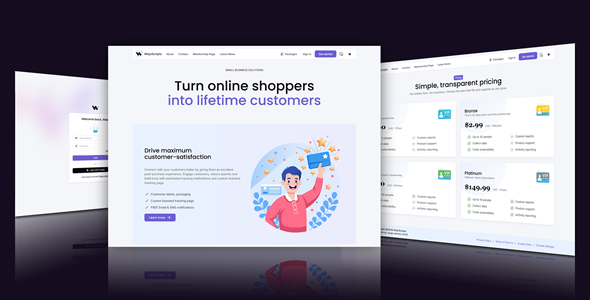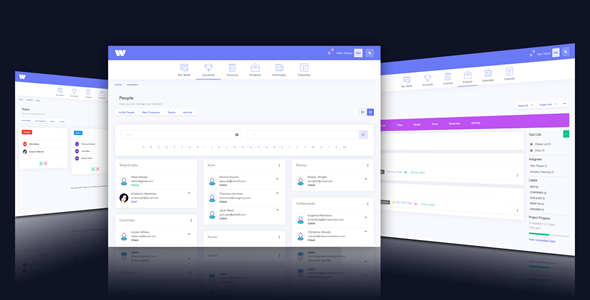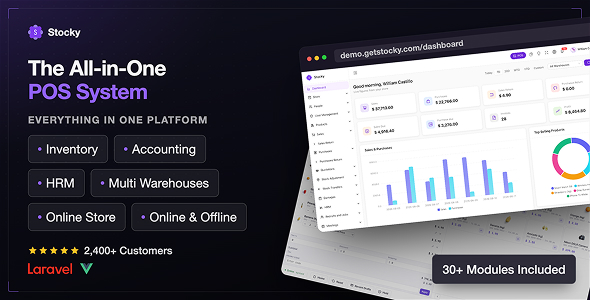
Stocky POS is a self-hosted business management script that combines point of sale, inventory control, invoicing, purchasing, accounting, HRM and a storefront module inside one Laravel application. It is sold once for $34 on CodeCanyon and installed on the buyer’s own server, so there are no monthly subscriptions or per-terminal charges. The product sits in the Project Management Tools category, though in practice it is a retail and back-office operations platform aimed at shop owners, wholesalers and agencies building systems for retail clients. Its 2,483 sales and 4.91 average rating from 220 reviews make it one of the more established PHP scripts in this niche, and the developer, ui-lib, ships it under a lifetime-update model.
What Stocky Actually Does Beyond Ringing Up Sales
The core of the product is a checkout screen, but the value sits in everything connected to it. Stocky runs as a Vue.js single-page application on top of a Laravel REST API, which means the interface updates without full page reloads — a small detail that matters at a busy counter where every second of lag is felt by the person waiting to pay.
Inventory handling goes deeper than simple stock counts. The system supports unlimited warehouses with stock transfers between locations and reporting per warehouse, which is the feature that separates it from entry-level POS scripts. Products can be priced across size and colour variants, tracked individually by serial number for electronics, weighed at the till for fresh produce, and monitored by batch and expiry date for pharmacies. Those four tracking models cover most of the awkward edge cases that generic systems handle badly.
The invoicing and purchasing side is fully built out: purchase orders, supplier records, profit and loss breakdowns, and reports on warranty and guarantee obligations for items already sold. There is also an HRM module for staff records, which is unusual at this price and useful for businesses that schedule shifts against a counter roster.
Two integrations stand out. WooCommerce sync is bi-directional and included in the base price rather than sold as a paid add-on — products, stock levels and orders move in both directions, with configurable overselling rules per product and automatic hiding of out-of-stock items from the storefront. Stocky also ships its own online storefront module, so a business can sell online and in person from one dashboard without a third-party platform. Shopify sync and offline sync are listed among the included features as well.
The reporting layer is marketed as AI-powered, covering sales trend analysis, stock valuation by cost and selling price, top-selling products and best-performing customers. Vendors use “AI” loosely in this category, and the listing does not explain which model or service powers it, so buyers should treat that label as a description of automated analysis rather than a guarantee of anything exotic.
Rounding out the package: full right-to-left language support, more than 24 languages manageable from the admin panel without touching code, a dark mode, multi-screen customer display support at checkout, and Excel import for products including service-type items.
Where Stocky Fits and Where It Does Not
A single-location retail shop with a handful of staff is the most obvious fit. The setup is quoted at under five minutes, and the breadth of included modules means a small business does not need to stitch together a POS, an invoicing tool and a separate accounting package.
Multi-location operations get more value from the warehouse transfers and per-location reporting. A business running a physical shop plus a WooCommerce store is arguably the ideal case, because the bi-directional sync removes the manual stock reconciliation that usually eats hours each week. Hybrid sellers who want their own storefront without paying for a separate platform are also well served.
Pharmacies, electronics retailers, repair workshops and grocery stores benefit from the specific tracking modes — expiry and batch, serial numbers, job tickets with parts logged against them, and weighed goods. Wholesalers and distributors fit the purchase order and supplier workflow.
Where Stocky is the wrong choice: businesses that want a fully hosted service with someone else managing updates, backups and server security. Stocky is self-hosted, so the buyer owns the server, the PHP 8.x and MySQL 8.x environment, the backups and the patching. A shop owner with no technical help and no appetite for hiring any should look at a managed SaaS product instead, even at a higher monthly cost. The same applies to operations that need native mobile apps for iOS and Android — the listing describes a browser-based application, and the vendor does not state that native apps are included.
Strengths and Limitations
Strengths
- One purchase price of $34 covers POS, inventory, ERP, invoicing, accounting, purchasing, HRM, WooCommerce sync and a storefront module — no feature gating behind add-ons.
- Bi-directional WooCommerce sync is included rather than sold separately, which is a real cost difference against scripts that charge for the same capability.
- Unlimited warehouses with stock transfers and per-warehouse reporting support genuine multi-location operations.
- Variant, serial, weight and batch/expiry tracking cover retail categories that simpler POS scripts cannot handle without workarounds.
- Laravel and Vue.js with a documented, structured codebase and source files included (JavaScript, HTML, CSS, Sass, PHP, SQL) makes customisation realistic for a development team.
- Full RTL support and 24+ admin-managed languages suit businesses trading in non-Latin scripts.
- Lifetime updates and six months of support, extendable to twelve, reduce long-term ownership cost.
Limitations
- Self-hosting shifts all responsibility for security patches, server hardening, uptime and backups onto the buyer. The vendor supplies the code, not the infrastructure.
- The listing does not state which AI service or model powers the “AI-powered” reports, nor what happens to that functionality if an external dependency changes. Buyers should verify this on the demo before committing.
- No native iOS or Android application is mentioned. Offline sync is listed as a feature, but the mechanics of how conflicts resolve when a terminal reconnects are not documented in the listing.
- Shopify sync is named among included features but described in far less detail than the WooCommerce integration, so parity between the two is unproven from the listing alone.
- Support is limited to six months by default. For a self-hosted system where the buyer handles deployment, that window can expire before the first significant problem appears.
- The product is filed under Project Management Tools on CodeCanyon, which means buyers searching for retail software may not find it through category browsing.
How Stocky Compares With the Wider Category
Self-hosted POS and inventory scripts on CodeCanyon generally fall into three groups. The first is the stripped-back till: a checkout screen, basic stock counts and a receipt printer, cheap but requiring separate tools for purchasing, accounting and online sales. The second is the modular platform, where the base script is affordable but WooCommerce sync, multi-warehouse support and storefront features are sold as paid extensions that can double or triple the effective price.
Stocky competes in a third position: a single purchase that bundles the modules most competitors charge for separately. That is its clearest advantage, and it is why the $34 price is misleading in a favourable way — the comparable total cost across a modular stack is meaningfully higher. The trade-off is that breadth sometimes comes at the cost of depth in any one module. A dedicated accounting package will outclass Stocky’s books, and a specialist eCommerce platform will outclass its built-in storefront.
Against hosted SaaS POS products, the comparison inverts. SaaS wins on convenience, automatic updates and zero server maintenance. Stocky wins on ownership, data control and the absence of recurring per-terminal fees. The right answer depends entirely on whether the buyer wants to operate software or simply use it.
Frequently Asked Questions
Does Stocky POS require a monthly subscription?
No. Stocky is a one-time purchase of $34 with lifetime free updates included. The only ongoing costs are the web hosting and domain needed to run the Laravel application, plus optional extended support after the initial six months. There are no per-terminal charges and no core features locked behind paid add-ons.
Can Stocky POS sync stock with WooCommerce automatically?
Yes. Bi-directional WooCommerce sync is built into the base product at no extra cost. Products and stock levels update in both directions, and the admin can set overselling rules per product and choose to hide out-of-stock items from the WooCommerce storefront automatically.
What server requirements does Stocky POS have?
The vendor lists PHP 8.x and MySQL 8.x as the required software environment, with the application built on the Laravel framework. It runs in Firefox, Safari, Opera, Chrome and Edge. Because it is self-hosted, the buyer also needs a server capable of running a modern PHP application, plus a plan for backups and updates.
Is Stocky POS suitable for a pharmacy or electronics shop?
Yes, those are two of its stronger use cases. Pharmacies can track medicine by batch number and expiry date, while electronics and mobile phone retailers can track individual units by serial number. Both benefit from warranty and guarantee reporting on items already sold, which the system includes.
Verdict
Stocky is worth buying for shop owners, wholesalers and multi-location retailers who are comfortable running a self-hosted PHP application and want POS, inventory, purchasing, accounting and a storefront in one purchase. The combination of unlimited warehouses, variant and serial tracking, included WooCommerce sync and lifetime updates represents genuinely strong value at $34, and the 4.91 rating across 220 reviews suggests the developer maintains it responsibly.
It is the wrong purchase for anyone who wants a managed service with no server responsibility, for businesses that require native mobile apps, and for operations that need accounting depth beyond what a bundled ERP module provides. Those buyers should budget for a hosted alternative instead. For everyone else in the target categories, the decision comes down to whether the breadth of included modules outweighs the maintenance the buyer takes on — and for most retail operations, it does.