WooCommerce – Minimum/Maximum Quantities is a paid extension that adds quantity and spend rules to a WooCommerce store. It lets a shop owner set minimum and maximum limits on how many units of a product, variation or category can be bought, how many items an order must contain, and how much an order must be worth before checkout is allowed. It is aimed at store owners whose catalogue needs buying constraints — wholesale packs, sample limits, bulk thresholds — rather than at general-purpose shops that sell single units freely.
The plugin is sold on CodeCanyon for $24, developed by wpeliteplugins, and has been purchased 1,825 times with a 4.96 out of 5 rating across 50 reviews. Those numbers matter here: quantity rules are a narrow niche, so a plugin with this volume of sales and near-perfect reviews is a signal of stability rather than a marketing claim. The vendor lists compatibility from WordPress 5.0 through 6.8 and WooCommerce 5.x through 9.x, which covers most live stores, and the most recent update landed in October 2025.
What the plugin actually does across four rule levels
The core idea is that rules can be attached at four different scopes, and each scope behaves differently in the cart. Understanding that structure is the fastest way to judge whether the plugin fits a given store.
Product-level limits
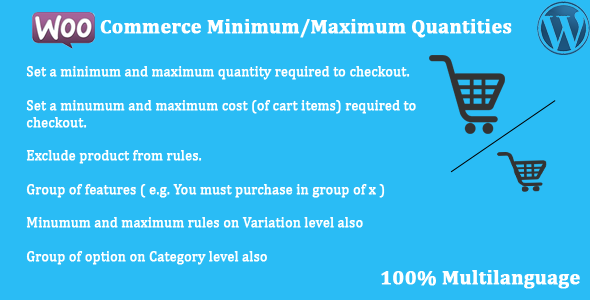
On any individual product, the store owner can require a minimum quantity before the item can be checked out and cap the maximum. This is the workhorse feature: it stops a customer from buying one item from a range that is only sold in cases, or prevents a single buyer from clearing limited stock. A separate exclusion option lets specific products opt out of rules that would otherwise apply to them, which avoids the common trap of a global rule breaking one unusual item.
Variation-level limits
For variable products, rules can be set per variation rather than only on the parent. A clothing store selling a shirt in sizes might allow a maximum of two per size on a clearance colourway while leaving other variations unrestricted. The vendor also added a shared rule that applies across all variations of a product, which saves configuring each variant by hand on large catalogues.
Group-of-quantity rules
This is the feature that distinguishes the plugin from simpler quantity limiters. Instead of a floor and a ceiling, a product can be required to be bought in multiples of a set number — the order total must divide evenly by that figure. It is the mechanic behind “sold in packs of six” and is applied at product, variation and category level. For a WooCommerce eCommerce store selling components, fasteners, beverages or printed materials, this single option often justifies the purchase.
Order and category thresholds
Beyond individual items, the plugin can enforce a minimum and maximum number of total items in the cart, and a minimum and maximum order value. Category-level rules extend this further, so a store can require a minimum spend within a category or a minimum number of items from it, independently of the rest of the basket. The vendor also notes that price calculations can include tax when tax is enabled, which prevents threshold rules from misfiring on stores that display prices excluding VAT or sales tax.
Where this plugin fits and where it does not
The clearest fit is a wholesale or trade store. Minimum order values, minimum item counts and pack multiples are standard expectations in B2B selling, and WooCommerce does not ship any of them natively. A store selling to retailers that must order in case quantities, or that needs a floor on order value to make fulfilment worthwhile, gets all of that from one extension.
The second fit is a retail store with deliberate scarcity or fairness rules. Limited-edition releases, ticketed events with per-customer caps, sample or tester products limited to a small number per order, and promotional bundles that only make sense in fixed multiples all fall into this group. Category-level rules are useful for stores that mix retail and bulk lines in one catalogue.
The third fit is a multilingual or multi-currency operation. The vendor explicitly lists WPML, WooCommerce Currency Switcher and WooCommerce Quick View as compatible, and the plugin is translated-ready through WPML. A store running several currencies needs order-value thresholds to behave correctly per currency, and that compatibility note is worth checking in a staging environment before committing.
Where it is the wrong choice: a simple store selling single items with no buying constraints. If nothing in the catalogue needs a floor, a ceiling or a pack size, the plugin adds configuration surface with no payoff. It is also a poor fit for stores that need dynamic or customer-specific rules — for example, different limits for logged-in wholesale accounts versus guests. The vendor does not list role-based or customer-group targeting, so a store needing tiered rules per customer type should confirm that gap before buying rather than assume it is covered.
Strengths and limitations
Strengths
- Four rule scopes — product, variation, category and order — cover most real buying constraints without needing several plugins.
- Group-of-quantity rules at product, variation and category level are the standout feature and are rarely handled well by general quantity plugins.
- Tax-inclusive price calculation for order-value thresholds removes a common source of incorrect rule enforcement.
- Exclusion settings let individual products escape global rules, which keeps large catalogues manageable.
- Strong track record: 1,825 sales and a 4.96 rating from 50 reviews is unusually consistent for a niche extension.
- Broad version support, from WordPress 5.0 to 6.8 and WooCommerce 5.x to 9.x, plus declared WPML and currency-switcher compatibility.
- Source files in PHP, JavaScript, HTML and CSS are included, so an agency can audit or extend behaviour.
Limitations
- No Gutenberg optimisation is declared. Stores that build product pages heavily with the block editor should test how rule messages render in blocks rather than assuming a native look.
- No high-resolution assets are listed, which is a minor point but relevant if rule notices need to match a polished storefront design.
- Rules are enforced through configuration screens rather than code, so highly conditional logic — different limits per customer role, per country or per cart composition — is not described by the vendor and should be treated as out of scope.
- The update mechanism was reworked in version 2.1.9 to live inside the plugin, and the vendor’s own changelog flags that buyers should read the update documentation. That is a small ongoing maintenance step rather than a one-click marketplace update.
- At $24 it is inexpensive, but it is a single-purpose extension: stores needing the same rules plus dynamic pricing or tiered pricing will likely need a second plugin.
How it compares with the wider quantity-rule category
Quantity control plugins generally fall into two camps. The first is the lightweight limiter: a small extension that sets a minimum and maximum per product and little else. Those are cheap and quick, but they usually stop at the product level, leaving variation, category and order-value rules unaddressed. The second camp is the broad pricing and rules suite, which bundles quantity limits with dynamic pricing, discounts and role-based pricing. Those suites are more capable but heavier, and a store that only needs buying constraints pays for features it will not use.
This plugin sits deliberately in the middle. It goes well beyond a basic limiter — variation rules, category thresholds, order minimums and group quantities are all present — without becoming a pricing engine. The trade-off is that it does not attempt tiered pricing, customer-role rules or conditional discounting, so a store with those requirements is looking at a different class of product. Judged purely as a quantity-rules tool, the scope is wide, and the declared compatibility with WPML and a currency switcher puts it ahead of many single-purpose alternatives for international stores.
The honest comparison point is not feature count but fit. A store that needs pack multiples and a minimum order value gets everything from this one extension. A store that needs those rules plus per-customer pricing needs a suite, and should expect to pay considerably more than $24.
Frequently Asked Questions
Does WooCommerce have built-in minimum and maximum quantity rules?
No. WooCommerce does not include native minimum or maximum quantity limits, minimum order values or pack-size rules. Store owners either add custom code or install an extension. This plugin fills that gap by adding configurable rules at product, variation, category and order level, enforced in the cart before checkout is permitted.
Can this plugin force customers to buy in multiples, such as packs of six?
Yes. The group-of-quantity feature requires the ordered total to be a multiple of a set number, and it can be applied at product, variation or category level. A customer attempting to buy seven units of a six-pack product would be blocked until the quantity is corrected to a valid multiple.
Does it work with variable products and product variations?
Yes. Rules can be set on individual variations rather than only on the parent product, so different sizes or colours can carry different limits. The vendor also provides a shared rule that applies the same constraint across all variations of a product, which reduces setup work on catalogues with many variants.
Is the plugin compatible with WPML and multiple currencies?
The vendor lists WPML and WooCommerce Currency Switcher as compatible, and the plugin supports tax-inclusive price calculation for order-value thresholds. That combination matters for stores selling across languages and currencies, where an order minimum must be evaluated correctly in whichever currency the customer is browsing.
Verdict
Buy this if the store needs genuine buying constraints: wholesale minimums, pack multiples, per-variation caps, category thresholds or a floor on order value. The feature spread is wide for the price, the sales and rating record is strong, and the compatibility list covers current WordPress and WooCommerce versions. Skip it if the catalogue sells single units with no restrictions, or if the requirement is customer-specific or role-based rules, which the vendor does not describe. Agencies building trade stores should treat it as a low-risk, single-purpose addition rather than a full pricing suite.