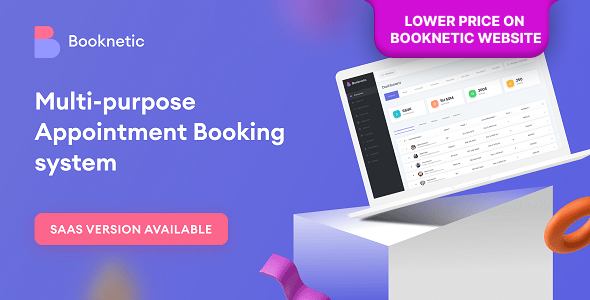
Booknetic is a WordPress plugin that turns a standard WordPress site into a full appointment booking and scheduling system, handling calendars, staff availability, payments and customer records from one dashboard. It is built for clinics, salons, consultants, repair services, tutoring centres and similar businesses that take bookings by time slot, and it also ships in a multi-vendor configuration for marketplace-style platforms where several independent providers sell under one roof. With more than 10,700 sales and a 4.91 out of 5 rating across 471 reviews on CodeCanyon, Booknetic Calendars is one of the more established paid options in this category rather than a new entrant.
What Booknetic Actually Does Beyond a Basic Booking Form
The core function is straightforward: a customer picks a service, a staff member, a date and a time, and the slot is removed from availability so nobody else can take it. The interesting part is what sits around that loop.
Availability management is granular. Business hours, holidays, break times and buffer periods between appointments are all configurable, which matters in practice because back-to-back bookings without travel or clean-up time are the most common source of scheduling complaints in service businesses. Custom availability rules let a business express exceptions rather than forcing every week into the same template.
Pricing is not a single number per service. Booknetic supports conditional pricing that can change based on factors such as time of day or answers given in the booking form, and it supports multiple durations for the same service so a client can choose a shorter or longer session. Service extras add optional add-ons at checkout, and discounts and promotions can be applied. For businesses that price by complexity rather than by clock, that flexibility removes the need for workarounds.
Payments run through multiple gateways, including WooCommerce and 2Checkout, and the payment method can be set per service rather than globally. Invoices can be generated and customised. For anyone running a deposit-based or prepaid model, this is the difference between chasing payment after the appointment and collecting it at the time of booking.
Staff and multi-location handling is where the plugin separates itself from lighter alternatives. Unlimited employee and customer profiles are supported, employees can self-schedule, and staff commission can be calculated as a share of the appointment price. Multiple business locations are supported from the same installation. User roles with different permission levels mean a front-desk account does not need the same access as an owner.
Calendar sync works in both directions with Google Calendar and Microsoft Outlook Calendar. Appointments created in Outlook appear inside the Booknetic calendar with matching colours and an icon, and changes made in Booknetic push back out. That two-way behaviour matters for staff who live in their own calendar app and will not switch tools.
Notifications go out by email, SMS and WhatsApp, with reminders and follow-up messages configurable. A waitlist captures demand for fully booked slots. Group appointments allow one booking to cover several participants, which suits workshops and classes. Packages let a business bundle appointments across different services and sell them together, and product inventory support means tangible goods can be sold alongside services with stock tracked automatically.
On the administration side there is a reporting dashboard covering business, service and staff performance, CSV export of appointment data, conversion tracking, and a webhook feature for pushing booking data into third-party systems. The plugin is also Gutenberg-optimised, compatible with Elementor and WPML, and the vendor states GDPR and HIPAA compliance for data protection — a claim worth verifying against specific obligations before relying on it.
Where Booknetic Fits Well, and Where It Does Not
Single-location service businesses are the clearest fit: a dental practice with four chairs, a salon with commissioned stylists, a physiotherapy clinic that needs buffer time between patients. The combination of per-service payment methods, staff commissions and conditional pricing covers most of what these operations need without additional plugins.
Multi-location operators benefit from running every branch through one installation rather than maintaining separate sites. Agencies building for clients in the wellness, medical, education and home-services sectors will find the role management and reporting useful for handover, since a client can be given a restricted account instead of full administrator access.
The SaaS and multi-vendor configuration is aimed at a different buyer entirely: someone building a marketplace where independent providers list their own availability and take their own bookings. That is a substantially more complex project than installing a booking form, and it should be treated as such.
Booknetic is the wrong choice for a business that needs only a single calendar with no payments, no staff and no client accounts. A free or low-cost plugin will cover that, and paying for a system this broad means maintaining and updating features that will never be switched on. It is also a poor fit for anyone who needs deep, industry-specific workflow logic — insurance claim handling, clinical charting, or regulated record-keeping — because those requirements sit outside what a general booking plugin is designed to do.
Strengths and Limitations
Strengths
- Breadth of scheduling logic — buffer times, custom availability rules, recurring appointments and multiple durations per service are all native rather than bolted on.
- Genuine two-way calendar sync with both Google Calendar and Microsoft Outlook Calendar, which is rarer than one-way export.
- Multi-vendor and SaaS capability built into the same product, so a marketplace project does not require a separate platform.
- Strong commercial features: conditional pricing, per-service payment methods, packages, commissions, inventory and invoicing.
- Established track record — over 10,700 sales and a 4.91 rating from 471 reviews indicates a product that has been tested across a wide range of real installations.
- Author fs-code has maintained the plugin across a long list of WordPress versions, from 4.9 through 7.0.x, which suggests ongoing compatibility work rather than abandonment.
Limitations
- At $299 for a single licence, the entry cost is high for a WordPress plugin. It is priced for businesses where booking is revenue-critical, not for hobby sites.
- The feature set is large enough that configuration is a real project. Setting up locations, staff, services, pricing rules and notification templates takes planning before anything goes live.
- The vendor claims GDPR and HIPAA compliance, but the listing does not explain what that means in practice — whether data is stored locally, what is logged, or how retention is handled. Buyers with regulatory obligations should confirm the specifics directly.
- Internet Explorer 11 appears in the supported browser list. That is a signal of how far back the compatibility target reaches, and it says nothing about performance on modern devices.
- Notification channels such as SMS and WhatsApp depend on third-party services, so there is an ongoing cost and configuration step beyond the plugin price itself.
- The vendor does not publish performance benchmarks or limits on the number of simultaneous bookings, so high-traffic marketplace operators cannot size the system from the listing alone.
How Booknetic Compares to the Wider Booking Plugin Category
The WordPress booking market splits roughly into three tiers. At the bottom are free or inexpensive plugins that handle a single calendar and little else. In the middle sit mid-priced plugins that add payments, notifications and basic staff management. Booknetic sits at the top of that middle tier and reaches into territory usually occupied by standalone SaaS booking platforms.
Against the free tier, the difference is not features but consequences. A free plugin that cannot enforce buffer times or handle two staff members with different availability will produce double-bookings, and fixing those manually costs more than the licence. Against mid-tier plugins, Booknetic’s advantage is the combination of multi-location support, multi-vendor capability and two-way Outlook and Google sync in one package — most competitors offer one or two of those, not all three.
Against hosted SaaS booking services, the trade-off runs the other way. SaaS platforms handle hosting, updates and scaling, and charge monthly. Booknetic is a one-time purchase that runs on infrastructure the buyer already controls, which keeps long-term costs lower and data in-house, but shifts responsibility for updates, backups and security onto the site owner. For agencies already managing WordPress sites, that is familiar work. For a solo operator with no technical support, it is a genuine consideration.
Frequently Asked Questions
Does Booknetic work with Google Calendar and Outlook?
Yes. Booknetic integrates with Google Calendar and supports two-way sync with Microsoft Outlook Calendar. Appointments created in Outlook appear in the Booknetic calendar with matching colours and an icon, and rescheduling, cancelling or deleting an appointment in Booknetic updates Outlook automatically. This keeps staff calendars and the booking system consistent without manual re-entry.
Can Booknetic handle multiple staff members and locations?
Yes, and this is one of its stronger areas. The plugin supports unlimited employee and customer profiles, multiple business locations from one installation, employee self-scheduling, and staff commission calculated from appointment price. User roles with different permission levels let owners restrict what front-desk or junior staff can see and change.
What payment gateways does Booknetic support?
Booknetic processes online payments through multiple gateways, including WooCommerce and 2Checkout. Payment methods can be assigned per service, so a business can offer different options depending on what is being booked. Invoices can also be created and customised. The vendor does not list every supported gateway in the product description, so specific requirements should be confirmed before purchase.
Is Booknetic suitable for a multi-vendor marketplace?
Yes. A SaaS and multi-vendor version is available, allowing independent providers to list services and manage their own availability under one platform. This is a significantly larger undertaking than a single-business installation, requiring configuration of vendor roles, payouts and permissions. Buyers planning a marketplace should budget setup time accordingly rather than treating it as a standard plugin install.
Verdict
Booknetic is worth buying for service businesses where a missed or double-booked appointment has a real cost, and for agencies building booking systems for clients in healthcare, wellness, education or home services. The multi-vendor version extends that to marketplace operators who want to own their platform rather than rent one. It is not the right purchase for a site that needs a simple calendar with no payments or staff, where a cheaper plugin will do the same job. Nor is it suited to businesses with specialised regulatory or clinical workflow requirements that fall outside general scheduling. At $299 with a 4.91 rating across 471 reviews, the price reflects a mature product with a long feature list — but buyers should go in expecting a configuration project, not a five-minute install.