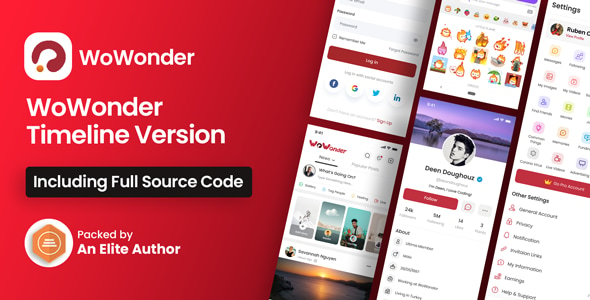
Mobile Native Social Timeline Applications Android is a compiled Android client that connects to an existing WoWonder PHP social network and rebuilds its timeline as a native app rather than a wrapped website. Built by DoughouzLight, the package ships the full Xamarin source code, Android XML layouts, and the assets needed to compile a branded app in Visual Studio 2022. It is aimed at operators of a WoWonder community who already have a working web platform and want a presence in the Play Store without commissioning a custom build from scratch.
The listing has moved 2,936 sales and holds a 4.7 out of 5 rating across 237 reviews, which places it among the more established Android add-ons in this niche. That track record matters here, because the product is not a standalone social network — it is an extension that only functions when paired with a compatible backend.
What the app actually delivers to members
The feature set is broad and mirrors the conventions of mainstream social apps closely enough that most users will need no instruction. The core loop is a native timeline that renders text posts, images, videos, map check-ins, and feeling/activity tags, with likes, comments, and shares handled inside the app rather than in a WebView. Posts can be composed, edited, deleted, and saved for later from the device, and each one carries its own privacy control.
Identity and discovery are handled through two parallel systems: a mutual friend model similar to Facebook and a one-way follow model similar to Twitter. Both run side by side, so a community can support either behaviour without choosing one. Search covers users, pages, and groups, and results can be filtered by avatar, status, or gender, with the option to add, like, or join directly from the results list.
Beyond the timeline, the package bundles a long list of secondary screens that would otherwise be separate purchases:
- Marketplace and product listings — members can browse products, contact sellers, and publish their own listings with images, description, and price.
- Groups, pages, and events — joining, following, creating, and viewing events all happen natively, with feeds and action buttons per entity.
- Messaging — chat is integrated with WoWonder Messenger v1.5, so conversations stay consistent between the app and the web platform.
- Nearby friends and contact sync — GPS-based discovery and phone contact matching for finding existing members.
- Status, pokes, articles, and popular posts — smaller engagement features that keep sessions longer.
- Pro membership and monetisation — promoted pages, promoted members, and a pro upgrade screen are built in, which is the mechanism an operator would use to charge for premium access.
Onboarding is more developed than is typical for a script of this price. There is a welcome screen with a choice between registration and login, recovery by email, a multi-step registration flow with avatar upload and suggested users to follow, and walkthrough pages that can be used to promote the chat function. Login supports six social providers in addition to standard credentials.
Where this fits, and where it does not
The clearest fit is an existing WoWonder installation with an active membership that has outgrown mobile browsing. Communities built around groups, events, and marketplace listings benefit most, because those are the areas where a native app outperforms a responsive theme — push notifications, camera access, contact sync, and offline handling all depend on native capability rather than page rendering.
It also suits agencies and freelancers who deliver WoWonder-based platforms to clients. The full Xamarin source means the app can be rebranded, extended, and resold as part of a larger build, and the settings class is designed to make language and configuration changes straightforward. A developer shipping several community apps from one codebase gets considerably more value here than a single-site owner does.
The wrong choice is any project without a WoWonder backend. The app requires WoWonder PHP v4.3.0 or higher and will not run against a different platform, a custom API, or a stock CMS. Anyone who has not yet built the web side should treat that as the prerequisite purchase, not this one. The same applies to operators who want a lightweight mobile web experience: a progressive web app or a tuned responsive theme costs less and avoids the Play Store review cycle entirely.
Strengths and limitations
Strengths
- Full native source code in Xamarin with Android XML layouts, so nothing is locked behind an encrypted or obfuscated build.
- Genuine feature parity with the web platform across timeline, groups, pages, events, marketplace, and messaging.
- Offline handling and a cache system that stores a substantial portion of data on the device, which improves perceived speed on poor connections.
- Push notifications, certificate chain configuration, and secure protocol support are included rather than sold as add-ons.
- Active maintenance — the vendor last updated the item in April 2025, and the version history is long enough to suggest ongoing support.
- Strong review volume for the category, which reduces the risk that the codebase is abandoned or undocumented.
Limitations
- Compiling requires Visual Studio 2022 and a working Xamarin Android toolchain. This is not a no-code product, and the vendor does not provide a hosted build service.
- The extended license is required if the app charges users or includes in-app purchases. Budgeting for the regular $59 price alone will be wrong for monetised projects.
- Xamarin’s long-term direction has shifted toward .NET MAUI, so teams planning a multi-year roadmap should confirm the migration path with the vendor before committing.
- Compatibility is declared for Android 9 through Android 15, but the listing does not state a minimum SDK or target SDK, which matters for Play Store submission requirements.
- Every feature depends on the matching WoWonder module being present and current on the server. A heavily customised backend can break native injection of likes, comments, and post actions.
- The listing does not document the update policy or support duration, so buyers should confirm both before purchase.
How it compares with the alternatives
The realistic alternatives fall into three groups: a responsive mobile theme for the web platform, a generic WebView wrapper that packages the existing site as an app, and a bespoke native build commissioned from a developer.
A responsive theme is the cheapest option and requires no build pipeline, but it cannot deliver push notifications, contact sync, camera integration, or offline caching in the way a native client does. A WebView wrapper sits in the middle: it is fast to produce and cheap, but it inherits the browser’s limitations, tends to feel sluggish on long feeds, and is frequently rejected or down-ranked in app store review for offering no native value.
A bespoke build offers the most control and the cleanest fit for an unusual feature set, but the cost is typically an order of magnitude higher and the timeline runs to months rather than days. This package occupies the practical middle ground: native performance and a full source tree, at a price and timeline that a small team can absorb. The trade-off is that the feature set is fixed to what WoWonder supports, and customisation means editing Xamarin code rather than configuring options.
Frequently Asked Questions
Does this app work without a WoWonder PHP installation?
No. The application is a client for WoWonder and requires WoWonder PHP v4.3.0 or higher running on a server. Without that backend there is no database, no user accounts, and no API for the app to talk to. Buyers who have not yet installed WoWonder should budget for both items together.
Do I need to know how to code to publish this app?
Some technical ability is required. The package ships Xamarin source code that must be opened and compiled in Visual Studio 2022, then signed and uploaded to the Play Store. Configuration is handled through a settings class rather than a graphical panel, so a developer or an experienced technical operator is the realistic minimum.
Which license do I need if users pay for pro membership inside the app?
The extended license. The vendor states plainly that charging users or selling in-app purchases requires it. The pro upgrade page and promoted content features are included in the code, but the licensing obligation is separate from the feature set, so the regular license only covers free community apps.
Does the app stay in sync with the website?
Yes, for the features both share. The app integrates with WoWonder Messenger v1.5 and the main PHP script, so messages, posts, and account data are read from and written to the same backend. Members see the same content on either surface, and activity in one appears in the other.
Verdict
This is a sensible purchase for anyone already running a WoWonder community who wants a native Android presence without funding a custom build. The combination of full Xamarin source, broad feature parity, and a vendor who has kept the item updated through 2025 makes it one of the safer picks in a category where abandoned scripts are common. It is a poor fit for anyone without a WoWonder backend, anyone unwilling to work in Visual Studio, and anyone whose roadmap depends on a framework with a clearer long-term future than Xamarin. Buyers planning to monetise inside the app should price the extended license into the decision from the start rather than discovering it at submission time.