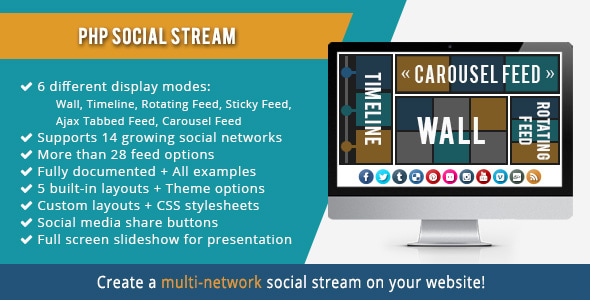
PHP Social Stream Social Networking is a self-hosted PHP script that pulls posts from multiple social media accounts and RSS feeds into a single feed embedded on a website. It is sold on CodeCanyon by the developer axentmedia for $18, and it suits site owners, freelancers and agencies who want one branded wall of Facebook, Instagram, YouTube, X/Twitter and similar content without handing the page over to a third-party widget service. The listing has drawn 2,101 sales and a 4.66 out of 5 rating across 58 reviews, which is a meaningful sample for a script in this price bracket.
What the script actually does with social content
The core job is aggregation. An administrator registers accounts or public pages from a supported network, chooses which feed type to pull, and the script renders the results on any page that can run PHP. Everything is served from the site’s own domain, so the feed inherits the site’s design rather than sitting inside someone else’s iframe.
Six ways to present the same feed
The same collected items can be displayed as a masonry-style Wall, a vertical Timeline, a Carousel, a Rotating Feed that cycles items automatically, an Ajax Tabbed Feed that splits content by network, or a Sticky Feed that pins to a position on the page. That range matters in practice: a news site might want the Timeline, a photography portfolio the Carousel, and a sidebar the Rotating Feed. Visitors can filter the wall by network and search within the stream, and the rotating slider exposes start and stop controls.
Breadth of sources
The vendor lists support for Facebook, X/Twitter, Instagram, YouTube, Tumblr, Pinterest, Flickr, Vimeo, DeviantArt, SoundCloud, VK and RSS, with TikTok named among the individual feed options. Within those networks the script distinguishes between feed types rather than treating each network as one source. Facebook alone covers page wall posts, album photos, page photos and page videos, with a setting to include posts written by the page, by visitors, or both. Twitter covers a user’s timeline, a list, or a hashtag search. YouTube covers uploads, playlists and keyword searches. Flickr separates a user’s photostream, a group pool and an album. That granularity is what allows one installation to serve as a photo gallery, a video wall or a hashtag board without extra plugins.
Practical controls for real sites
Several options address problems that appear the moment a social wall goes live. Caching with a configurable lifetime reduces how often the script calls each network’s API, which matters because most platforms impose rate limits. A load-more button extends long feeds without pagination. Word limits on titles and descriptions with a read-more link keep uneven post lengths from breaking the grid. Images can lazy-load, links can be set to open in a new window, the parent window or a lightbox, and link status can be switched between follow and nofollow. Visitors can share items to Facebook, X/Twitter, Pinterest or LinkedIn, and can reply, retweet or favourite Twitter posts directly from the stream.
Design and integration
Styling is handled through theme selection plus granular colour, border, background and font settings for the stream body, individual items and the rotating feed header. Network icons and post-type icons can be recoloured, and a custom CSS stylesheet can override anything the panel does not expose. The vendor also states the script can be embedded inside an existing PHP CMS or framework, and the download includes unminified JavaScript, HTML, CSS and PHP source files. A lightbox slideshow view is available for presenting media on large screens.
Where this fits and where it does not
The strongest fit is an organisation that already publishes across several platforms and wants those posts mirrored on its own site. A restaurant, gym, church, music venue or festival can show a combined feed of Instagram photos, Facebook updates, YouTube videos and a news RSS feed on one page, styled to match the brand. Agencies will find the multi-account, multi-feed handling useful for client sites where each client needs a different mix of sources.
It also suits specialist builds: a photo or video gallery assembled from Flickr, Vimeo and YouTube; a hashtag board for a conference or campaign that tracks a search term across networks; a news aggregation page driven by several RSS URLs. Because the output is plain HTML rendered server-side, the content is present in the page source, which is an advantage over JavaScript-only embed widgets for indexing and for sites with strict privacy requirements.
The wrong choice is a project that needs genuine two-way social interaction or user accounts. This is a display and aggregation tool, not a social network platform; it does not offer registration, profiles, messaging or friend relationships, despite sitting in the Social Networking category. It is also a poor fit for anyone unwilling to manage API credentials. Every network requires an app registration or access token, those tokens expire, and platform policies change. Sites that cannot maintain that overhead should use a hosted feed service instead.
Strengths and limitations
Strengths
- Genuinely broad source coverage, with distinct feed types per network rather than one generic connector each.
- Six display layouts plus a lightbox slideshow cover most placement scenarios without a second product.
- Deep visual controls and accessible CSS, so the feed can be made to look native to the site.
- Caching, load-more, word limits and lazy loading address the practical failure modes of social walls.
- Source files are included, and the script is stated to work with PHP 7.x and 8.x.
- Established track record on the marketplace, with more than two thousand sales and a rating near 4.7.
Limitations
- Dependence on platform APIs is the central risk. Search-based feeds for Twitter and Instagram are flagged by the vendor as subject to API restrictions, and access rules for these networks have tightened repeatedly in recent years. Buyers should verify current access for each network before committing.
- Setup is not turnkey. Each network needs its own developer app, credentials and token refresh process, and the vendor does not state that any guided OAuth wizard is included.
- No hosted fallback. If a token lapses, the corresponding feed goes blank until someone fixes it.
- No high-resolution image flag on the listing, and no stated accessibility conformance, so teams with strict WCAG requirements will need to audit the output themselves.
- The interface is built around short social posts; long-form content handling is limited to word truncation and a read-more link.
How it compares with the alternatives
Three categories compete here. Hosted social wall services require no server work and handle token maintenance, but they charge recurring fees, render inside their own containers, and often cap the number of sources on lower plans. A one-off $18 script with unlimited accounts is cheaper over any multi-year horizon, at the cost of self-maintenance.
Free WordPress plugins occupy similar ground for WordPress sites, but they are tied to that platform and typically support fewer networks with less layout choice. This script runs on any PHP host and can be dropped into a custom CMS, which is the deciding factor for non-WordPress builds.
Custom development offers total control but costs far more than the licence and duplicates functionality that already exists. For a display-only aggregation wall, building from scratch rarely makes sense. The script’s advantage is breadth of sources and layouts at a low price; its disadvantage is that the buyer absorbs all operational risk around API access.
Frequently Asked Questions
What is PHP Social Stream used for?
It collects posts from multiple social accounts and RSS feeds and displays them as one combined feed on a website. Typical uses are a brand’s social wall, a photo or video gallery assembled from several platforms, a hashtag board for an event, and a news page built from RSS sources.
Does PHP Social Stream require API keys?
Yes. Each network needs its own developer application and access credentials before the script can pull content. The vendor does not state that a guided setup wizard is included, so buyers should expect to register apps manually and to refresh tokens periodically as platform policies require.
Can PHP Social Stream be used with WordPress?
It can, because the script outputs standard HTML, CSS and JavaScript that a WordPress page template can render. It is not a native plugin, however, so integration means embedding the script within a theme or shortcode wrapper rather than installing it from the plugin directory. The vendor states it can also be embedded in other PHP frameworks.
Is PHP Social Stream still maintained?
The listing shows a vendor update dated 29 June 2024, and the script is declared compatible with PHP 7.x and 8.x. That is recent enough to suggest active upkeep, but buyers should confirm that the specific networks they need still permit the feed types they intend to use, since platform access rules change independently of the script.
Verdict
Buy this if the goal is a display-only social wall on a self-hosted PHP site, the sources span several networks, and someone on the team can manage API credentials and occasional token refreshes. The combination of twelve-plus networks, six layouts and detailed styling controls is strong value at $18, and the sales and rating record supports that. Do not buy it expecting a social network platform, user accounts or two-way messaging, and avoid it if nobody can own the API maintenance. Teams that need zero-ops reliability should pay for a hosted service instead.