Active eCommerce Affiliate Add-on is a paid extension for the Active eCommerce CMS that adds a referral marketing layer to an existing store. It lets a shop owner recruit affiliates, issue each one a shareable product link, record the sales those links produce, and pay out a commission. It is built for people already running an Active eCommerce store who want performance-based promotion without moving to a different platform.
The add-on is sold on CodeCanyon by ActiveITzone for $25 and has been purchased 1,813 times, holding a 4.57 out of 5 rating across 35 reviews. Those numbers are meaningful for a niche extension: the product has a real user base and a long enough track record to be judged on. The Active eCommerce Affiliate Add-on Add-ons category on the marketplace is small, and this is one of the few options that plugs directly into the parent CMS rather than sitting alongside it as a separate service.
What the add-on actually adds to a store
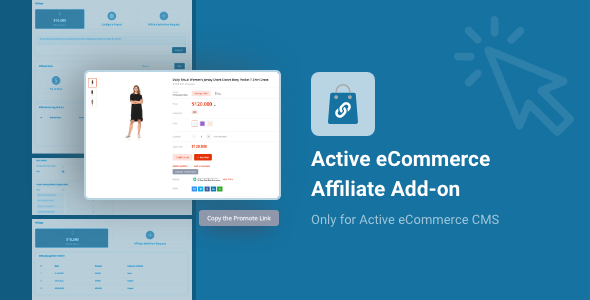
The core mechanic is a tracked referral link. Once installed, the add-on opens a registration route where people can sign up as affiliates. Each approved affiliate receives a unique link to the store or to individual products, and any order placed through that link is attributed to them. The store owner sees the resulting commission owed in the admin panel and settles it later. That is the whole loop, and it is the part that matters most, because attribution is where most homegrown referral schemes fall apart.
Link sharing and referral users
Affiliates can share links to specific products rather than only the homepage, which suits stores with a large catalogue where a promoter wants to push one item. A separate referral-user feature, added in version 1.2, lets existing customers be drawn into the programme as referrers. For a shop with a decent repeat customer list, that is a lower-friction recruitment channel than cold outreach to strangers.
Commission rules that go beyond a flat percentage
Commission can be set as either a fixed amount or a percentage, and the vendor added category-wise commission handling in version 2.2. In practice this means an owner can pay a higher rate on high-margin categories and a lower rate on thin-margin ones, instead of applying one blunt rate across the whole store. The same release added a category-wise earnings history, so both the owner and the affiliate can see where the money came from rather than staring at a single running total.
Withdrawals and payout control
Affiliates can request a withdrawal of their balance, and the store owner approves it. Version 2.0 introduced a configurable minimum withdrawal amount, which is a small setting with a large effect: it stops a flood of tiny payout requests that would otherwise consume admin time. Registration also gained reCAPTCHA support in version 2.1, which matters because any public signup form on a live store attracts bots.
Installation and platform fit
Setup assumes Active eCommerce CMS is already installed on the server. The add-on is then uploaded through the CMS’s own add-on manager, and the vendor describes the process as complete at that point. The codebase is Laravel-based and the package ships with PHP, JavaScript and JSON source files plus layered PNG assets, so a developer can modify behaviour rather than being locked to the vendor’s defaults. PHP 7.x is the declared runtime, and the vendor lists support for IE10 through Edge, which is a broad and slightly dated browser matrix.
Where this add-on fits, and where it does not
The clearest fit is an established Active eCommerce store that already has traffic and a product range worth promoting. A store owner who wants to convert loyal customers into advocates, or who wants to recruit outside promoters on a pay-for-results basis, gets the tracking and payout machinery without building it. Agencies maintaining several Active eCommerce builds for clients can also use it as a standard component, since the same install routine applies each time.
It is also a reasonable choice for stores with mixed margins, precisely because of the category-level commission rules. A shop selling both low-margin electronics and high-margin accessories can set rates that reflect reality instead of overpaying on the thin side.
Where it is the wrong choice: any store not running Active eCommerce CMS. The vendor states plainly that this is not a standalone system and works only with that CMS. A WooCommerce, Shopify or custom Laravel shop cannot use it at all, and buying it first would be a wasted $25. It is also a poor fit for a brand-new store with no traffic and no products, because an affiliate programme multiplies existing demand rather than creating it. Finally, an owner who wants a fully hosted affiliate network with automatic tax handling and multi-merchant support should look at dedicated affiliate platforms instead; this is a self-hosted module with a narrower scope.
Strengths and limitations
Strengths
- Deep integration with the parent CMS: affiliates, orders and commissions live in the same admin panel rather than a second dashboard.
- Commission flexibility covers fixed amounts, percentages and per-category rates, which is more control than most budget referral scripts offer.
- Payout controls, including a minimum withdrawal threshold and an approval step, keep admin workload predictable.
- Source files are included, so a developer can extend or restyle the affiliate area.
- A steady update history tied to parent CMS releases, including compatibility work for CMS 10.8, suggests the developer tracks upstream changes.
- At $25 with 1,813 sales and a 4.57 rating, the cost-to-capability ratio is favourable for a store that already runs the CMS.
Limitations
- Hard dependency on Active eCommerce CMS. There is no path to using it elsewhere, and the parent CMS is a separate purchase.
- The declared PHP 7.x requirement is narrow by current standards; buyers should confirm their server’s PHP version against the parent CMS requirements before installing.
- Affiliate-facing reporting is functional rather than polished, with category-wise history being the main breakdown. The vendor does not state whether affiliates get their own analytics dashboard beyond earnings and withdrawal views.
- Commission tracking depends on cookie or session attribution, which the vendor does not document in detail; stores with long consideration cycles should test attribution behaviour before promoting the programme.
- Payouts are manual requests approved by the owner. There is no stated integration with payment gateways for automatic disbursement.
- The browser support list still cites IE10 and IE11, which signals that some front-end code has not been modernised recently.
How it compares with the wider category
Affiliate functionality for eCommerce generally comes in three shapes: a hosted affiliate network, a standalone self-hosted script, or a module bolted onto the store platform itself. Hosted networks bring reach and automatic payouts but take a cut and keep the affiliate relationship at arm’s length. Standalone scripts are platform-agnostic but require a second installation, a second login and careful order-syncing work. This add-on takes the third route, and that is its main differentiator: attribution happens inside the same database as the orders, so there is no sync layer to break.
Against standalone scripts, the trade-off is flexibility. A store planning to change platforms, or one running several storefronts on different systems, is better served by a platform-neutral tool. Against hosted networks, the trade-off is reach: this add-on gives no access to a marketplace of professional affiliates, so recruitment is entirely the owner’s job. For a single Active eCommerce store that wants control and no revenue share, the module approach is the more economical fit.
Frequently Asked Questions
Do I need Active eCommerce CMS to use this add-on?
Yes. The vendor states explicitly that the affiliate system is not independent and runs only on Active eCommerce CMS. The CMS must already be installed on the server before the add-on is uploaded through the add-on manager. Buying the add-on without the parent CMS results in a product that cannot be installed or used.
How much does the Active eCommerce Affiliate Add-on cost?
It is listed at $25 on CodeCanyon as a one-off purchase, separate from the cost of Active eCommerce CMS itself. The price includes the source files, so a developer can modify the code. The vendor does not state a renewal or support-extension fee in the listing, so buyers should check the item’s support policy on the marketplace page.
Can affiliates earn different commission rates for different product categories?
Yes. Version 2.2 added working category-wise affiliate commissions and a category-wise earnings history. The store owner can therefore pay a higher percentage on high-margin categories and a lower one elsewhere. Commission itself can be configured as either a fixed amount or a percentage, depending on how the owner wants to structure the programme.
How do affiliates get paid?
Affiliates accumulate a balance and submit a withdrawal request, which the store owner reviews and approves. A configurable minimum withdrawal amount, added in version 2.0, prevents a large volume of very small requests. The vendor does not state that payouts are processed automatically through a payment gateway, so the settlement step is manual on the owner’s side.
Verdict
Buy this if an Active eCommerce store is already live, has products worth promoting, and the owner wants referral tracking and commission payouts handled inside the existing admin panel for a one-off $25. The category-level commission rules and withdrawal controls are the features that justify the purchase over a generic script. Do not buy it if the store runs on any other platform, if the shop is still pre-launch with no traffic, or if the plan requires a hosted affiliate network with automated disbursement. The dependency on the parent CMS is absolute, so the decision should be framed as an upgrade to an existing Active eCommerce installation rather than a standalone purchase.