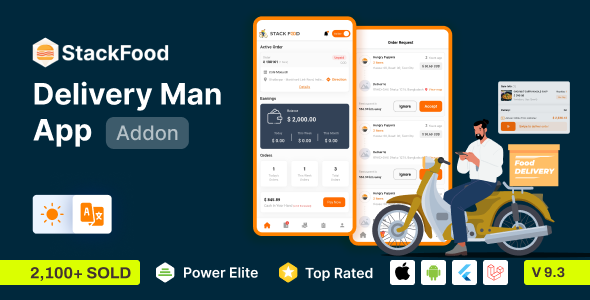
StackFood Multi Restaurant Flutter is a mobile application codebase for food delivery couriers, sold on CodeCanyon as one module of a larger multi-restaurant ordering system. The app lets a driver set an online or offline status, accept nearby orders, track earnings, and review past deliveries, with live location visible to the admin, the restaurant and the customer. It is aimed at developers and agencies building a marketplace-style food platform who need the courier side of the workflow already assembled rather than written from scratch.
The product comes from sixamtech, a developer with a track record on the marketplace, and it has moved 2,106 sales with a 4.76 out of 5 rating across 80 reviews. At $29 it is priced as a component, not a platform, and that framing matters for anyone evaluating it.
What the courier app actually handles day to day
The core of the product is the delivery run itself. A driver opens the app, flips into an online state, and becomes visible to the dispatch side of the system. From there the app surfaces orders close to the driver’s position, which the driver can accept or pass on. That nearby-order model is the standard pattern for on-demand delivery and it removes the need for a dispatcher to manually assign every job.
Once an order is accepted, the app carries the driver through to completion. The vendor states that admins, restaurants and customers can follow the courier’s movement, which implies location reporting is built into the client and surfaced across the other panels. For a multi-restaurant marketplace this is the feature that holds the whole experience together: a customer watching a marker move toward their address is the difference between a delivery platform and a phone call.
Earnings and history for freelance drivers
The app includes an earnings balance view, and the vendor ties this specifically to freelance couriers rather than salaried staff. That distinction suggests the system supports at least two courier arrangements — a house driver who is paid through the restaurant or platform, and a self-employed driver who accumulates a balance the platform settles later. Order history sits alongside the balance, so a driver can reconcile what they earned against what they delivered.
Notifications and status control
Real-time notifications push new order offers and status changes to the driver without requiring a manual refresh. Combined with the online/offline toggle, this gives the courier a clear boundary between working and not working, which matters for freelance drivers who are not on a shift schedule.
The technical packaging
The app is written in Flutter 3.x and ships as Dart and YAML source with native Kotlin and Swift layers for the Android and iOS builds. Flutter means a single codebase compiles to both platforms, so a team maintains one set of delivery logic rather than two. The presence of native Kotlin and Swift files indicates platform-specific integrations — likely for background location and push notifications — rather than a purely Dart build.
Where this fits, and where it does not
The obvious fit is an existing StackFood installation. The vendor describes this app as the most important module of the wider system, and the demo instructions reference creating a courier credential from the admin panel. That tells the reader plainly that the app is not standalone: it needs the matching backend to authenticate drivers and serve orders. A buyer with the rest of the StackFood stack in place gets a courier client that should connect with minimal integration work.
A second fit is an agency delivering a local or regional delivery marketplace on a tight budget. At $29 the codebase is a starting point, and a team comfortable with Flutter can rebrand it, adjust the order-acceptance logic and ship. The sales volume and review count suggest enough other teams have done this that community answers and vendor support are plausible.
The clear mismatch is anyone without the StackFood backend. Buying this app alone delivers a client with nothing to talk to — no order feed, no authentication, no admin controls. A solo founder expecting a complete delivery business in a $29 download will be disappointed. The same applies to operators who want a fully hosted, no-code delivery platform: this is source code, and it assumes a developer is involved.
Strengths and limitations
Strengths
- Purpose-built for the courier role rather than a generic app template, so the online/offline state, nearby-order acceptance and earnings ledger are already modelled.
- Cross-platform Flutter 3.x codebase with native Kotlin and Swift layers, reducing the maintenance burden of two separate mobile builds.
- Location visibility spans three audiences — admin, restaurant and customer — which is the coordination layer a multi-vendor marketplace needs.
- Freelance earnings tracking is a specific, thoughtful inclusion that many courier apps in this price bracket omit.
- Strong marketplace signal: 2,106 sales and a 4.76 rating from 80 reviews is a meaningful sample for a CodeCanyon item.
- Low entry cost of $29 makes it cheap to evaluate against building the same screens internally.
Limitations
- The app is not standalone. It depends on the StackFood admin and restaurant modules, and the vendor does not state that it works with any other backend.
- The listing does not publish a feature breakdown for routing, batching multiple orders per run, or in-app chat between driver and customer, so buyers should confirm those before purchase if they matter.
- Pricing at $29 typically implies standard CodeCanyon support terms rather than an ongoing service relationship; the vendor does not state a support duration in the supplied data.
- Because it is distributed as source, every customisation is the buyer’s responsibility to maintain against future Flutter and platform updates.
- No performance, battery-usage or background-location benchmarks are published, which are the practical concerns for any always-on courier app.
How it compares with the broader category
Courier apps sold as source code generally fall into two groups: standalone driver apps that connect to a generic ordering API, and modules tied to a specific delivery platform. This product is firmly the second kind. The trade-off is straightforward — tighter integration and less configuration if the buyer already runs StackFood, and a hard wall if they do not.
Against standalone courier templates, the advantage here is that the surrounding system already exists: admin dashboards, restaurant panels and customer-facing ordering are part of the same family, so the data model is consistent end to end. The disadvantage is lock-in. A standalone app might connect to a custom backend, but it usually arrives with less of the delivery workflow pre-built.
Against building in-house, the calculus is time versus control. A Flutter team can replicate these screens, but the location reporting, notification plumbing and earnings logic represent weeks of work that $29 removes from the schedule. What the buyer gives up is the freedom to shape the architecture from the ground up. For most small teams, that is a fair trade; for a platform with unusual dispatch rules, it is not.
Frequently Asked Questions
Does the StackFood delivery man app work without the main StackFood system?
No. The app is a client for the StackFood multi-restaurant backend and needs that backend to authenticate drivers, serve orders and record earnings. The vendor’s own demo instructions require creating a courier credential from the admin panel. Buyers who do not already run StackFood should budget for the wider system as part of the project.
What does a delivery driver actually see and do inside the app?
Drivers toggle an online or offline status, receive real-time notifications for nearby orders, accept or decline them, and follow each job through to delivery. The app also shows order history and, for freelance couriers, an accumulated earnings balance. Admins, restaurants and customers can track the driver’s location while a delivery is in progress.
Is the StackFood courier app suitable for a small local restaurant?
Usually not. The product is built for multi-restaurant marketplaces where several vendors share one delivery fleet. A single restaurant with its own drivers would be paying for marketplace complexity it never uses, and would still need the full StackFood stack. A simpler single-vendor ordering setup is a better match for that scenario.
What skills are needed to customise this Flutter app?
Working knowledge of Flutter 3.x and Dart is essential, since the UI and delivery logic live in Dart files. Familiarity with Kotlin and Swift helps when touching the native layers, which typically handle background location and push notifications. Buyers should also understand the StackFood backend well enough to keep the app’s API calls in sync with it.
Verdict
Buy this if the StackFood multi-restaurant system is already part of the plan or the build, and a Flutter developer is available to brand and adapt the courier client. The price is low, the sales and rating record is solid, and the delivery workflow — status, nearby orders, tracking, earnings — is already modelled rather than sketched. Do not buy it as a first step toward launching a delivery business, because without the backend it has nothing to connect to. Teams wanting a fully managed or no-code delivery platform should look elsewhere entirely.