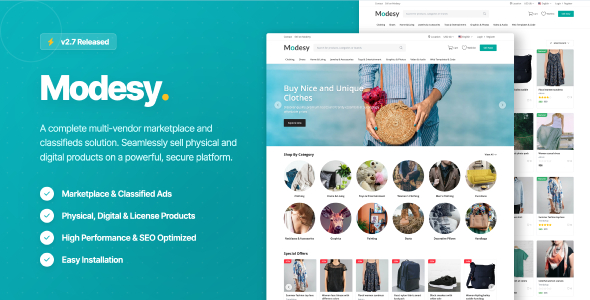
Modesy is a self-hosted PHP script for building an online store or a multi-vendor marketplace, sold on CodeCanyon under the PHP Scripts > Miscellaneous category. It runs on the CodeIgniter framework and lets a site owner switch between single-vendor retail, a commission-based marketplace, and a classified ads board from the admin panel. It suits developers, agencies and established businesses that want to own their platform outright rather than rent space on a hosted store builder.
The Modesy Miscellaneous listing carries 2,654 sales and a 4.94 out of 5 rating across 264 reviews, which is a strong signal for a script in this price bracket. It was written by Codingest, an author with a track record on the same marketplace, and the vendor’s most recent update landed in September 2026. The licence costs $89.
What the script actually does under the hood
The central design decision in Modesy is that the selling model is a setting, not a fork of the codebase. An operator can launch as a conventional shop selling their own stock, then open the platform to third-party sellers later, or run it purely as a classified listings board where no transaction takes place on site. That flexibility matters because most projects in this category force a choice at installation and charge again to change it.
Product handling goes well beyond simple stock items. Physical goods, digital downloads and software licence keys all sit in the same catalogue, and a dynamic options system supports layered variations — size, colour, material and so on — with rules attached. For anyone selling configurable products, that removes the need for a separate plugin or a custom field hack.
Commission, payout and seller economics
The commission engine is hierarchical rather than flat. Rates can be set globally, per category, per vendor or per individual product, with the global value acting as a fallback when nothing more specific applies. Vendors get their own dashboard for managing listings, tracking earnings and requesting payouts through PayPal, IBAN or SWIFT. A membership and packages layer adds subscription tiers with product upload limits, and a promoted products system lets sellers pay for featured placement on a daily or monthly basis. Together these give a marketplace operator several independent revenue lines rather than commission alone.
Payments, wallets and checkout
Payment coverage is broad: PayPal, Stripe, PayStack, Razorpay, Flutterwave, Iyzico, Midtrans, YooMoney, Mercado Pago and PayTabs are all named, with bank transfer and cash on delivery available as manual options. A wallet system lets buyers hold a balance for faster repeat checkout, and the cart is database-driven, so a basket persists across devices once a customer is signed in. There is also a built-in affiliate programme that issues referral links and pays commission on referred sales.
Infrastructure, storage and performance
Modesy runs on PHP 8.x with MySQL 5.x or 8.x, and the vendor states PHP 8.1 or higher for best results. File storage can be pointed at local disk, Amazon S3, Cloudflare R2 or Backblaze B2, which matters once image volume grows past what a single server should hold. An image engine automatically resizes and generates multiple versions of every upload, including WebP output. A built-in cache layer reduces server load, and the front end is Progressive Web App ready, meaning mobile visitors get an app-like experience without an app store listing. Email can be sent through PHPMailer, CodeIgniter Mail, Amazon SES, Brevo or Mailgun.
Content, SEO and administration
URLs are search-engine friendly and the front end is built with on-page SEO in mind. An OpenAI-powered generator produces product descriptions, blog posts and page copy from the admin area — genuinely useful for a marketplace with hundreds of thin listings, though the output still needs a human pass. Administrators get a central brand library that vendors can assign to their products, a vendor verification badge system, custom product fields, unlimited categories with bulk upload, and full control over listing status including pending, hidden and draft states. Product cloning speeds up catalogue building when listings share most attributes.
Where Modesy fits and where it does not
This script is a good match for an agency building a marketplace for a client who wants to own the code and the customer data. It also suits an existing retailer with a product catalogue that has outgrown a hosted platform, particularly one selling a mix of physical goods and downloads. Niche verticals work well too: a classified ads site for a local market, a software reseller issuing licence keys, or a B2B portal using the request-a-quote bidding model instead of fixed pricing.
It is the wrong choice for someone who wants a store online this afternoon with no technical involvement. Modesy is self-hosted, which means the buyer arranges hosting, installs the script, configures payment credentials, handles SSL and takes responsibility for updates, backups and security patching. A solo founder with no developer available and no budget for one will find a hosted platform a better fit. Projects needing deep integration with an existing ERP or a bespoke fulfilment pipeline should also expect custom development work on top of the purchase price.
Strengths and limitations
Strengths
- One codebase covers single-vendor retail, multi-vendor marketplace and classified ads, switchable from the admin panel.
- Commission rules operate at four levels, which supports genuinely varied seller agreements without code changes.
- Multiple revenue mechanisms ship in the box: commissions, promoted listings, vendor subscriptions and an affiliate programme.
- Storage abstraction across S3, R2 and B2 means the platform can scale image volume without rebuilding the hosting setup.
- Source files are included — JavaScript, JSON, HTML, CSS, PHP and SQL — so the code can be extended rather than only configured.
- Broad payment gateway coverage, including several regional providers that competing scripts often omit.
- The 4.94 rating from 264 reviews indicates buyers are largely satisfied after purchase, not just at the point of sale.
Limitations
- Self-hosting transfers all operational responsibility to the buyer. There is no managed option, and no support for server configuration, security hardening or backups.
- The AI content generator depends on an OpenAI account and API key that the buyer supplies and pays for separately. The vendor does not bundle credits, and usage costs scale with catalogue size.
- Payouts are request-based through PayPal, IBAN and SWIFT. There is no automated split payment at the moment of sale, so marketplace operators handle seller settlement as a manual process.
- Compatibility is declared for PHP 8.x and MySQL 5.x or 8.x, but the vendor recommends PHP 8.1 or higher. Sites on older PHP builds will need an upgrade before installing.
- Customisation requires working knowledge of CodeIgniter. Developers expecting a modern JavaScript framework on the front end will need to adjust.
- The vendor’s listing does not state a support period, renewal terms or an update policy, so those details need confirming before purchase.
How it compares with the wider category
Self-hosted marketplace scripts generally fall into two groups: lightweight ones that handle listings but leave payments, commissions and seller management to third-party tools, and heavier platforms that bundle everything but demand more server resources. Modesy sits closer to the second group. Its differentiator is breadth within a single licence — commission tiers, memberships, promoted listings, an affiliate system and a wallet all ship together, where comparable products often treat several of those as separate purchases or omit them entirely.
Against hosted marketplace services, the trade-off is straightforward. Hosted platforms remove the technical burden and charge monthly, taking a cut of transactions and holding the customer relationship. Modesy costs $89 once and hands over the database, the code and the revenue. That is a better deal for anyone with the technical capacity to run it and a worse one for anyone without.
Against general-purpose e-commerce scripts, Modesy’s advantage is that multi-vendor functionality is native rather than bolted on. Commission logic, vendor dashboards, payout requests and seller verification are core features, not extensions that may or may not keep pace with the main product.
Frequently Asked Questions
Do I need coding skills to run Modesy?
Basic server administration is enough to install and operate it, but customisation needs PHP knowledge. The script installs through a setup process and the admin panel covers products, sellers, orders, payments and settings without touching code. Changing the design, adding features or integrating external systems requires familiarity with PHP and the CodeIgniter framework, since that is what the source files are written in.
Can Modesy handle both physical products and digital downloads?
Yes, both run from the same catalogue alongside software licence keys. The platform supports physical goods with shipping options, digital downloads delivered after purchase, and licence key issuance for software. A single store can mix all three, which suits sellers who bundle a physical product with a downloadable manual or a software activation code.
What payment gateways does Modesy support out of the box?
Ten online gateways are named: PayPal, Stripe, PayStack, Razorpay, Flutterwave, Iyzico, Midtrans, YooMoney, Mercado Pago and PayTabs. Bank transfer and cash on delivery are available as manual options for markets where card penetration is limited. Each gateway requires the operator to hold a merchant account and supply their own API credentials during configuration.
Is Modesy suitable for a large product catalogue?
The vendor states the script is engineered for extensive catalogues and deep category hierarchies, with a built-in cache and automated image processing to keep load times down. Storage can be offloaded to Amazon S3, Cloudflare R2 or Backblaze B2, which removes the main bottleneck as image volume grows. Actual capacity depends on the hosting environment chosen, not the script alone.
Verdict
Modesy is a well-rounded purchase for agencies, developers and established retailers who want a marketplace or store they fully control. The combination of switchable selling models, four-level commissions, multiple revenue streams and flexible storage makes it unusually complete for a single $89 licence, and the 4.94 rating across 264 reviews suggests buyers are not disappointed after installation. It is not the right product for someone without technical resources, since self-hosting means owning every operational task, and the reliance on a separately funded OpenAI key and manual seller payouts are real constraints rather than minor caveats. Buyers who can absorb those trade-offs get a platform that scales with the business instead of charging more as it grows.