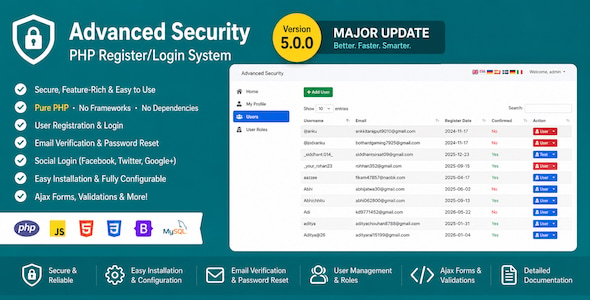
Advanced Security – PHP Register/Login System is a self-contained authentication script for PHP applications, sold on CodeCanyon under the PHP Scripts > Miscellaneous category. It handles user registration, login, password reset, email verification and role-based access through a Bootstrap 5 interface, and it can either run as a standalone site or be dropped into an existing PHP project. It suits developers and agencies who need a working account system without building one from scratch, and it is a poor fit for anyone who wants a hosted service or a CMS plugin.
The script comes from developer niftycode and has been downloaded 2,759 times, holding a 4.81 out of 5 rating across 166 reviews. That volume of feedback, combined with a changelog that stretches back through multiple major rewrites, makes this one of the more established options in the Advanced Security Miscellaneous bracket of CodeCanyon’s PHP listings.
What the script actually handles
At its core the product covers the full account lifecycle. Visitors can register, confirm their email address, log in, request a password reset and update their profile or password from inside the application. Every form submits through Ajax, which means the page does not reload on validation errors, and validation runs on both the browser and the server so a disabled JavaScript client cannot bypass the checks.
Security is the part the vendor leans on hardest, and the implementation mostly matches the claims. Database queries use PDO prepared statements, which separates SQL code from user input and closes off the most common injection route. Passwords are hashed server-side with Bcrypt, and the script supports a client-side SHA-512 hash before transmission, which the vendor frames as protection for sites running without HTTPS. That framing deserves scrutiny: a client-side hash is not a substitute for TLS, and the documentation itself advises enabling HTTPS where possible. Treat the feature as defence in depth, not a replacement for a certificate.
Beyond hashing, the script regenerates session identifiers to reduce session fixation risk, issues and validates CSRF tokens on form submissions, and locks out repeated failed login attempts to slow down brute force attacks. These are the four controls that matter most in a login system, and all four are present rather than promised.
Administration is deliberately lightweight. The admin panel lets an operator add, edit, search and paginate users, ban accounts, and assign roles. Three roles ship by default — Admin, Editor and User — and additional roles can be created without limit. Redirect targets can be set per role, which is useful when different account types need to land on different dashboards after signing in.
Configuration is handled through an installation wizard that writes the config file and creates the database tables automatically. Email can be sent through PHP’s native mail function or through SMTP, and the interface strings and validation messages are translatable, with full Unicode support so non-Latin scripts render correctly. Social login is available through Facebook, Twitter and Google, though the changelog shows Google+ was replaced with Google Sign-in back in version 3.0.1, so the older terminology in the feature list is out of date.
The source is object-oriented PHP and JavaScript with inline comments, released under the included source files (JavaScript, HTML, CSS, PHP). Version 5.0.0 raised the minimum requirement to PHP 8.0, updated all third-party libraries and added automated test coverage across the codebase — a meaningful signal for anyone maintaining the script long term.
Where this fits and where it does not
The strongest use case is a custom PHP application that needs authentication bolted on. Because the script is not tied to a framework, a developer can lift the classes into an existing codebase, point them at the current user table, and keep the surrounding application untouched. The standalone mode is equally viable: a small membership site, an internal tool behind a login wall, or a client portal can go live with the default Bootstrap 5 styling and a logo swap.
Freelancers building small portals for clients will find the installation wizard removes most of the setup friction, and agencies running several small projects can reuse the same base rather than rebuilding account logic each time. The role system covers the common case of administrators, content editors and ordinary members without custom work.
It is the wrong choice for a WordPress site. This is a standalone PHP script, not a plugin, and forcing it into a CMS that already has its own user tables creates two competing authentication systems. It is also a poor fit for projects that need enterprise identity features the listing does not claim: no SAML, no OAuth provider mode, no multi-factor authentication, no audit logging beyond what the admin panel shows. Teams that need those should look at a dedicated identity platform instead.
Strengths and limitations
Strengths
- Prepared statements, Bcrypt hashing, CSRF tokens and session regeneration are all implemented, covering the core attack surface of a login system.
- Framework-agnostic PHP means it can be embedded in an existing application rather than dictating the stack.
- The installation wizard generates the config file and database tables automatically, cutting setup time to minutes.
- Unlimited custom roles with per-role redirects give more access control than most scripts at this price point.
- Translatable interface strings and full Unicode support make non-English deployments straightforward.
- Version 5.0.0 added automated test coverage and modernised dependencies, which matters for long-term maintenance.
- Documentation is described as complete and detailed, and a live demo with published admin credentials lets buyers evaluate before purchasing.
Limitations
- The client-side SHA-512 password hashing is presented as a workaround for missing HTTPS. It offers limited real protection against an active attacker on the network and should not be treated as a substitute for TLS.
- There is no multi-factor authentication, no login attempt logging dashboard and no audit trail. Sites with compliance requirements will need to add these.
- Social login covers Facebook, Twitter and Google only. There is no generic OAuth provider support, so adding another identity provider means writing custom code.
- The front end is Bootstrap 5. Projects on Tailwind, Foundation or a bespoke design system will need to restyle every template.
- PHP 8.0 is now the minimum, so the script cannot be deployed on older shared hosting running PHP 7.x without downgrading to an earlier release.
- The vendor does not state whether updates are included indefinitely or for a fixed period, so buyers should confirm the support terms before purchase.
How it compares with the alternatives
The realistic alternatives fall into three groups: building authentication from scratch, adopting a framework’s built-in auth package such as Laravel Breeze or Symfony Security, or buying a script like this one.
Building from scratch gives complete control but takes days of work to reach the same security baseline, and the failure modes are well documented — missing CSRF tokens, weak session handling, plaintext password storage. Most small teams underestimate the effort. Framework auth packages are excellent, but they only apply if the project already uses that framework; a legacy procedural PHP application cannot adopt them without a rewrite.
Against other CodeCanyon login scripts, the differentiators here are the age and stability of the codebase, the automated test coverage added in version 5.0.0, and the 166-review rating. Many competing scripts in the same category were last updated years ago and still target PHP 5.x. That said, a buyer who needs multi-factor authentication or a modern JavaScript front end will find this script’s feature set conservative, and a headless auth service may be a better architectural fit despite the recurring cost.
Frequently Asked Questions
Does Advanced Security work with an existing PHP application?
Yes. The script is written in plain object-oriented PHP without framework dependencies, so its classes can be included in an existing codebase and pointed at an existing user table. Integration requires some manual work to map the current schema to the script’s expectations, and the vendor documentation covers the configuration file and database layer.
Is a separate HTTPS certificate still needed if passwords are hashed client-side?
Yes. The client-side SHA-512 hash reduces what a passive observer sees, but it does not protect session cookies, form data or the rest of the page from interception. The vendor’s own guidance recommends HTTPS, and any site handling real user credentials should run it. Treat the hash as an extra layer, never as a replacement.
What PHP and MySQL versions are supported?
Version 5.0.0 requires PHP 8.0 or higher, and the vendor lists compatibility with both MySQL 8.x and MySQL 5.x. Older releases of the script supported PHP 5.3 and above, but those are no longer maintained. Deploying on a host still running PHP 7.x means using an outdated release without the current security updates.
Can new user roles be created beyond the default three?
Yes. The script ships with Admin, Editor and User roles, and the admin panel allows unlimited additional roles to be defined. Each role can be given its own post-login redirect target, which allows separate dashboards for different account types without modifying the core authentication code.
Verdict
Advanced Security – PHP Register/Login System is a sensible purchase for PHP developers and small agencies that need a proven, security-conscious account system without spending a week building one. The 4.81 rating across 166 reviews and a changelog reaching back through several major versions indicate a maintainer who keeps the code current, and the version 5.0.0 test coverage is a genuine differentiator in this category.
Buyers should go in with clear expectations. There is no multi-factor authentication, no audit logging and no generic OAuth support, and the client-side hashing claim should not be read as a reason to skip HTTPS. Projects needing those features, or sites running on WordPress or another CMS, should look elsewhere. For straightforward registration and login inside a custom PHP application, this remains one of the more defensible $19 purchases in the Miscellaneous category.