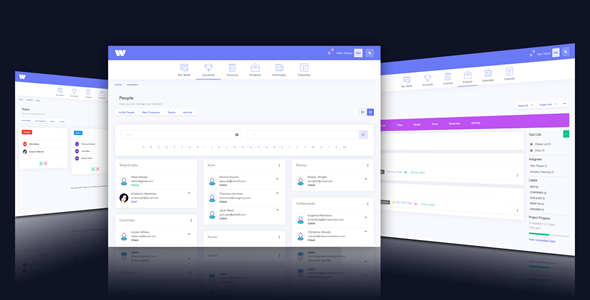
Inilabs School Express : School Management System is a self-hosted PHP web application that handles the administrative and academic operations of a school from a single dashboard. It covers admissions, student records, fees, exams, timetables, assignments and library lending, and it ships with separate logins for administrators, teachers, students, parents, accountants, librarians and receptionists. It is aimed at private schools, academies and tuition centres that want to run their own installation rather than rent a per-student cloud platform.
The script is sold on CodeCanyon by the developer inilabs for $59. At the time of writing it has 2,378 sales and a 4.32 out of 5 rating across 233 reviews, which puts it among the more established listings in its niche. The most recent vendor update is dated July 2026, and the project has been maintained continuously since at least 2022.
What the system actually does
School Express is built on CodeIgniter, a PHP framework that keeps the codebase organised into models, views and controllers. Buyers receive the full source: PHP, SQL schema, JavaScript, HTML, CSS and LESS stylesheets. That matters because it means the front-end design and the database structure can both be changed without touching an encrypted core.
The functional surface is broad. The admission module accepts applications from the public-facing website, so a prospective parent can submit details and upload documents before a staff member reviews the record. Once a student is enrolled, their profile carries the information the rest of the system depends on: class, section, guardian contact details, and the fee plan attached to them.
Fee collection is where most schools feel the pain, and the script treats it as a first-class module rather than an afterthought. Invoices can be generated, discounts and fines applied, and partial payments recorded against a running balance. The accountant role exists specifically to work in this area without needing access to academic settings. Parents see the same numbers from their own login, which removes a large volume of routine phone calls to the office.
Examinations are handled in two directions. Staff can define exam terms and mark sheets, and the system produces progress cards and mark sheet reports. Separately, there is an online exam feature that lets students sit a timed assessment inside the portal and see results afterwards. The changelog shows this area receiving attention over several releases, including a fix for a bug where a student could not take an exam, and a correction to progress card reports.
Around those core modules sit the day-to-day tools: class timetables, assignment distribution, attendance, a library module for issuing and returning books, leave applications from staff or students, event scheduling, and an internal email facility that gained file attachments in version 5.8. A frontend announcement bar was added in version 6.5 for broadcasting notices to anyone visiting the public site.
Two smaller details are worth noting because they reflect ongoing maintenance rather than launch-day polish. Google Analytics integration arrived in version 6.7, giving administrators visibility into how the public pages perform. The About page gained a default feature image in version 6.6. Neither is transformative, but both indicate the vendor is still shipping incremental improvements rather than abandoning the product.
Where it fits and where it does not
The clearest fit is a single-campus private school or academy with somewhere between a few dozen and a few thousand students. The multi-role login structure maps well onto how these institutions are actually staffed: a small office team where one person handles reception, another handles accounts, and teachers need access to their own classes only.
Tuition centres and coaching institutes are a reasonable second fit. The admission, fee and attendance modules work the same way regardless of whether the institution follows a national curriculum, and the frontend admission form can be repurposed as a general enquiry funnel.
Freelancers and small agencies building a site for a school client are a third audience. Because the source is included and the stack is plain PHP with MySQL, a developer can rebrand the interface, adjust the schema and hand over a system that does not depend on a third-party subscription. The $59 price is a one-off cost rather than a recurring per-student fee, which is a meaningful difference for a school with tight budgets.
Where it is the wrong choice: a large multi-campus university or a group of schools that needs consolidated cross-institution reporting. Nothing in the supplied specification suggests the data model is designed around multiple legal entities sharing one installation, and the reporting described is per-school. Institutions that need deep integration with an existing student information system, or that require compliance certifications the vendor does not publish, should look at enterprise platforms instead.
Strengths and limitations
Strengths
- Full source code in PHP, SQL, JavaScript, HTML, CSS and LESS, so the interface and database can be modified without restriction.
- Seven distinct user roles, including parents and a dedicated accountant login, which matches how schools divide administrative work.
- Fee management goes beyond simple invoicing, with discounts, fines and partial payment tracking.
- Both offline mark entry and online timed exams are supported, with progress cards and mark sheet reports generated from the same data.
- A long, visible update history covering bug fixes, a PHP 8.2 upgrade and a frontend redesign, which is a reasonable signal of continued support.
- Built on CodeIgniter and tested against PHP 8.x with MySQL 5.x and 8.x, so it runs on standard shared hosting.
Limitations
- The declared browser compatibility list includes Internet Explorer 7 through 11. That list is almost certainly stale, and it suggests the compatibility matrix has not been revisited in some time. Anyone relying on that claim should verify behaviour in current browsers rather than trust the field.
- The category placement on CodeCanyon is “Project Management Tools”, which is not where a school administrator would naturally look. Buyers researching this space may simply never find the listing.
- The changelog is dominated by small bug fixes and minor additions. There is no evidence in the supplied data of a mobile app, an API for third-party integrations beyond the one referenced in version 5.9, or support for multi-campus consolidation.
- A 4.32 rating across 233 reviews is solid but not exceptional for a script at this price point, and the gap between that and a near-perfect score usually reflects a steady trickle of unresolved complaints.
- The vendor does not state the level of documentation, the length of the support period, or whether future updates are included indefinitely. Those are material questions for a school that will depend on the system for years.
How it compares with the wider category
School management software splits into two broad camps. On one side are hosted platforms that charge per student per month and handle hosting, backups and updates as part of the subscription. On the other are self-hosted scripts like this one, where the buyer pays once and takes on the operational responsibility.
The hosted route wins on convenience and on the assumption that the vendor will keep the product current with browser and security changes. It loses on long-term cost, on data ownership and on flexibility. A school with 800 students paying even a modest monthly fee will exceed the price of this script within the first year.
The self-hosted route wins on cost control and on the freedom to modify anything. It loses on the fact that the buyer becomes the IT department. Upgrades have to be applied deliberately, backups have to be configured, and a PHP version bump on the hosting account can break a script that has not been tested against it.
Within the self-hosted segment, the differentiator is usually breadth of modules rather than depth in any one area. School Express covers the full administrative loop, which is the right trade-off for a school that currently runs on spreadsheets and paper. A school that has already solved, say, fee collection with dedicated accounting software may find the overlap more annoying than useful.
Frequently Asked Questions
Is Inilabs School Express a hosted service or do I install it myself?
It is a self-hosted script that must be installed on a web server running PHP and MySQL. The purchase includes the source files and a SQL database schema, but not hosting. Installation requires uploading files and importing the database, which is within reach of anyone comfortable with a typical PHP script setup but may need a developer otherwise.
Can parents and students log in to check fees and results?
Yes. The system ships with separate logins for parents and students alongside administrator, teacher, accountant, librarian and receptionist accounts. Parents can view fee balances and invoices, while students can access assignments, timetables and exam results. Demo credentials for every role are published by the vendor, so the access levels can be checked before purchase.
Does the system support online exams as well as paper-based ones?
Both are covered. Staff can define exam terms and enter marks manually to produce progress cards and mark sheet reports, and there is a separate online exam feature where students take a timed assessment inside the portal and see results afterwards. The online exam area has received bug fixes across multiple releases.
What PHP and MySQL versions does it require?
The vendor lists compatibility with PHP 8.x and MySQL 5.x or 8.x. Version 5.7 of the script upgraded the codebase to PHP 8.2, so a modern PHP 8 installation is the sensible target. The framework is CodeIgniter, and the declared browser support list includes legacy Internet Explorer versions that should be treated with scepticism.
Verdict
Inilabs School Express is a sensible purchase for a single-campus private school, academy or tuition centre that wants to stop running admissions, fees and results across disconnected spreadsheets. The breadth of modules, the one-off price and the included source code make it a reasonable foundation for a developer to adapt to a specific institution’s workflow. It is also a fair option for a freelancer who needs a school management base to customise for a client.
It is not the right product for a multi-campus institution needing consolidated reporting, nor for a school that wants a vendor to handle hosting, backups and upgrades as part of a subscription. Buyers in those situations are better served by a hosted platform, even at a higher ongoing cost. Anyone considering this script should test the demo across all seven roles first, and should confirm the support terms and documentation scope directly with the vendor, because the listing does not state them.