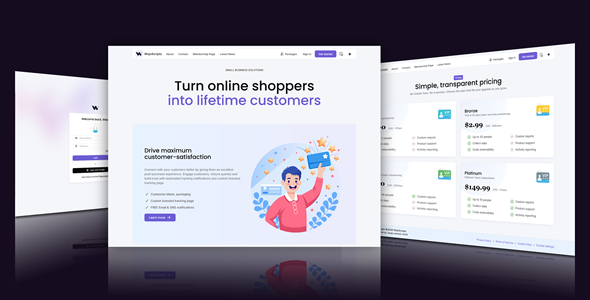
eClass is a self-hosted learning management system built as a PHP script on the Laravel framework and sold through CodeCanyon for $11. It gives an organisation its own course marketplace, with separate dashboards for students, instructors and administrators, covering video lessons, quizzes, assignments, live classes, certificates and paid enrolment. It belongs in the eClass Project Management Tools category because it handles the administrative side of running a teaching business as much as the teaching itself. Small training companies, independent tutors and agencies building a client’s course platform are the natural buyers.
The product has been purchased 2,099 times and holds a 4.44 out of 5 rating across 127 reviews, which is a meaningful sample for a script at this price. It is developed by media-city, a seller with a track record on the same marketplace. The vendor last updated it in September 2026 and states compatibility with PHP 8.x.
What the platform actually does across its three user roles
eClass is organised around three logins, and the feature set is best understood by what each one can do rather than as a single checklist.
Course delivery for students
Learners get a dashboard showing enrolled courses, completion status and grades, with filtering and both grid and list views for browsing the catalogue. Content can be video, audio, images, PDFs and downloadable archives, and the built-in PDF reader means documents open inside the platform rather than being handed off to the browser. Video playback supports multiple speed settings, looping and a resume-from-where-you-stopped behaviour. Quizzes can be objective or subjective, and there is a separate test series area with previous papers and download options. Progress tracking, a leaderboard and a wish list round out the study experience, and certificates can be issued and downloaded on completion.
Teaching and administration tools
Instructors create and organise courses, add lessons and assessments, grade submissions and leave feedback. They can schedule live classes, accept appointments, message students and run question-and-answer threads per course. The platform also supports instructor profiles that students can follow, which matters for anyone building a personal brand around their teaching. Administrators control enrolment, device access limits, private courses and the review system, including the ability to act on reported reviews.
Commerce, payments and growth features
This is where eClass goes further than a bare course player. Courses can be sold individually or as bundles on a subscription model through Stripe, with coupon support. There is an affiliate or referral system, a gift-a-course option and a “become an instructor” application flow, so the site can grow its catalogue without the owner recruiting every teacher personally. Invoices download as PDFs. Social login covers Facebook, Google, GitLab, Amazon, LinkedIn and Twitter, which reduces sign-up friction, and messaging extends to Facebook Messenger and WhatsApp buttons for prospective students who prefer to ask before buying.
Customisation and technical footing
Source files include JavaScript, CSS, PHP and SQL, so the layout and styling can be changed directly rather than through a locked template editor. The vendor lists compatibility with Chrome, Firefox, Safari, Opera, Edge and IE11. The Laravel foundation is a genuine advantage for buyers with PHP developers available: it is a widely documented framework, which makes hiring and long-term maintenance easier than working with a bespoke codebase.
Where eClass fits well, and where it does not
The strongest fit is a training business or solo educator who wants to own the storefront, the customer list and the payment relationship rather than rent space on a large course marketplace. A language school selling term-length subscriptions, a consultancy packaging its expertise into paid modules, or a tutor running cohort-based courses with live sessions and certificates are all realistic deployments. Agencies also use scripts like this as a starting point for client builds where the budget rules out a custom application, since the source files allow rebranding.
It is the wrong choice for an organisation that needs formal accreditation features, complex multi-tenant structures where several separate schools share one installation, or deep integration with an existing student information system. The vendor’s own feature list mentions integration only in general terms and does not name specific connectors, so any assumption of ready-made links to external systems should be verified on the demo before purchase. Buyers without PHP skills, or without access to a developer, should also think carefully: a self-hosted script means updates, security patching, hosting and backups are the owner’s responsibility, not the vendor’s.
Strengths and limitations in plain terms
Strengths
- Unusually broad feature set for the price. At $11, the inclusion of subscriptions, affiliates, live classes, certificates and a quiz engine is well beyond what most scripts at this level offer.
- Three-role architecture. Separate student, instructor and admin experiences mean the platform can support a marketplace of many teachers, not just one owner publishing courses.
- Editable source files. JavaScript, CSS, PHP and SQL are all included, so design and behaviour can be changed without hacking around a closed system.
- Laravel and PHP 8.x. A mainstream framework and a current PHP version make the code easier to maintain and easier to hand to a developer.
- Proven demand. More than two thousand sales and a 4.44 rating suggest the core flows work for a substantial number of buyers.
- Working demo for all three roles. Admin, instructor and student logins are published, so the purchase decision can be based on hands-on testing rather than screenshots.
Limitations
- Demo restrictions. The vendor states that some features are disabled or limited in the demo for security and performance reasons, so a few capabilities cannot be fully evaluated before buying.
- Payment coverage is narrow. Subscription billing and coupons are described around Stripe. The listing does not name other gateways, which is a real constraint for buyers in regions where Stripe is unavailable.
- No stated integration catalogue. Beyond social login and chat buttons, the vendor does not list specific third-party integrations such as email marketing platforms or accounting tools.
- Self-hosted burden. Updates, hosting, SSL, backups and security are entirely the buyer’s responsibility, and a script at this price should be expected to need occasional developer attention.
- Listing quality signals caution. The vendor copy contains visible typos and inconsistent capitalisation, which is worth noting as a signal about documentation polish rather than as a comment on the code itself.
- IE11 support is listed but dated. It suggests parts of the front end have not been modernised recently, even though the product was updated in 2026.
How eClass compares with the wider category
Buyers researching this space generally face three options: hosted SaaS platforms billed monthly, open-source LMS applications, and commercial scripts sold once on a marketplace. Hosted platforms remove all maintenance but charge per learner or per month and keep the data; open-source systems are free and powerful but demand real server administration and often feel dated to end users; marketplace scripts sit in between, offering a modern storefront and a one-off cost in exchange for the owner handling infrastructure.
eClass competes most directly on breadth per dollar. Its combination of subscriptions, affiliates, live classes and certificates is closer to what hosted platforms charge recurring fees for than to what most one-off scripts include. Where it gives ground is ecosystem maturity: hosted platforms bring support staff, uptime guarantees and a long list of integrations, while open-source projects bring large developer communities and years of documentation. A buyer choosing eClass is essentially trading those safety nets for ownership, a low entry cost and full control of the code.
Frequently Asked Questions
What is eClass Learning Management System used for?
It is used to run a self-hosted online course business, including selling courses, delivering video and document lessons, setting quizzes and assignments, issuing certificates and managing instructors. The platform provides separate dashboards for students, teachers and administrators, so one installation can support a marketplace with multiple instructors rather than a single publisher.
Does eClass support subscription payments and coupons?
Yes, subscription billing on bundled courses and coupon codes are supported through Stripe. The vendor does not list alternative payment gateways in the product description, so buyers who need PayPal or a regional processor should confirm availability on the demo or with the developer before committing to a purchase.
Do I need coding skills to run eClass?
No coding is required to operate the site day to day, since courses, users and payments are handled through the admin dashboard. However, installation, updates, hosting and any design changes require familiarity with PHP and the Laravel framework, or a developer who can handle those tasks. Source files are included for customisation.
Can students take courses on a phone?
Yes, the platform is built to be mobile compatible, and the vendor lists support for Chrome, Firefox, Safari, Opera, Edge and IE11. Students can access lessons, quizzes and their progress from a smartphone or tablet, and the vendor offers a live demo where the mobile experience can be checked directly.
Verdict
eClass is a sensible purchase for educators, training companies and agencies that want a fully featured course marketplace they own outright, have access to a PHP developer, and are comfortable managing hosting and updates themselves. The price-to-feature ratio is the strongest argument in its favour, and the sales volume and rating suggest it delivers on the basics for most buyers. It is not the right pick for organisations that need guaranteed support, extensive third-party integrations or a hands-off hosted service. Buyers should test the demo thoroughly, particularly the payment and live class areas where the demo is limited, and budget for a developer to handle installation and ongoing maintenance.