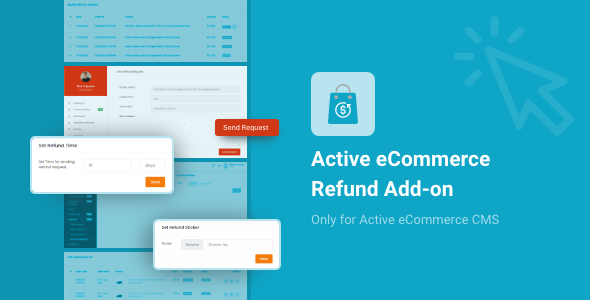
The Active eCommerce Refund add-on is a paid extension for the Active eCommerce CMS that adds a complete product returns workflow to an existing store. It lets customers request money back on delivered orders, routes those requests to sellers and administrators for approval, and credits approved amounts to a customer wallet or settles them offline. It is aimed at store owners already running Active eCommerce who need a formal, auditable refund process rather than handling complaints by email. The add-on is sold on CodeCanyon by ActiveITzone for $25 and has been purchased 1,946 times, with an average rating of 4.07 out of 5 across 27 reviews.
The Refund add-on is not a standalone script. It installs inside an Active eCommerce installation and depends on that CMS being present, so it is only relevant to stores already built on that platform. The vendor publishes a live demo, and the item has been updated regularly, most recently in July 2026 with version 2.3.
What the refund add-on actually does
The core of the extension is a request-and-approval pipeline. A customer opens a refund request against a delivered order, supplies a reason and can attach product photos as evidence, then waits while the request moves through review. Once approved, the money either lands in the customer’s wallet automatically or is paid out through a bank transfer or another offline method, with the administrator able to record a transaction reference and upload proof of payment.
Policy rules that run without manual checks
Refund eligibility is governed by settings rather than by staff judgement on each case. The store owner chooses whether one policy applies across the catalogue or whether rules vary by product category, including sub-categories. Each category can carry its own refund window, expressed as a number of days after delivery. Once that window closes, the request form stops accepting submissions, and products outside an active refund period cannot be flagged as refundable. Individual products can also have the refund option switched off entirely, which is useful for digital goods, perishables or made-to-order items.
Two refund routes: wallet credit and offline payment
Wallet refunds are the simpler path. When an administrator approves a request, the balance is credited to the customer’s account without further action, and the customer can spend it on a different product later. Offline refunds suit stores that would rather return money through the original payment channel. The administrator marks the request as settled, records the transaction identifier and attaches confirmation, so there is a paper trail. The vendor notes that the offline route requires the separate Active eCommerce Offline add-on, version 1.7 or later.
Seller involvement in multi-vendor stores
On a marketplace with multiple sellers, the add-on supports a seller-first review step: the seller sees the request, approves or rejects it with a stated reason, and the administrator then makes the final call. Administrators can also override that sequence and approve a seller’s refund without waiting for the seller, and can decide in settings whether seller approval is required at all. Products sold directly by the store rather than by a third-party seller skip the seller stage and go straight to the administrator.
Visibility for customers and staff
Customers get a tracking panel showing where each request stands, why it was rejected if that happened, and which payment method was used. Product pages can display a refund badge and a written refund note, so the conditions are visible before purchase rather than buried in a policy page. Version 2.3 added a refund timeline that shows the full history of a request in a single panel, plus a dispute mechanism that lets a customer reopen a rejected request with new evidence. It also made refund causes and rejection causes configurable lists, which keeps the reasons consistent across the store instead of free text.
Where this add-on fits, and where it does not
A multi-vendor marketplace built on Active eCommerce is the clearest fit. Once several sellers are listing physical goods, refund disputes stop being an edge case and start being a daily operational task. The seller-review step and the administrator override give the store a defensible process without requiring sellers to handle money directly.
A single-seller store selling physical products also benefits, particularly where category-level rules make sense: clothing might carry a longer window than electronics, for example. Stores selling a mix of physical and digital goods can use per-product toggles to keep refunds off the intangible items.
Stores that already handle returns through a helpdesk tool and only need to move money back to customers should think carefully. If the actual refund happens at the payment gateway and the store just needs a record, the wallet-centric design here may duplicate work rather than replace it.
The add-on is the wrong choice in three situations. It cannot be used on WooCommerce, Shopify, Magento or any platform other than Active eCommerce, so it is not a general-purpose refund tool. It is also unsuitable for stores that have not yet bought the base CMS, since the add-on does nothing on its own. Finally, a store selling only digital downloads with an all-sales-final policy has little use for a returns pipeline at all.
Strengths and limitations
Strengths
- Refund rules are enforced by the software rather than by staff memory, so time limits and per-product toggles apply consistently.
- The seller-first review flow with administrator override is a sensible design for marketplaces where sellers and the platform share responsibility.
- Wallet refunds settle automatically on approval, which removes a manual accounting step for the most common case.
- Category-level refund windows, including sub-categories, cover the realistic variation in return policies without needing custom code.
- Configurable refund and rejection reasons produce cleaner records than free-text notes and make later reporting easier.
- The dispute and timeline features added in version 2.3 give customers a route to appeal and give staff a single chronological view of each case.
- Installation runs through the CMS’s own add-on manager, and the vendor keeps the item current with recent CMS releases.
Limitations
- The offline refund route depends on a second paid add-on (Active eCommerce Offline, version 1.7 or newer), so the true cost of that workflow is higher than the $25 headline price.
- Refund money goes to a store wallet or an offline transfer; the add-on does not appear to push refunds back through the original card or gateway automatically, which means gateway-side refunds still have to be handled separately.
- The item is tied to PHP 7.x and Laravel in its declared specifications, and the vendor does not state PHP 8 support, which is worth confirming before installing on a newer server.
- An average rating of 4.07 from 27 reviews suggests a solid but not flawless item; buyers should read the review comments rather than relying on the score alone.
- Because the add-on hooks into the CMS core, major CMS updates can require a matching add-on update, so stores should expect to track both release cycles.
- Wallet credit is store-specific. A customer who wants money back on their card rather than credit in one shop will need the offline route, with its extra dependency.
How it compares with other ways of handling refunds
The obvious alternative is a general helpdesk or ticketing system. Those tools handle the conversation well and can store evidence, but they do not know what a customer bought, whether the order was delivered, or how long the refund window has been open. The add-on wins on context: it reads order and delivery state directly, so eligibility is decided from real data rather than from what a support agent types. A helpdesk wins on breadth, since it covers complaints, chargebacks and general enquiries that have nothing to do with refunds.
The second alternative is doing nothing and relying on manual wallet adjustments. That works at very low volume but leaves no record of why money moved, and it scales badly once more than a handful of requests arrive each week. The add-on’s audit trail, rejection reasons and timeline are the main advantage here.
The third option is a dedicated returns or reverse-logistics platform. Those are built for large retailers with warehouse integrations and carrier labels, and they are priced and scoped accordingly. For a store on Active eCommerce, they are overkill, and they would not integrate with the CMS’s order tables without custom development. The add-on is the proportionate choice for that platform, and the only one that installs cleanly into it.
Frequently Asked Questions
Do I need Active eCommerce CMS to use this refund add-on?
Yes. The add-on is an extension, not a standalone script, and it only functions inside an Active eCommerce installation. The vendor states plainly that the refund system is not independent. A store on another platform cannot use it at all, and buying the add-on before the CMS would be wasted spend.
How does a customer actually get their money back?
Through one of two routes chosen at request time. A wallet refund is credited automatically to the customer’s store balance once an administrator approves the request. An offline refund is paid by bank transfer or another method the store defines, with the administrator recording the transaction ID and uploading proof. The add-on does not appear to reverse card payments through the payment gateway itself.
Can sellers approve refunds without the admin?
No, the administrator retains final control. On seller-listed products, the seller reviews the request first and gives an approval or rejection with a reason, which the administrator then sees before acting. Settings in version 2.3 let the store decide whether seller approval is required, and administrators can approve a seller’s refund without waiting for that approval.
Is there a time limit on refund requests?
Yes, and it is configurable. The store owner sets a refund window per category, including sub-categories, and requests are only accepted after an order is marked delivered and before that window closes. Products can also have refunds switched off individually, which removes the option from the product page entirely.
Verdict
This add-on is worth buying for anyone already running an Active eCommerce store that sells physical goods, and it becomes close to essential for multi-vendor marketplaces on that platform where refund disputes are handled ad hoc. The $25 price is modest for the amount of workflow it replaces, and the regular updates suggest the developer is maintaining it against current CMS releases. Stores that sell only digital products, or that already have a returns process working well elsewhere, will get little from it. Buyers should also budget for the Offline add-on if bank-transfer refunds are part of the plan, and should confirm PHP compatibility with the vendor before installing on newer hosting.