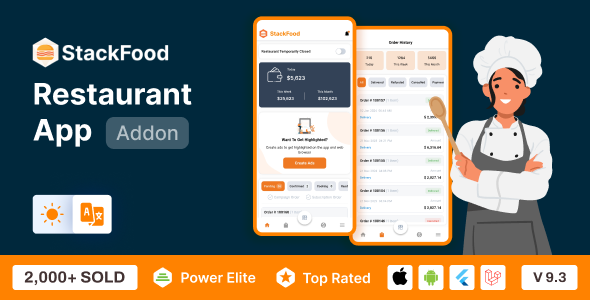
StackFood Multi Restaurant is a commercial Flutter-based food ordering system sold on CodeCanyon, built around a multi-vendor model where several restaurants trade through one customer-facing app. The package centres on a restaurant module: a mobile app that lets each restaurant owner manage orders, menus and day-to-day operations from a phone instead of being tied to a desktop web panel. It is aimed at developers and agencies building marketplace-style delivery platforms, and at restaurant groups that want their own branded ordering channel without building native apps from scratch. The StackFood Multi Restaurant Flutter codebase is distributed as editable source, so buyers can rebrand and extend it rather than renting a closed SaaS platform.
What the system actually does, and where the restaurant app fits
The product is best understood as a set of connected pieces rather than a single app. There is an admin panel that sits at the centre, a customer app, and the restaurant app that this listing focuses on. The vendor describes the restaurant app as a core module of the wider system, which matters for buyers: the restaurant tool is not a standalone product, and its value depends on the rest of the stack being installed and configured.
Restaurant-side operations from a phone
The restaurant app gives each vendor a mobile interface for the tasks a kitchen or front-of-house manager handles during service. In practice that means receiving incoming orders, reviewing their contents, and moving them through the fulfilment stages. The vendor states that owners can carry out all their operations through the app as an alternative to the restaurant web panel, so the mobile app is positioned as a full substitute for the browser dashboard, not a cut-down companion.
Multi-vendor architecture
Because the system is designed for many restaurants on one platform, the admin panel is where new vendors are registered and where each restaurant’s presence on the marketplace is controlled. The vendor’s own setup note is telling here: it recommends registering a fresh restaurant from the admin panel before testing, rather than relying on the shared demo credentials, because too many people logging into the same demo account makes testing unreliable. That single detail reveals how the pieces are wired together — the admin panel provisions restaurants, and the restaurant app is the vendor’s working surface once provisioned.
Flutter source code and native project files
The package is declared compatible with Flutter 3.x and ships with Dart source, YAML configuration files, and the .kotlin and .swift files needed for the Android and iOS build layers. For a development team this is the practical part of the offer: the Dart code is where business logic and screens are customised, the YAML files carry dependency and asset configuration, and the native files are where platform-level settings such as app identifiers, permissions and signing are adjusted before store submission. A team that already knows Flutter can work in this codebase without learning a proprietary framework.
White-label branding
Buying source rather than a subscription means the visual identity, app name and store listings can be changed to suit the client. For agencies, that is the difference between delivering a platform under the client’s brand and reselling someone else’s product with a logo swap.
Where this product fits, and where it does not
The clearest fit is a marketplace build: a client wants a delivery or pickup platform where independent restaurants list menus and take orders, and the developer needs a working foundation rather than a blank repository. Agencies producing this kind of app repeatedly will find the most value, because the same codebase can be rebranded per client and the learning curve is paid once.
A second fit is a restaurant group or franchise that wants its own ordering channel and has, or can contract, Flutter development capacity. The restaurant app gives each branch or brand manager a phone-based operations tool while the admin panel keeps central control.
It is also a reasonable starting point for a developer building a portfolio piece or an MVP to show investors, since the multi-vendor structure and the restaurant workflow already exist and can be demonstrated quickly.
Where it is the wrong choice: a single independent restaurant that only needs a simple menu and order form. The multi-vendor architecture, admin provisioning and marketplace concepts add complexity that a one-location business will never use, and a simpler ordering plugin or a hosted ordering service would cost less in setup time. It is equally unsuitable for a buyer with no development resources who expects a finished, hosted product — this is source code that has to be installed, configured and maintained, and the vendor’s listing does not state that installation or hosting is included.
Strengths and limitations
Strengths
- Editable Flutter source. The Dart, YAML, Kotlin and Swift files are included, so the app can be rebranded, extended and submitted to the app stores under the buyer’s own accounts.
- Restaurant app as a full operations tool. The vendor positions it as a complete alternative to the web panel, which suits owners who work from a phone during service.
- Multi-vendor foundation already built. Admin-side restaurant registration and per-vendor management are part of the system, saving the architecture work a marketplace build normally requires.
- Current Flutter target. Compatibility with Flutter 3.x means the codebase aligns with a modern toolchain rather than an obsolete version.
- Proven demand and satisfaction. Around 2,000 sales and a 4.8 out of 5 average across 79 reviews indicate a large installed base and generally satisfied buyers.
- Low entry price. At $29, the cost of evaluating the code against a project’s requirements is small relative to the development time it could save.
Limitations
- Not a standalone product. The restaurant app depends on the wider StackFood system and admin panel; a buyer cannot treat this listing as a complete ordering platform on its own.
- Shared demo credentials are unreliable. The vendor explicitly warns that the public demo login is used by many people, so hands-on testing can be unstable unless a new restaurant is registered from the admin panel first.
- Development skill is assumed. Nothing in the listing suggests a no-code setup path; configuring a Flutter project, native build files and store submissions requires a developer.
- Documentation and support terms are not stated in the listing. The vendor does not describe the scope of support, update policy or documentation depth here, so those need checking on the item page before purchase.
- Ongoing maintenance falls to the buyer. Flutter and platform requirements change; a source-code purchase means the buyer owns those updates, not the vendor.
How it compares with the wider category
Buyers researching this space usually weigh three kinds of option: hosted ordering SaaS, single-restaurant scripts, and multi-vendor source-code kits like this one. Hosted SaaS wins on speed to launch and removes maintenance, but it locks the business into a monthly fee, limits branding, and usually keeps the customer relationship and data on the provider’s terms. Single-restaurant scripts are simpler and cheaper to configure, but they have no concept of multiple vendors, so they cannot become a marketplace without being rebuilt.
Multi-vendor source kits sit in the middle. They cost more in setup effort than SaaS and less than a custom build, and they hand the buyer full control of code and data. Within that group, the differentiators are the depth of the restaurant-side tooling, how current the framework target is, and how actively the codebase is maintained. StackFood’s restaurant module is a meaningful point in its favour, because many competing kits concentrate on the customer app and admin panel while leaving vendors with a thin interface. The trade-off is the same across the category: control and ownership in exchange for development responsibility. A team that wants to ship in a week should look at hosted platforms; a team that wants to own the platform should look here.
Frequently Asked Questions
What is StackFood Multi Restaurant Flutter used for?
It is a source-code package for building multi-vendor food ordering apps with Flutter. The listing focuses on the restaurant module, a mobile app that lets each restaurant owner manage orders and operations instead of using the web panel. It is part of a larger system that includes an admin panel and a customer-facing app.
Do I need to know Flutter to use StackFood Multi Restaurant?
Yes, practical use requires Flutter development skills. The package ships Dart source, YAML configuration and native Kotlin and Swift files, all of which have to be configured, rebranded and built for the app stores. The vendor does not present a no-code setup route, so a buyer without a developer will struggle to launch it.
Is the restaurant app included with the main StackFood system or sold separately?
The restaurant app is a module of the wider StackFood multi-restaurant system rather than a complete platform on its own. It relies on the admin panel to register restaurants and manage the marketplace. Buyers should confirm on the item page exactly which modules the purchase includes before committing to a build.
How many sales and what rating does StackFood Multi Restaurant have?
At the time of writing the item shows roughly 2,013 sales and a 4.8 out of 5 rating from 79 reviews on CodeCanyon. That volume suggests a substantial installed base and broadly positive buyer experience, though individual results depend heavily on how well the code is configured for each project.
Verdict
StackFood Multi Restaurant is worth buying for Flutter developers and agencies that need a multi-vendor food ordering foundation and intend to customise the source for a client. The restaurant module, with its phone-based operations workflow, fills a gap that many competing kits leave thin, and the sales and rating record gives reasonable confidence in the codebase. Buyers should not expect a turnkey platform: the restaurant app depends on the full system, testing needs a freshly registered restaurant rather than the shared demo, and support and documentation terms are not stated in the listing. Single-location restaurants and buyers without development capacity should choose a simpler or hosted option instead.