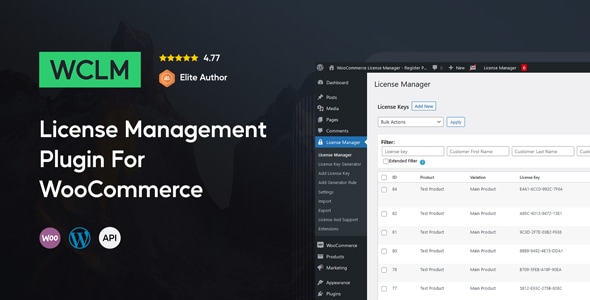
WooCommerce License Manager is a WordPress plugin that turns a WooCommerce store into a storefront for selling and delivering license keys, activation codes and other digital credentials. It handles the full chain — storing codes securely, generating or importing them in bulk, attaching them to orders, delivering them by email, on the order page or through a REST API, and validating or deactivating them later for software that needs an activation check. Store owners selling software licences, game keys, gift cards, PIN codes or downloadable builds should consider it; shops selling only physical or ordinary downloadable goods will find it overkill.
The plugin comes from CodeCanyon, is developed by firassaidi, costs $159 as a one-off licence fee, and has been maintained since 2016. It has 1,893 sales and a 4.83 out of 5 rating across 89 reviews, which is a meaningful sample for this category. The vendor lists compatibility from WordPress 4.9 through 7.0.x and WooCommerce 5.x through 10.x, and the package includes PHP, JavaScript, HTML and CSS source files.
What the plugin actually does beyond delivering a code
Most stores that sell digital codes outgrow a simple “email the buyer a string” setup quickly. The interesting parts of this plugin are the pieces that handle what happens after the first delivery.
Key inventory, imports and automatic generation
License keys live in their own inventory inside WooCommerce rather than in a custom field on the product. Keys can be imported from TXT, CSV or ZIP files (the ZIP route is for image-based codes such as gift card artwork), typed in manually, or generated by the plugin itself. The generator supports custom prefixes and suffixes, configurable chunk length and chunk count, and bulk runs — enough to produce consistent, branded key formats without an external script. Each key can carry an expiry date, a validity duration, multi-line content and even an HTML link, which covers the common cases where a code is really a small bundle of instructions.
Delivery channels and customer access
Codes can appear on the thank-you page, inside the customer’s order details, in transactional emails, or through the REST API. The vendor also allows a setting where buyers retrieve keys from the site instead of receiving them by email — useful for stores that want to force a login before a code is exposed. Image-based delivery is a separate mode for scratch-card and gift-card style products, and it is the detail that distinguishes this plugin from licensing tools built purely for software vendors.
A licensing API for activation workflows
The REST API is the part that matters to anyone selling desktop software, a WordPress plugin, a SaaS product or a game. It exposes endpoints to activate, deactivate and validate a key, check activation limits, confirm a purchase, retrieve licensed downloads and return a status such as valid, invalid or expired. That is the minimum surface a real activation system needs; without it, a “license manager” is only a code dispenser.
Software packages and versioned downloads
Files and updates can be attached to products and variations with version information, and customers holding a valid licence can pull updates from their order history or via the API. For a small software vendor this replaces a separate update server, though it does mean download traffic and file hosting sit on the same WordPress install as the store.
Variations, stock and backorders
Variable products can draw from different key pools per variation, so a Standard, Pro and Enterprise edition — or region-specific keys — can be sold from one product page. Stock can be synchronised with WooCommerce’s own stock counter, low-inventory notifications are built in, and backorders are supported so sales continue while keys are restocked and get assigned when new stock arrives. Administrators can also resend, replace, delete or reassign keys from the order screen, and deliver more than one key per purchase.
Encryption at rest
Stored codes are encrypted using two secret keys that the store owner defines, so a database dump on its own does not expose sellable inventory. The vendor also cites SQL injection protection and authenticated API access. The honest caveat: encryption keys held in the same WordPress installation protect against leaked database backups, not against an attacker who already has full server access.
Where this fits, and where it does not
The clearest fit is a small software vendor or indie developer selling licences through WooCommerce and needing activation checks, seat limits and update delivery without building a licensing backend. A second strong fit is any store selling pre-bought codes — game keys, antivirus subscriptions, top-up cards, PIN codes — where bulk import, per-key expiry and image delivery do most of the work. A third is the multi-edition store using variable products to sell tiers or regions from a single listing.
Agencies building stores for clients in these niches also benefit, because the source files are included and the admin screens live inside WooCommerce rather than in a separate dashboard the client has to learn.
It is the wrong choice for a store whose “digital product” is really just a PDF or a ZIP with no per-customer code. WooCommerce’s native downloadable product handling covers that for free, and the licensing layer adds configuration without adding value. It is also a poor fit for high-volume enterprises that need a dedicated licence server with its own SLA, separate infrastructure and multi-store centralisation — a plugin running inside one WordPress install is not that.
Strengths and limitations
Strengths
- Genuine end-to-end coverage: inventory, generation, import, delivery, activation API and update distribution in one plugin.
- Encrypted key storage with owner-defined secrets is a real safeguard against database exposure, and it is uncommon at this price point.
- Variable product support with separate key pools per variation handles tiered and regional pricing without workarounds.
- Image-based code delivery covers gift cards and scratch cards that text-only licensing plugins ignore.
- Backorders plus stock synchronisation mean a sell-out does not stop sales or require manual reconciliation.
- Long maintenance history since 2016 and a broad compatibility range back to WordPress 4.9, which matters for stores on older stacks.
- Source files are included, so agencies can audit or extend behaviour.
Limitations
- $159 is a one-off CodeCanyon purchase, but ongoing support and updates depend on the author’s continued maintenance — there is no separate support contract, and the vendor does not state a formal support policy in the listing.
- The licensing API is a REST interface documented by the vendor; integrating it into a desktop app or a non-PHP product requires development work on the client side, which is not a drop-in task.
- Everything runs inside the WordPress database and file system, so large key inventories, heavy download traffic and API validation calls all compete with the store itself for resources.
- Encryption protects stored data, not a compromised server; the two secret keys live in the same installation they protect.
- There is no built-in multi-site or multi-store central licensing view described, so a business running several WooCommerce stores would manage each separately.
- Browser compatibility is listed down to Internet Explorer 9, which says more about the age of the codebase’s baseline than about practical modern needs.
How it compares with the wider category
Alternatives in this space fall into three groups. Standalone licence-management SaaS platforms are stronger on activation analytics, multi-product centralisation and abuse detection, but they require a monthly fee, a second account and a data sync between WooCommerce and the external service. Lightweight code-delivery plugins are cheaper and simpler, but most stop at emailing a string — they lack an activation API, encryption and versioned downloads. Generic digital-downloads plugins handle files well and codes poorly.
WooCommerce License Manager sits in the middle: more capable than a code-delivery add-on, less operationally independent than a dedicated licensing service, and priced as a one-time purchase rather than a subscription. For a store doing hundreds rather than hundreds of thousands of activations a month, that trade is usually favourable. For a software company whose entire revenue depends on licence enforcement uptime, a hosted licensing platform with its own infrastructure is the safer architecture, even at higher cost.
Frequently Asked Questions
What is WooCommerce License Manager used for?
It is used to sell and deliver license keys, activation codes and digital credentials through a WooCommerce store. The plugin stores codes securely, assigns them to orders automatically, delivers them by email, order page or API, and lets software check whether a key is valid, expired or over its activation limit.
Does WooCommerce License Manager work with variable products?
Yes. Each variation can draw from its own pool of keys, codes or software versions. That allows a store to sell Standard, Pro and Enterprise editions, or region-specific activation keys, from a single product listing while keeping the inventory for each tier separate and trackable.
Can it deliver license keys as images instead of text?
Yes. The plugin supports image-based delivery, which suits gift cards, scratch cards, recharge cards and mobile top-up codes where the code is supplied as artwork. Image files can be imported in bulk through ZIP uploads, and customers receive the image through the same delivery channels as text-based keys.
Is WooCommerce License Manager secure for storing license keys?
Codes are encrypted before being written to the database, using two secret keys the store owner defines, so a leaked database backup does not expose sellable inventory. The vendor also cites SQL injection protection and authenticated API access. Encryption does not protect against an attacker who already controls the server itself.
Verdict
Buy it if the store sells anything where each customer needs a unique code, a licence that can be activated and checked, or a downloadable build tied to a valid licence — software, game keys, gift cards, PIN codes and subscription credentials all qualify. The combination of encrypted storage, bulk import, an activation API and variation-level key pools is hard to match at a one-off $159, and the sales and rating history suggest the plugin is genuinely in use rather than abandoned. Do not buy it for ordinary downloadable files, or if licence enforcement is business-critical enough to justify a dedicated licensing platform with its own infrastructure and support agreement. Stores running several WooCommerce installations should also expect to manage each one separately.