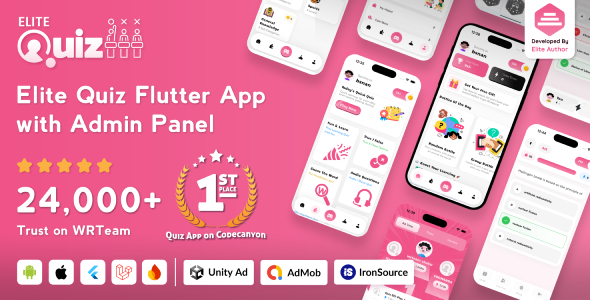
Elite Quiz Flutter is a complete quiz application kit sold on CodeCanyon for $49, consisting of a Flutter mobile app for Android and iOS plus a PHP admin panel for managing content, users and revenue. It targets developers, agencies and entrepreneurs who want to launch a branded trivia or exam-style game without building the backend, question engine and monetisation layer from scratch. The package has been purchased more than 2,100 times and holds a 4.79 out of 5 rating across 227 reviews, which places it among the more established quiz templates on the marketplace.
What the Package Actually Delivers
The core of the product is a single Flutter codebase that compiles to native Android and iOS apps. That matters commercially: one build pipeline, one set of screens to reskin, and no separate iOS developer needed for a first release. The vendor states compatibility with Flutter 3.x and ships Dart, YAML, PHP, JavaScript, CSS and HTML files, so the buyer receives both the mobile source and the server-side application rather than a compiled binary.
On the content side, the admin panel supports several question formats: text, image and audio. Categories and subcategories can be nested, and questions can be imported in bulk, which is the difference between a demo with twenty questions and a launchable product with several thousand. The vendor also bundles an AI question generator that connects to OpenAI or Gemini, letting an operator draft question sets programmatically instead of writing every entry by hand — useful when populating niche categories that would otherwise take weeks of manual research.
Engagement mechanics go beyond a simple quiz loop. The app supports contests with entry fees, head-to-head battles, a virtual coin currency, badges and leaderboards with live scoring. Coins feed into a premium category system, so selected content can sit behind a coin paywall. Together these form the retention layer that keeps a quiz app from being a one-session download.
Monetisation is handled from the same dashboard. In-app purchase products are configured there, as is ad management, so a publisher can run both a paid currency model and display advertising without touching the codebase. Push notifications run through Firebase and can be scheduled for daily quizzes, contest reminders and announcements.
For operators running in more than one market, the admin panel manages multiple languages and their translations centrally. Role-based access control lets the owner create staff accounts with scoped permissions — a moderator who can review reported questions, for example, without access to payment settings. There is also user and content moderation tooling: reported questions can be reviewed and users managed from one screen.
The technical stack is MySQL with an API-ready backend, and the vendor lists six months of free support alongside lifetime updates. WRTeam, the developer behind the product, maintains a live demo at elite-quiz.wrteam.in where the app and panel can be inspected before purchase.
Where Elite Quiz Fits and Where It Does Not
The strongest fit is a solo developer or small agency producing a white-label quiz product for a client — a media company wanting a trivia app tied to its brand, a publisher building a companion game around a book or show, or an education provider needing a lightweight assessment tool. The admin panel means the client can add questions and run contests without a developer on retainer, which is often the deciding factor in these engagements.
It also suits entrepreneurs testing a quiz business model. The combination of coins, entry-fee contests and in-app purchases gives enough surface area to experiment with monetisation quickly, and the $49 price keeps the downside small if the concept does not gain traction.
There are cases where this is the wrong purchase. Anyone wanting a web-first quiz platform should note that the web version is sold separately and is not included here — the package covers mobile apps only. Teams already committed to React Native, native Kotlin/Swift, or a headless CMS backend would be adopting a second stack and should weigh that cost carefully. And a buyer who needs a fully hosted, no-code SaaS quiz tool will find a self-hosted script like this more work than they expect: servers, domains, store accounts and Firebase configuration all remain the buyer’s responsibility.
Strengths and Limitations
Strengths
- One Flutter codebase covers both Android and iOS, reducing build and reskin effort compared with maintaining two native apps.
- The PHP admin panel is genuinely operational rather than a stub: content, users, coins, contests, purchases, ads, languages and staff permissions are all configurable without code changes.
- Multiple question formats — text, image and audio — plus bulk import and optional AI generation make large question banks realistic to assemble.
- Monetisation is built in from the start, covering in-app purchases, advertising and a coin economy with premium category gating.
- A live demo is publicly available, so the interface and feature set can be assessed before spending money.
- Six months of support and lifetime updates are included, and the product has a substantial review base rather than a handful of early ratings.
Limitations
- The vendor states that upgrading from version 2.3.9.1 to 3.0.x is not supported and requires a fresh installation. Existing installations therefore cannot be updated in place, which is a real migration cost for anyone already running an older build.
- The web version is a separate purchase. Buyers who assume a browser interface is bundled will be disappointed.
- Running the product requires a PHP/MySQL host, a Flutter build environment, Firebase project setup and Apple/Google developer accounts. The vendor does not present this as a turnkey hosted service, and it is not one.
- AI question generation depends on the buyer supplying their own OpenAI or Gemini API credentials, with the associated usage costs falling on the operator.
- Because the app and panel are tightly coupled, heavy customisation of one side can create upgrade friction later — relevant given the version migration note above.
How It Compares With the Broader Category
Quiz app kits on code marketplaces generally fall into three tiers. At the low end are single-platform templates with a minimal or absent backend, where the buyer writes their own content API. In the middle sit cross-platform kits with a basic admin panel but limited monetisation. Elite Quiz sits at the upper end of that middle tier and edges into the top: it is cross-platform, ships a full PHP dashboard, and treats monetisation, contests and moderation as first-class features rather than add-ons.
Against custom development, the trade-off is straightforward. A bespoke quiz app costs many multiples of $49 in developer time, but it fits the client’s requirements exactly. Elite Quiz trades that fit for speed and price, and the reskin-and-extend path is realistic because the code is described as modular and commented. Against hosted quiz SaaS platforms, the comparison inverts: those remove the infrastructure burden entirely but usually restrict branding, data ownership and revenue terms. Elite Quiz gives full ownership of code and data at the cost of running the stack.
The main differentiator within its own tier is breadth of engagement features — battles, entry-fee contests, coins, badges and leaderboards in one package — combined with the AI generation option, which is less common in competing kits. The absence of a bundled web front end is the most significant gap relative to what some buyers expect.
Frequently Asked Questions
Does Elite Quiz include the web version of the quiz app?
No. The package covers the Flutter mobile app for Android and iOS plus the PHP admin panel. The vendor states that a compatible web version is available separately and syncs with the mobile app, so it must be purchased as an additional item if a browser interface is required.
Can an existing installation be upgraded to version 3.0.x?
Not in place. The vendor explicitly notes that upgrading from version 2.3.9.1 to 3.0.x is unsupported and that a fresh installation is required. Anyone running an older build should read the migration documentation before attempting the move, since content and settings may need to be transferred manually.
What hosting and third-party services are needed to run it?
A PHP and MySQL host is required for the admin panel and API, along with a Flutter build environment for the mobile apps. Firebase is used for push notifications, and Apple and Google developer accounts are needed to publish to the app stores. AI question generation requires separate OpenAI or Gemini API credentials.
What kinds of quizzes can be created with the admin panel?
Text, image and audio question formats are supported, organised into categories and subcategories. The same engine covers trivia, exam-style assessments, guess-the-word games and picture quizzes. Questions can be added individually or imported in bulk, and the built-in AI integration can generate question content automatically.
Verdict
Elite Quiz Flutter is a well-scoped purchase for developers and small agencies who want a cross-platform quiz app with a working admin backend, and who are comfortable running their own PHP hosting, Firebase project and app store accounts. The feature depth around contests, coins and monetisation is the main reason to choose it over cheaper single-platform templates, and the 2,100-plus sales with a 4.79 rating suggest the codebase holds up in practice. It is not the right choice for anyone expecting a hosted, no-code platform, nor for teams already invested in a different mobile stack. Buyers upgrading from older versions should factor in a fresh installation rather than an update. At $49 with six months of support and lifetime updates, the risk is low relative to the build time it replaces.