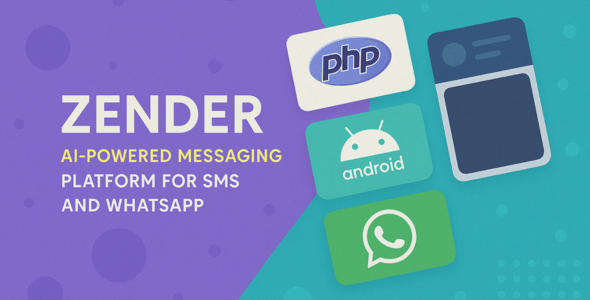
Zender is a self-hosted PHP platform for running a commercial SMS and WhatsApp messaging service. It combines a multi-tenant SaaS dashboard, a companion Android app that turns a phone into an SMS gateway, a WhatsApp server the buyer hosts, AI-generated auto-replies, subscription billing and bulk campaign tools in one codebase. It is aimed at developers, agencies and resellers who want to sell messaging without paying per-message fees to a third-party API provider. Within the CodeCanyon Miscellaneous category, this is one of the more ambitious scripts on offer, and it has the sales history to match: 1,935 sales and a 4.45 out of 5 rating across 207 reviews.
What the platform actually does, and which parts matter most
The core idea is that Zender replaces the usual messaging API provider. Most bulk SMS and WhatsApp services sit on top of a paid gateway such as Twilio, which charges per message and controls the delivery infrastructure. Zender removes that layer in two ways.
For SMS, an Android app installed on a real phone acts as the gateway. The phone sits on a normal mobile plan with a SIM card, and the platform pushes outgoing messages to it. That means the per-message cost is whatever the SIM’s carrier plan charges, not a markup from an API vendor. The app can be rebranded with the operator’s own logo, name and colours, and it is installed by sideloading the APK through an “Add Device” form in the dashboard rather than through Google Play. The vendor states that the app requires Google Play Services to function and is not intended for Play Store submission.
For WhatsApp, the buyer hosts a WhatsApp server themselves. The vendor ships the server binaries and setup guides, and SSH access to the server is a stated requirement. This is the most technically demanding part of the product and the part most likely to determine whether a project succeeds.
On top of those two delivery channels, Zender layers the business features that turn a gateway into a sellable service:
- Multi-tenant subscriptions. The operator defines pricing tiers, and end users sign up and pay through built-in PayPal and Mollie integrations, with support for additional payment plugins. Revenue comes from subscriptions rather than from per-message billing.
- Partner monetisation. Users who contribute an Android phone as a gateway can earn from the traffic they carry. This creates a distributed delivery network without the operator buying hardware.
- AI auto-replies. Incoming messages can be answered automatically using OpenAI, Gemini, Claude or Deepseek. A support line, an order-status bot or a lead-qualification flow can run without a human watching the inbox.
- Bulk campaigns and contact management. Contact lists are imported from Excel, segmented, and used to drive scheduled or immediate campaigns. Message templates and a campaign manager keep repeated sends consistent.
- REST and SaaS APIs. Both come with documentation, so external systems — a CRM, an e-commerce store, a booking tool — can trigger messages programmatically.
- USSD support. Useful in markets where balance checks and airtime top-ups happen over USSD menus rather than apps.
- SCSS-based theming. The interface can be restyled to match a client’s brand without rewriting templates.
The stack is conventional and well documented: PHP 8.3 or higher, MySQL 5.7 or higher, Apache or Nginx (the vendor recommends Nginx), and a list of standard PHP extensions including gd, curl, intl, zip and bcmath. Source files cover PHP, JavaScript, HTML, CSS, Sass and SQL, so the code can be modified freely. The vendor recommends a VPS rather than shared hosting, which is a fair signal of the resource profile involved.
Where Zender fits, and where it does not
The strongest fit is a regional messaging reseller. In markets where WhatsApp Business API access is expensive or slow to obtain, and where SMS termination through aggregators carries a heavy margin, hosting the infrastructure directly changes the economics. An operator with a handful of Android devices and a VPS can offer a localised service at prices the global providers cannot match.
Agencies are the second natural buyer. An agency already running marketing campaigns for clients can fold SMS and WhatsApp into its retainer instead of reselling a third-party tool at a thin markup. The white-label design means the agency’s brand appears throughout, and the subscription tiers let it package messaging as a recurring product.
Developers building a Twilio-style service for a specific vertical — clinics sending appointment reminders, schools notifying parents, logistics firms confirming deliveries — are the third fit. The REST API and documented SaaS API make integration straightforward, and the one-time price removes the per-message overhead that would otherwise eat into margin at low volumes.
The wrong choice is a single small business that just wants to send its own newsletters. Zender is infrastructure for selling messaging, not a plug-in-and-go marketing tool. A business with one mailing list would pay for a multi-tenant billing system, partner payouts and a WhatsApp server it has no reason to maintain. Shared hosting is also a non-starter: the VPS recommendation, SSH requirement and WhatsApp binaries rule it out. And anyone unwilling to handle server administration — patching, monitoring, backups, TLS — should look at a managed messaging API instead, because the cost saved on API fees is partly paid back in operational attention.
Strengths and limitations in plain terms
Strengths
- No per-message API fees. Delivery runs through owned Android devices and a self-hosted WhatsApp server, so marginal cost is tied to carrier plans rather than vendor pricing.
- Genuinely complete SaaS layer. Subscriptions, payment gateways, partner revenue sharing, analytics and user management are included, not left as an exercise for the buyer.
- White-label throughout, from the web interface to the Android gateway app’s logo and colours.
- AI auto-replies support four major providers, so the operator can pick on price or capability rather than being locked in.
- Full source code in PHP, JavaScript, Sass and SQL, with SCSS theming for rebranding.
- Documented REST and SaaS APIs, which matters for anyone integrating with existing business systems.
- Strong marketplace track record: 1,935 sales and 207 reviews averaging 4.45, plus lifetime updates from developer titansys.
- Broad browser support across Chrome, Firefox, Safari, Edge and Opera for the web dashboard.
Limitations
- The WhatsApp server is the hard part. It requires SSH access, shipped binaries and a setup guide, and the vendor does not state a managed hosting option — the buyer owns that maintenance permanently.
- The Android gateway depends on Google Play Services and cannot be distributed through the Play Store. Devices must be provisioned manually via the Add Device form, which does not scale gracefully past a few dozen phones without process work.
- Deliverability is now the operator’s problem. Carrier filtering, sender reputation and message throughput on consumer SIMs are outside the platform’s control, and the vendor makes no claims about delivery rates.
- PHP 8.3+ and MySQL 5.7+ with a specific extension list means older hosting environments need upgrading before installation.
- There is no native iOS gateway app; SMS delivery depends on Android hardware.
- The breadth of the feature set — billing, partners, AI, campaigns, USSD — implies a real learning curve for the admin, even though the vendor markets it as no-code.
How it compares with the wider category
Most scripts in the CodeCanyon Miscellaneous bracket are single-purpose: a form builder, a URL shortener, a booking widget. Zender is closer to a business-in-a-box, and that changes the comparison. Against hosted messaging APIs, the trade is clear — Zender costs $79 once and removes per-message fees, but it shifts infrastructure, deliverability and compliance onto the buyer. A hosted API is more expensive per message and far less work.
Against other self-hosted messaging scripts, the differentiators are the Android gateway model and the built-in SaaS monetisation. Many alternatives wrap a paid provider’s API, which reintroduces the fees Zender is designed to avoid. Fewer include partner payouts, subscription billing and AI auto-replies in the same package. The cost of that breadth is complexity: a leaner script would be faster to deploy but would leave the buyer assembling billing and gateway management separately.
Against building from scratch, the calculation is time. A capable PHP team could replicate the dashboard and campaign tools, but the Android gateway app, WhatsApp server integration and payment plumbing represent months of work. For most buyers, the $79 is trivially justified; the real investment is the server and the operational discipline.
Frequently Asked Questions
Does Zender work without Twilio or any paid messaging API?
Yes. SMS is delivered through an Android phone running the bundled gateway app, and WhatsApp runs on a server the buyer hosts. Neither channel depends on a third-party messaging API, so there are no per-message fees. The trade-off is that the buyer takes on server maintenance and delivery responsibility instead.
Can Zender be resold as a SaaS business?
Yes, that is its primary design goal. The platform includes subscription tiers, PayPal and Mollie payment integration, user analytics and a partner programme that pays users for sharing Android gateways. The buyer sets prices and keeps the revenue. White-label branding means end users see the operator’s brand, not the script vendor’s.
Can the Android gateway app be installed without Google Play?
Yes. The APK is sideloaded through the Add Device form in the dashboard rather than published to Google Play. Google Play Services must still be present on the phone for the app to function. The vendor explicitly states the app is not intended for Play Store submission, so manual provisioning is the expected workflow.
What server setup does Zender require?
It needs PHP 8.3 or higher, MySQL 5.7 or higher, and Apache or Nginx, with Nginx recommended. SSH access is required to install the WhatsApp server binaries, and several PHP extensions must be enabled. The vendor recommends a VPS rather than shared hosting, which reflects the resource demands of running a messaging service.
Verdict
Zender is worth buying for anyone who intends to operate messaging as a business: resellers in markets where API costs are prohibitive, agencies adding a recurring channel to client retainers, and developers building a vertical-specific alternative to the big gateways. The combination of an Android SMS gateway, a self-hosted WhatsApp server and a complete billing layer is unusual at this price, and the sales and rating figures suggest it delivers on most of that promise. It is not suitable for a single business that simply wants to send its own campaigns, nor for anyone who cannot administer a VPS and troubleshoot a WhatsApp server. The honest summary is that Zender sells infrastructure, and infrastructure requires an operator who is comfortable owning it.